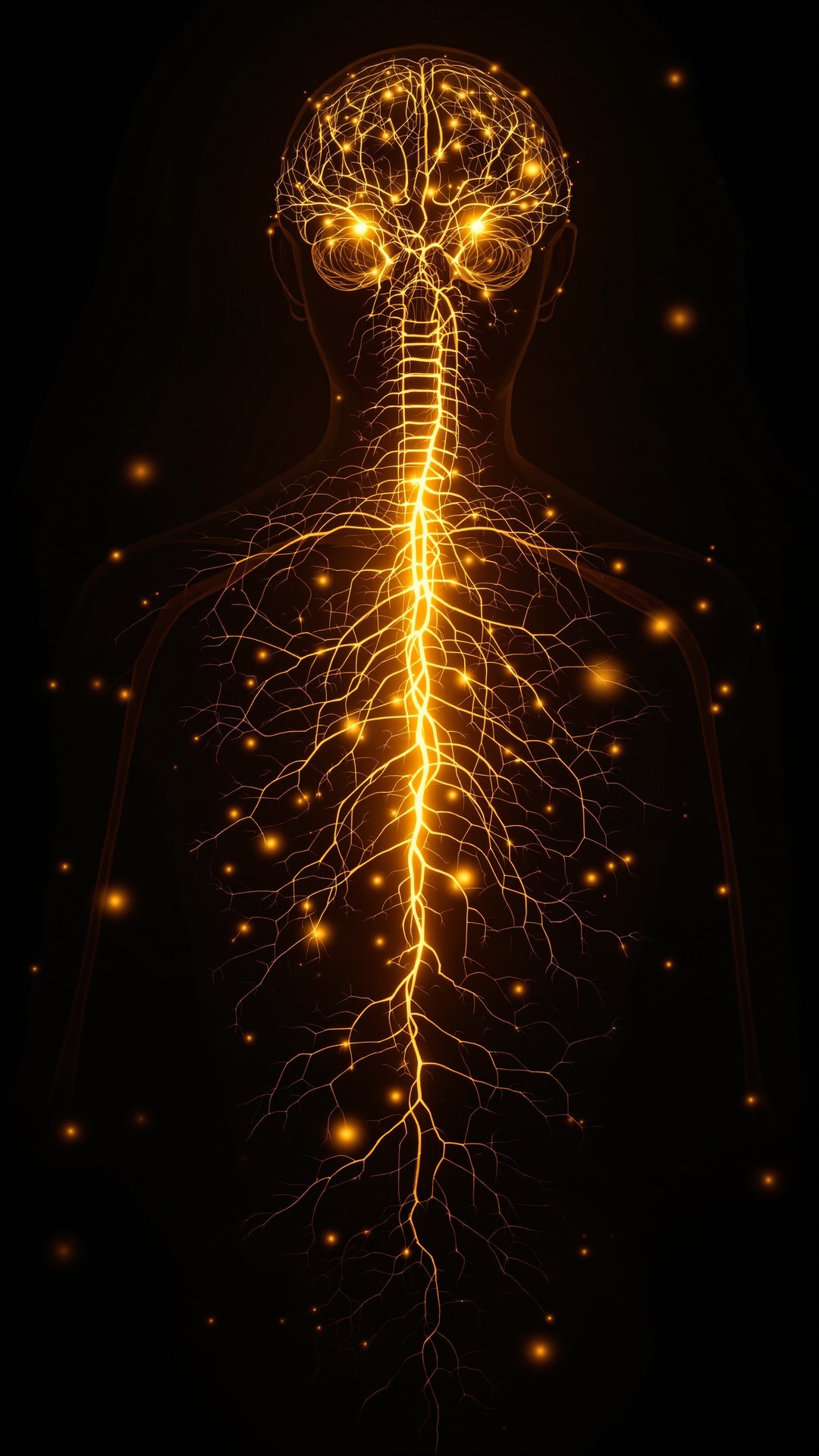
The critical anatomical fact — the one that overturns decades of assumptions — is the 80/20 split of fibre direction. Most people, including many clinicians, conceptualise the vagus nerve as a top-down system: the brain sends calming signals to the body. This is not primarily what the vagus nerve does. It primarily tells the brain what the body is doing.
The gut reports its microbiome composition, its inflammatory status, its serotonin production. The heart reports its rate and rhythm. The lungs report their ventilation status. And all of this information flows upward to the nucleus tractus solitarius (NTS) in the brainstem, which routes it to the insula, the anterior cingulate cortex, the hypothalamus, and the limbic system.
This is interoception — the brain’s awareness of the body’s internal state. And it is the neural substrate of what we call emotion.
Polyvagal Theory: Three States, Not Two
Stephen Porges’ polyvagal theory reorganises the autonomic nervous system around three distinct states, each with a phylogenetically distinct neural substrate and specific behavioural and physiological signatures.
State 1: Ventral Vagal — Safe and Social
Governed by the myelinated ventral vagal complex, originating in the nucleus ambiguus. This is the most evolutionarily recent system, present only in mammals. It regulates the “social engagement system”: the muscles of facial expression, the middle ear (tuned to the frequency range of the human voice), the larynx, and the heart. When active, a person feels safe, curious, open, and capable of genuine connection. Digestion functions optimally. Immune regulation is efficient. This is the state associated with deep meditation, loving relationships, successful therapy, and — we will return to this — the peak states of a psilocybin journey.
State 2: Sympathetic — Mobilise and Fight
When the ventral vagal system detects threat signals it cannot resolve through social engagement, it withdraws and the sympathetic nervous system mobilises. Heart rate increases, stress hormones flood the system, digestion halts, blood redirects to skeletal muscle. When this becomes chronic — as in unresolved trauma — it produces the pathophysiology of PTSD: hypervigilance, startle response, difficulty accessing social connection, impaired digestion, immune dysregulation.
State 3: Dorsal Vagal — Shutdown and Collapse
The most phylogenetically primitive state, governed by the unmyelinated dorsal vagal complex, shared with reptiles. When threat is perceived as inescapable, the nervous system collapses. Heart rate drops. Metabolic rate decreases. The person may freeze, dissociate, collapse, lose affect entirely. In trauma, this produces the numbing, disconnection, and flatness associated with complex PTSD and severe depression.
The critical clinical insight: Porges demonstrated that safety is not an absence of threat — it is an active neurological state. The ventral vagal system must be engaged. And it can only be engaged when the nervous system receives sufficient cues of safety — through breath, through social attunement, through prosodic voice, through appropriate touch. This is why the set and setting of a psilocybin experience is not merely psychological. It is physiologically necessary for the ventral vagal circuit to remain online.
Vagal Tone: How It Is Measured and Why It Matters
Vagal tone — the tonic level of parasympathetic activity through the vagus — is measurable non-invasively through heart rate variability (HRV). The mechanism is elegant: vagal efferents to the sinoatrial node produce beat-to-beat variation in heart rate that is coupled to respiratory rhythm. During inhalation, vagal tone briefly decreases and heart rate rises. During exhalation, vagal tone increases and heart rate falls. This oscillation — respiratory sinus arrhythmia — is the direct expression of vagal activity on cardiac function.
High HRV means the heart rate is varying widely, dynamically, responsively. This indicates high vagal tone: the nervous system is flexible, can rapidly shift between states, and can recover quickly from stress. Low HRV means the heart rate is relatively fixed — the autonomic nervous system is rigid, chronically sympathetically activated, unable to access the ventral vagal state.
PTSD
Consistent finding of reduced HRV and sympathetic dominance. Correlates with symptom severity. Normalises with successful treatment.
Major Depression
Reduced HRV predicts poor antidepressant response and elevated relapse risk. Psilocybin responders show post-session HRV improvement.
Social Anxiety
Low vagal tone impairs social engagement system function — the very capacity for prosodic, connected communication.
Cardiovascular Disease
HRV is a stronger predictor of cardiac mortality than most traditional risk factors. Vagal tone is cardioprotective.
OOTW Psilocybin Mushroom Treats
Precisely-dosed, lab-tested, quality psilocybin mushroom treats — crafted for daily ritual, neural support, and sustained clarity. Journal readers: 10% off your first order with code JOURNAL10 (applied automatically at checkout).
Claim 10% Off →The Gut–Brain Axis: Why 95% of Serotonin Lives in Your Belly
The enteric nervous system — the gut’s own neural network, containing over 100 million neurons — produces approximately 90–95% of the body’s serotonin. This is not the serotonin that antidepressants act on. Gut serotonin does not cross the blood-brain barrier. But it is the dominant chemical signal in the gut-brain communication system, produced by enterochromaffin cells in the gut mucosa in response to nutrients, mechanical stimulation, and microbiome metabolites.
This gut serotonin acts on 5-HT3 and 5-HT4 receptors on vagal afferent fibres in the gut wall. When these receptors are activated, the vagal afferents fire, transmitting signals up to the NTS. The NTS integrates this input alongside input from the heart and lungs, and routes it to the insula (interoception), the hypothalamus (regulation), the amygdala (emotional processing), and the prefrontal cortex (executive function).
The microbiome directly participates in this system. Specific bacterial species — Lactobacillus, Bifidobacterium, and others — produce neuroactive metabolites including short-chain fatty acids, GABA precursors, and tryptophan metabolites. These stimulate enterochromaffin cells to produce serotonin, which activates vagal afferents. Dysbiosis — disrupted microbiome composition — impairs this entire pathway.
This is why gut health is brain health. And why the state of the gut on the day of a psilocybin session matters for the quality of what can be processed.
Psilocybin and the Vagus Nerve: The Convergence
The connection between psilocybin and the vagal system operates through multiple converging mechanisms — and it is arguably the missing piece in a complete account of why psychedelic therapy works.
Mechanism 1: NTS 5-HT2A Agonism. The nucleus tractus solitarius — the brainstem’s primary vagal relay — expresses 5-HT2A receptors. Psilocin, the active metabolite of psilocybin, binds these receptors and modulates the NTS’s processing of ascending visceral signals from the gut, heart, and lungs. Psilocybin is not just acting on the cortex. It is acting at the primary integration point of visceral-to-brain communication — reshaping how the body’s internal reports are received and interpreted by the brain.
Mechanism 2: DMN Suppression Breaks Sympathetic Lock. Chronic sympathetic activation — the hallmark of unresolved trauma — is maintained partly by a hyperactive default mode network generating constant threat-prediction. Psilocybin produces 40–60% suppression of DMN connectivity. This suppression interrupts the ruminative self-referential processing that keeps the nervous system locked in sympathetic or dorsal vagal states. The result is a brief but profound window in which the ventral vagal state becomes accessible — often for the first time in years or decades for patients with chronic trauma.
Mechanism 3: The Peak Experience as Ventral Vagal Activation. The phenomenology of the classic psilocybin peak — oceanic boundlessness, felt safety, dissolution of threat, profound connection to all living things — is the experiential correlate of deep ventral vagal engagement. The psilocybin experience, at its depth, is a neurophysiologically enforced safety state. And this is therapeutic precisely because it demonstrates to the nervous system that such states are possible.
Clinical evidence: A 2023 study by Carhart-Harris and colleagues found that psilocybin-assisted therapy produced significant improvements in HRV at 1-month follow-up in patients with major depression — independent of symptom reduction scores. The authors interpreted this as evidence of autonomic recalibration: lasting shifts in the default operating state of the autonomic nervous system, not merely changes in mood or cognition.
OOTW Spirit Guide
Set. Setting. Dose. Integration. The questions you can't bring to your doctor — answered by an AI grounded in every peer-reviewed paper, protocol, and ceremony manual. Private, sober, always there.
Talk to the Spirit Guide → A Sacred 5-MeO-DMT Ceremony · MiamiJoin the OOTW Sacrament
The oldest prayer, remembered — the gentle dissolving of the self into light, held in ceremony by a master facilitator. Sit with our community first: a free, live weekly circle on Zoom. No commitment, simply a conversation.
Join the Weekly Circle →The Integration Window: Why Vagal Practices Matter Most in the 72 Hours After
The neuroplasticity window following a psilocybin session — the 24–72 hours of elevated BDNF, enhanced synaptic plasticity, and increased dendritic spine formation — is also a window of elevated autonomic flexibility. The vagal system is primed to consolidate new patterns.
This is the neurobiological reason why integration practices during this window are not optional. If the post-session period is spent in high-stress environments, in sympathetic activation, in social conflict — the plastic brain consolidates those states. If it is spent in environments that sustain ventral vagal engagement — breath, nature, gentle social connection, body-based practices — the therapeutic gains of the session are locked into new autonomic baselines.
Coherence Breathing
5 seconds in, 5 seconds out (0.1 Hz). Resonates with Mayer wave frequency. Produces maximum HRV amplitude and vagal tone increase. 20 minutes per day is sufficient.
Extended Exhale
4-7-8 pattern or any breath where the exhale is longer than the inhale. The exhale specifically activates vagal efferents to the sinoatrial node, driving parasympathetic dominance.
Humming & Chanting
The recurrent laryngeal branch of the vagus nerve innervates the vocal cords. Humming, extended OM tones, or any sustained vocalisation directly stimulates vagal afferents. Singing in groups is one of the most powerful vagal activators known.
Cold Water Immersion
The diving reflex — triggered by cold water on the face — produces strong, immediate vagal activation. Even 30 seconds of cold water on the face produces measurable HRV elevation. Best used in the morning of integration days.
The Cacao Connection: Theobromine, CB1, and Vagal Priming
Ceremonial-grade cacao’s relevance to vagal function is more specific than it might appear. Theobroma cacao — the full species name means “food of the gods” in Greek — contains compounds that interact with the vagal system at multiple points.
Theobromine at therapeutic doses (42–80g ceremonial grade) produces mild vasodilation and cardiovascular effects that are partly mediated through parasympathetic pathways. The sustained calm alertness that distinguishes cacao from coffee — described as “heart-open” in ceremonial traditions — corresponds to a physiological state of elevated vagal tone: cardiac variability increased, cortisol reduced, social receptiveness enhanced.
Cacao’s anandamide content and its N-acylethanolamine precursors activate CB1 receptors expressed on vagal afferents throughout the gut wall. CB1 activation on these fibres modulates the tone of ascending visceral signals — specifically reducing the transmission of stress-related gut signals that would otherwise maintain sympathetic activation.
The ritual dimension of cacao ceremony — the intentional gathering, the shared space, the prosodic voice of the facilitator, the music tuned to stimulate the social engagement system — activates the ventral vagal complex through precisely the cues Porges identified as vagal safety signals. The ceremony itself is a nervous system intervention, not merely a cultural practice.
Clinical Applications: PTSD, Depression, and the Autonomic Floor
Understanding the vagal mechanism clarifies why psilocybin’s therapeutic effects are not simply about changing thoughts or beliefs. They operate at the autonomic floor — the baseline state from which all emotional processing, social engagement, and cognitive function must proceed.
In PTSD, the autonomic floor is set too high — chronic sympathetic activation or dorsal vagal collapse. Talk therapy has limited access to this floor because the prefrontal cortex is effectively offline when the nervous system is in threat state. This is the “window of tolerance” problem: to process trauma, the nervous system must be within a window where it is neither hyperaroused nor shutdown. Most trauma patients spend significant portions of their life outside that window.
Psilocybin is effective — uniquely effective — because it enforces that window from below. It directly suppresses the threat-detection system and activates the ventral vagal state via NTS modulation and the phenomenology of oceanic boundlessness. It temporarily resets the autonomic floor, allowing traumatic material to be processed from within a physiological state of safety that the patient may not have accessed in years.
The 67% PTSD remission rates seen in early trials are not driven by insight alone. They are driven by the nervous system’s experience of spending hours in ventral vagal engagement — and the lasting autonomic recalibration that follows when that experience is integrated properly.
Precisely-Dosed Psilocybin Mushroom TreatsBring the Science Home
Every article here is the why. OOTW's ceremony-ready mushroom confectioneries are the how — precision-crafted to carry the medicine into your daily practice. Journal readers: 10% off your first order with code JOURNAL10 (applied automatically at checkout).
Claim 10% Off →