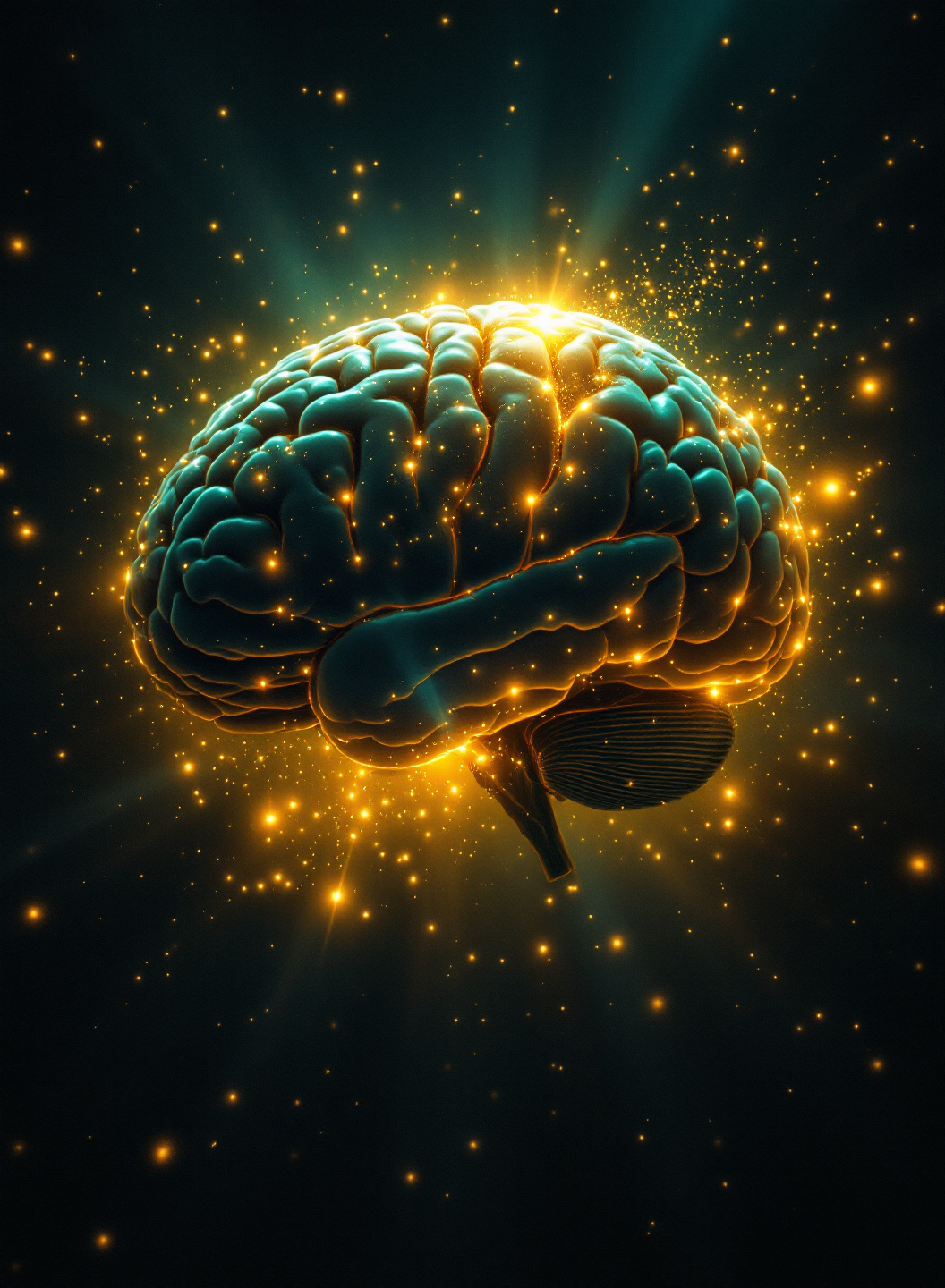
What is Global Workspace Theory? It is one of the leading scientific theories of consciousness. The psychologist Bernard Baars proposed in 1988 that the mind works like a theater: countless unconscious processes run in the dark, and a piece of information becomes conscious when it is placed in a shared “global workspace” and broadcast to the whole audience of the brain (Baars, 1988). Stanislas Dehaene and Jean-Pierre Changeux turned this into a brain model: information becomes conscious through “ignition” — a sudden, non-linear surge of activity that spreads across the fronto-parietal cortex around 300 milliseconds after a stimulus, making the information globally available (Dehaene & Changeux, 2011). Below that threshold, processing stays local and unconscious.
Here is the deepest puzzle in all of neuroscience, stated plainly: your brain performs an enormous amount of sophisticated work — recognizing faces, understanding sentences, calculating trajectories — entirely in the dark, with no accompanying experience at all. And yet some of that work is lit from within; it feels like something. What is the difference between the brain activity that stays unconscious and the brain activity that becomes a conscious experience? Global Workspace Theory is the most influential scientific attempt to answer that question with a mechanism you can actually measure — and, remarkably, it turns the mystery of consciousness into something you can trigger, block, and watch unfold in real time.
A theater with no audience but itself
In 1988 the cognitive scientist Bernard Baars offered a metaphor that has shaped the science ever since. Imagine the mind as a theater. On the stage, under a bright spotlight, sits the small amount of information you are conscious of right now — these words, perhaps, or a feeling in your chest. Surrounding the stage, in the dark, is a vast audience of unconscious specialist processes: the systems that recognize letters, retrieve meanings, monitor your body, and far more. They work silently, in parallel, each expert at its narrow job.
Consciousness, in this picture, is what happens when a piece of information steps into the spotlight and is broadcast to the entire audience at once. The spotlight is attention; the stage is a limited, serial “global workspace” that can hold only a little at a time. The point of the workspace is sharing: once something is on the lit stage, every specialist in the dark can access it, coordinate around it, and act on it together. That, Baars argued, is the function consciousness serves — not raw processing, which the unconscious does brilliantly, but the global integration and distribution of information across an otherwise fragmented brain.
From metaphor to mechanism: ignition
A metaphor is not a mechanism, and this is where Stanislas Dehaene and Jean-Pierre Changeux made the theory testable. In their Global Neuronal Workspace model, the “stage” is a network of neurons with long-range connections, concentrated in the prefrontal and parietal cortex, that can broadcast to the rest of the brain. Most incoming signals are processed locally and quietly by sensory regions and die away. But when a signal is strong enough and attended, something dramatic happens: a threshold is crossed and the workspace “ignites.”
Ignition is the key idea. It is non-linear — not a gentle increase in activity but a sudden, self-amplifying, all-or-nothing surge, as recurrent loops between cortical areas catch fire and sustain the representation. When Dehaene and colleagues compared brain activity on trials where a stimulus was consciously seen versus not seen — using clever tricks like masking, where an image is flashed and then hidden — they found a striking divergence roughly 270 to 300 milliseconds after the stimulus: on conscious trials, activity surged and spread forward into fronto-parietal cortex; on unconscious trials, activity rose early in sensory areas and then simply faded (Dehaene & Changeux, 2011). The late, global surge — often visible as a scalp signal called the P3b — became a candidate signature of conscious access: the moment the workspace lights up.
Watching consciousness switch on and off
What makes the theory more than philosophy is that ignition can be manipulated. Present a word too briefly and mask it, and it is processed — its meaning even primes later responses — but it never ignites, and you never consciously see it. Nudge the timing or the attention, and the same word crosses the threshold, ignites, and becomes reportable. The stimulus can be identical; what differs is whether the workspace catches fire. Consciousness, in this frame, is not about how much processing occurs but about whether that processing achieves global broadcast.
The clinic tells the same story from the other direction. General anesthesia abolishes consciousness in large part by preventing ignition — sensory cortex may still respond to a sound, but the long-range surge to fronto-parietal networks is blocked, and the signal stays local and unfelt. In patients with disorders of consciousness — the vegetative and minimally conscious states — the presence or absence of this late global response has been used to probe whether anyone is still “home.” The workspace, it seems, can be dimmed, switched off, and sometimes detected flickering back on.
Precisely-Dosed Psilocybin Mushroom TreatsOOTW Psilocybin Mushroom Treats
Precisely-dosed, lab-tested, quality psilocybin mushroom treats — crafted for daily ritual, neural support, and sustained clarity. Journal readers: 10% off your first order with code JOURNAL10 (applied automatically at checkout).
Claim 10% Off →The gate and the broadcast
Global Workspace Theory does not stand alone; it slots neatly into the architecture this journal has been tracing. If the workspace is the lit stage, the thalamus is part of the gate that decides which signals even reach it, and the mysterious claustrum — densely wired to the whole cortex — has been proposed as a conductor that helps synchronize the broadcast. The workspace is not a single spot but a network property: the brain’s capacity to make one piece of information suddenly available everywhere at once.
It also frames the deep divide in consciousness science. Global Workspace Theory is a theory of access — of what makes information available for report, reasoning and control. Its main rival, Integrated Information Theory, focuses instead on the intrinsic structure of experience and locates consciousness more in the back of the brain than the front. The two make different predictions — for instance, about whether the prefrontal cortex is essential for experience or merely for reporting it — and large adversarial experiments are now pitting them against each other. Neither has won. The honest state of the field is that we have powerful, testable theories of consciousness and no consensus on which, if any, is right.
What psychedelics do to the workspace
Here is where the theory meets the theme of this journal. Psychedelics do not switch the workspace off, as anesthesia does — people on them are vividly, often overwhelmingly conscious. Instead they seem to change what gets broadcast, and how much. If ordinary consciousness is a disciplined theater — one spotlight, a strict door policy, most of the audience kept in the dark — the psychedelic state looks like a theater whose doors have been thrown open: far more content flooding onto the stage, the usual filtering relaxed, associations and images and feelings that are normally kept local suddenly achieving global broadcast.
This fits the entropic brain picture of a higher-entropy, less-constrained state, and the predictive-coding view of relaxed filtering; a lowered threshold for ignition would mean more of the brain’s normally-private activity breaking into awareness. It may also help explain ego dissolution: if the self is partly a story the workspace keeps broadcasting, loosening that broadcast can loosen the self. And it connects to the loosening of the default mode network, one of the workspace’s central hubs. The workspace is not abolished — it is flung wide open.
AI That Understands The MedicineOOTW Spirit Guide
Set. Setting. Dose. Integration. The questions you can’t bring to your doctor — answered by an AI grounded in every peer-reviewed paper, protocol, and ceremony manual. Private, sober, always there.
Talk to the Spirit Guide → A Sacred 5-MeO-DMT Ceremony · MiamiJoin the OOTW Sacrament
The oldest prayer, remembered — the gentle dissolving of the self into light, held in ceremony by a master facilitator. Sit with our community first: a free, live weekly circle on Zoom. No commitment, simply a conversation.
Join the Weekly Circle →The function of being conscious
One quiet implication of Global Workspace Theory is worth sitting with: it gives consciousness a job. In this view, awareness is not a useless glow riding on top of the machinery, but the brain’s mechanism for flexible, global coordination — the way a fragmented committee of specialists shares information, breaks out of automatic routines, and brings the whole mind to bear on a single problem. The things you can only do consciously — hold a plan across distractions, report an experience, deliberately override a habit — are, in this frame, exactly what the workspace is for. Consciousness is how a brain stops being merely a bundle of reflexes and becomes a mind that can be aware of, and act upon, its own contents.
That reframes what an altered state is. To widen the workspace, lower its threshold, or change what it broadcasts is to change not just the content of consciousness but its very geometry — how much of the mind is shared with itself at once. It is a reminder that consciousness, so often treated as an all-or-nothing given, is in fact a dynamic, tunable process — one whose settings can be dialed by an anesthetic, a coma, a meditation, or a molecule.
Precisely-Dosed Psilocybin Mushroom TreatsBring the Science Home
Every article here is the why. OOTW’s precisely-dosed, lab-tested, quality psilocybin mushroom treats are the how — crafted to carry the medicine into your daily practice. Journal readers: 10% off your first order with code JOURNAL10 (applied automatically at checkout).
Claim 10% Off →The honest cautions
Global Workspace Theory is a leading framework, not a proven fact, and intellectual honesty requires naming its limits. It is fundamentally a theory of access — of how information becomes reportable and globally available — and critics argue this may capture the machinery around consciousness rather than the felt quality of experience itself. Whether the late fronto-parietal ignition is the true signature of consciousness, or merely the signature of reporting and attention that usually accompanies it, is genuinely contested; some experiments find rich experience with less prefrontal involvement than the theory predicts. And no version of it dissolves the “hard problem” — why any of this physical broadcasting should be accompanied by inner experience at all remains unanswered.
The psychedelic extensions are more speculative still. That these drugs “widen the workspace” or “lower the ignition threshold” is an appealing and plausible reading of the imaging, but it is an interpretation layered on a theory that is itself unsettled — a hypothesis about a state we still struggle to measure, described in terms of a model we have not yet confirmed. It should be held lightly, as a way of thinking, not a proven account.
The lit stage
Strip away the equations and the debates and a simple, strange image remains. Most of your brain works in the dark, brilliantly and forever unseen. Consciousness is the small, bright stage where, for a moment, one thing is shared with the whole of you at once — and the science of the global workspace is the attempt to understand how that stage lights up, what raises and lowers its curtain, and why the mind bothers to have a place where it can, at last, know its own mind. Whatever consciousness ultimately turns out to be, we now have something we did not have a generation ago: a mechanism to point at, a signal to measure, and a light we can watch ignite.
OOTW Journal is educational and does not provide medical advice. Global Workspace Theory is one of several competing scientific theories of consciousness and is not settled science; the psychedelic interpretations here are hypotheses, not established facts. Psychedelics are controlled substances, are not safe for everyone — including people with a personal or family history of psychosis or bipolar disorder — and nothing here is a recommendation to use them.