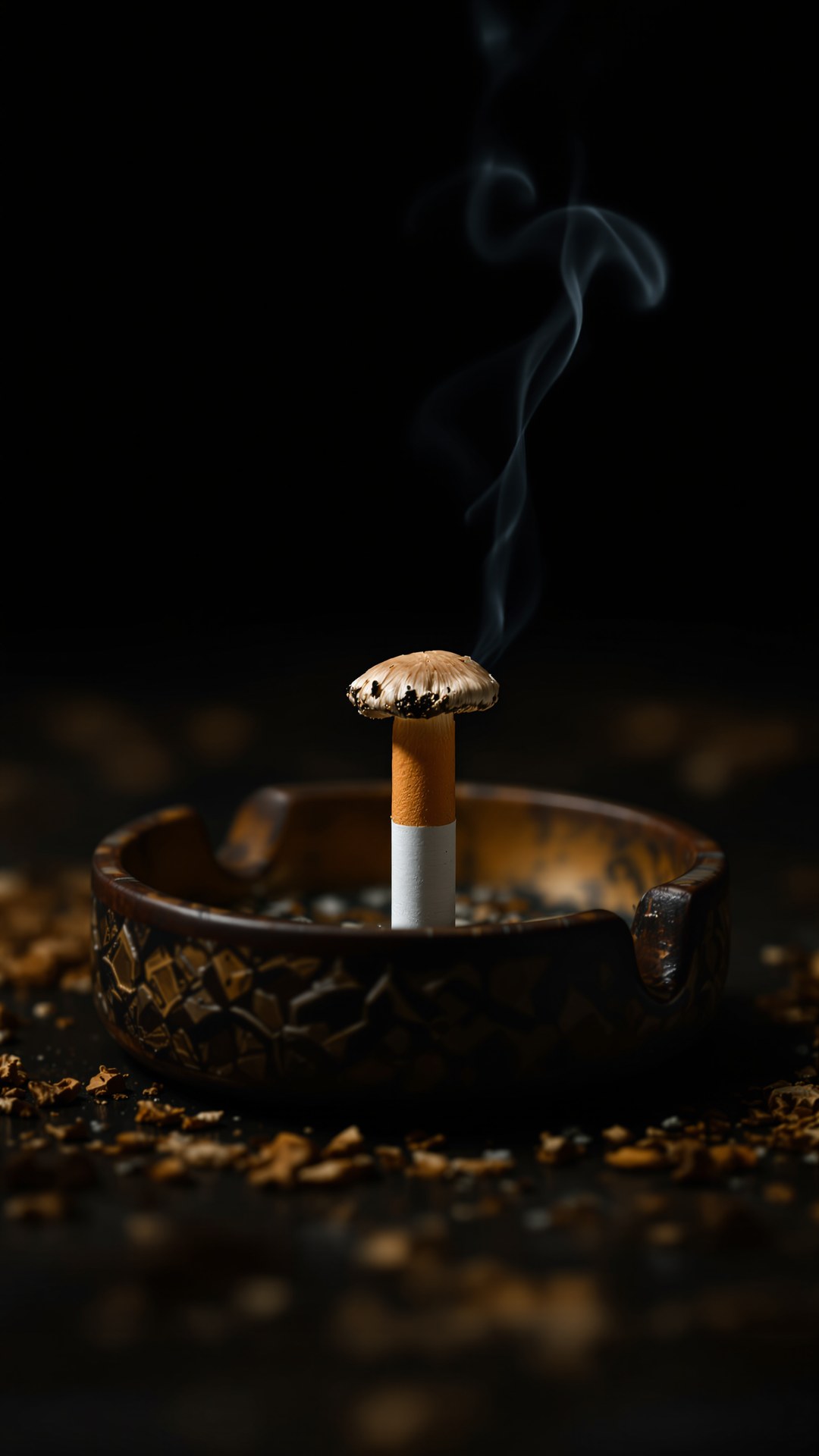
There is a substance you can purchase at a petrol station, a supermarket, or a vending machine in most countries on earth. It is sold legally, taxed generously, and consumed daily by over a billion people. It kills 8 million of them every year — more than HIV, tuberculosis, and malaria combined. Half of lifetime users will die from its effects. And the treatments we have to help people stop — nicotine patches, gums, prescription medications — produce verified abstinence in approximately 13% of users at 12 months. Against that backdrop, a Johns Hopkins research team reported a finding so extreme that, in any other field, it would have triggered immediate replication and emergency regulatory review: psilocybin-assisted therapy produced 80% verified 12-month abstinence in long-term smokers. This is not a marginal improvement on existing treatment. It is a different category of result entirely.
The Most Addictive Drug You Can Buy at a Gas Station
Nicotine dependence is not simply a bad habit or a failure of willpower. It is a neurobiological disorder with a well-characterised molecular mechanism, a defined clinical trajectory, and an extraordinarily high relapse rate that no existing treatment has adequately addressed. To understand why psilocybin works where everything else fails, you first need to understand what nicotine does to the brain at the circuit level — and why that makes it so hard to stop.
Nicotine binds to nicotinic acetylcholine receptors (nAChRs) throughout the central nervous system, with particular density in the ventral tegmental area (VTA) — the origin point of the mesolimbic dopamine pathway. Activation of VTA nAChRs triggers dopamine release in the nucleus accumbens (NAc), the brain's primary reward processing hub. This dopamine signal is experienced as pleasure, satisfaction, and a reduction in anxiety and negative affect. The brain registers it as significant and worth repeating.
Critically, nicotine reaches the brain within 10 seconds of inhalation — faster than any other route of drug administration. This rapid onset creates an extremely tight temporal association between the behaviour (smoking) and the reward (dopamine), which is precisely the condition that drives the most powerful behavioural conditioning. The brain learns the association with exceptional speed and efficiency.
Neuroadaptation and the Withdrawal Trap
Chronic nicotine exposure triggers neuroadaptation: the brain downregulates its own dopamine production and reduces the density and sensitivity of dopamine receptors. The system recalibrates around the presence of nicotine. This creates the withdrawal trap — when nicotine is absent, dopamine tone falls below baseline, producing dysphoria, anxiety, irritability, difficulty concentrating, and intense craving. The smoker is no longer smoking to feel good. They are smoking to feel normal. The drug has redefined normal.
This neuroadaptation is not merely chemical — it is structural. Chronic nicotine use produces lasting changes in synaptic architecture in reward circuits, prefrontal cortex, and the insula — a cortical region that integrates interoceptive signals (bodily states) with decision-making. Notably, the 2007 Science paper by Naqvi et al. found that smokers who suffered strokes that damaged the insula showed immediate, effortless smoking cessation — suggesting that the insula encodes the somatic craving signal that drives smoking behaviour. Targeting the insula is therefore a rational therapeutic objective.
Cue-Triggered Craving: The Loop That Won't Break
Beyond the biochemistry of withdrawal, nicotine addiction is deeply characterised by cue-triggered craving — the phenomenon whereby environmental stimuli associated with smoking (the smell of smoke, the sight of a cigarette, the morning coffee routine, the post-meal ritual) trigger intense, involuntary urges to smoke. These cue-reactivity patterns are mediated by the same Pavlovian conditioning mechanisms as other addictions, encoded in the amygdala and striatum through repeated pairing of sensory cues with nicotine reward.
Standard cessation approaches — NRT, varenicline, CBT — can reduce withdrawal symptoms and provide tools for managing craving, but they do not extinguish cue-reactivity at the neural level. The conditioned associations between smoking cues and the reward signal remain encoded in the brain long after cessation, predisposing to relapse when cue exposure occurs. This is why 80–90% of unaided quit attempts fail within three months, and why most pharmacotherapy-supported attempts fail within 12 months.
The Hopkins finding cuts through decades of incremental progress in smoking cessation research: a compound that was known primarily as a consciousness-altering agent, with no obvious pharmacological relationship to nicotine receptors, produced quit rates that conventional medicine has never approached. The question — how? — turns out to have a detailed and mechanistically coherent answer.
Four Mechanisms: How Psilocybin Breaks the Circuit
Mechanism 1: 5-HT2A Activation and Addiction Circuit Plasticity
Psilocybin is a potent agonist at the 5-HT2A serotonin receptor, with highest density expression in the prefrontal cortex and limbic system — precisely the circuits that are dysregulated in addiction. 5-HT2A activation produces a cascade of downstream effects that include release of brain-derived neurotrophic factor (BDNF), activation of mTOR signalling, and rapid dendritic spine growth and synaptic remodelling — collectively termed psychoplastogenesis by David Olson's UC Davis group.
In addiction circuits, this plasticity appears to have a normalising effect. The downregulated dopamine system — recalibrated around chronic nicotine exposure — is reset toward baseline. Prefrontal control over subcortical reward signals, weakened by years of nicotine-driven neuroadaptation, is restored. The structural changes that encode addiction-related cue reactivity are disrupted. The brain, temporarily in a state of heightened plasticity, is amenable to a fundamental reorganisation of its relationship to nicotine.
Mechanism 2: Default Mode Network Disruption and Identity Shift
The Default Mode Network (DMN) — the interconnected set of midline cortical structures active during self-referential thought — encodes narrative identity: the running autobiographical story through which we understand who we are. In long-term smokers, this identity network contains "I am a smoker" as a deeply embedded self-concept. Smoking is not merely a habit — it is part of how the person understands themselves, their social role, their relationship to stress, their daily rhythms.
Psilocybin produces profound, dose-dependent suppression of DMN activity — the most consistent neuroimaging finding across multiple research centres. The posterior cingulate cortex, a key DMN hub that encodes narrative self-continuity, goes nearly silent. This DMN disruption corresponds experientially to the dissolution of the ordinary sense of self — ego dissolution in its mild forms, mystical unity in its complete forms.
Clinically, this means the rigid self-concept "I am a smoker" loses its grip. Participants in the Hopkins trial reported that the psilocybin experience produced a fundamental reappraisal of who they were and what role smoking played in their life — a shift in values and identity that conventional therapy works toward over months or years but rarely achieves. The DMN disruption creates a window of psychological flexibility in which identity can be rewritten.
Mechanism 3: Prefrontal Restoration and Craving Control
Nicotine dependence is characterised by impaired prefrontal function — reduced cognitive control over craving, weakened inhibitory regulation of the amygdala's cue-reactivity signal, and degraded decision-making capacity in scenarios involving delayed reward. The prefrontal cortex, which should be saying "the long-term cost of this cigarette outweighs the short-term relief," is losing the argument to the amygdala and striatum.
Psilocybin's 5-HT2A agonism in the prefrontal cortex produces temporary hyperactivation followed by lasting structural enhancement — increased synaptic density, upregulated BDNF expression, and restored top-down inhibitory control. Post-psilocybin participants consistently report reduced craving intensity, improved cognitive control over impulses, and a subjective sense of having greater agency over their behaviour. This is not placebo — it corresponds to measurable changes in prefrontal-limbic connectivity that persist weeks after the drug has cleared.
Mechanism 4: Fear Extinction of Nicotine Cues
Psilocybin enhances fear extinction learning — the neural process by which conditioned threat responses (and by extension, conditioned reward responses) are suppressed through new memory formation. In the addiction context, this means that cue-triggered craving responses — the Pavlovian conditioned associations between smoking cues and nicotine reward — can be more efficiently extinguished in the post-psilocybin neuroplasticity window.
This mechanism interacts synergistically with the CBT and behavioural support provided in the Hopkins protocol. The therapeutic work — confronting smoking cues, building new associations, developing alternative responses — is consolidated more deeply in a brain whose synaptic plasticity has been elevated by psilocybin. The behavioural interventions work better because the neural substrate for learning is more responsive.
OOTW Psilocybin Mushroom Treats
Precisely-dosed, lab-tested, quality psilocybin mushroom treats — crafted for daily ritual, neural support, and sustained clarity. Journal readers: 10% off your first order with code JOURNAL10 (applied automatically at checkout).
Claim 10% Off →The Evidence: Hopkins Smoking Cessation Trials
Pilot Study: Johnson et al. (2014)
Matthew Johnson, Albert Garcia-Romeu, Mary Cosimano, and Roland Griffiths at Johns Hopkins published the landmark pilot study in 2014. Fifteen adult smokers with a mean of six prior quit attempts and average daily consumption of 19 cigarettes were enrolled in a 15-week programme combining moderate-intensity CBT with two or three high-dose psilocybin sessions (20 or 30 mg/70 kg). Quit date was set at the first psilocybin session. Abstinence was biologically verified — not self-reported — via carbon monoxide breath testing and urine cotinine analysis.
At 6 months: 80% biologically confirmed point prevalence abstinence. At 12 months: 67% biologically confirmed abstinence. These numbers need context to be properly understood. The best pharmacotherapy available — varenicline (Champix/Chantix), the most effective licensed smoking cessation drug — produces approximately 22% 12-month abstinence in randomised trials. NRT produces approximately 13%. Behavioural counselling alone: approximately 6–10%. The Hopkins figures are not a modest improvement. They are a different order of magnitude.
Long-Term Follow-Up: Johnson et al. (2017)
The 2017 long-term follow-up of the same cohort found that the majority of those who had achieved abstinence at 12 months maintained it at 16 months, and many remained abstinent at 30 months and beyond. Participants attributed their continued abstinence to the psilocybin experience itself — specifically to shifts in how they perceived themselves, their relationship to the habit, and their sense of meaning and agency. No additional psilocybin sessions had occurred. The initial experience had catalysed a lasting transformation.
The Garcia-Romeu (2019) analysis of the mystical experience data found that complete mystical experiences during psilocybin sessions were the strongest predictor of smoking abstinence — stronger than dose, stronger than prior quit history, stronger than CBT engagement. This is consistent with the DMN disruption mechanism: it is not primarily the pharmacological action on nicotine receptors that produces abstinence. It is the psychological reorganisation triggered by the intensity of the experience itself.
The Evidence Base Expands
The Hopkins pilot, while extraordinary, was small (n=15). Subsequent work has extended the evidence base. A 2022 randomised controlled trial investigating psilocybin for smoking cessation (the first RCT) produced results consistent with the pilot — though full publication and analysis are ongoing. The broader addiction literature also supports the mechanism: psilocybin has demonstrated significant efficacy in alcohol use disorder (Bogenschutz, 2022), and the neural mechanisms for nicotine and alcohol addiction share substantial overlap in the mesolimbic dopamine pathway. What works for the circuit appears to work regardless of which substance has hijacked it.
The Mystical Experience as the Active Ingredient
One of the most counterintuitive findings in the addiction treatment literature is the central role of the mystical experience in producing smoking abstinence. Standard addiction pharmacology works through direct receptor modulation — blocking, activating, or modulating the specific receptor targets of the addictive substance. Psilocybin produces its most powerful addiction-breaking effects through something entirely different: a peak psychological experience that participants describe as among the most profound of their lives, producing lasting changes in values, meaning, and self-perception.
Garcia-Romeu's analysis of the Hopkins cohort found a dose-response relationship between mystical experience intensity (measured by the Mystical Experience Questionnaire) and smoking abstinence rates. Participants who had complete mystical experiences showed significantly higher abstinence at every timepoint. Participants who had incomplete or absent mystical experiences showed results closer to those of conventional therapy. The drug is necessary but not sufficient — it is the experience the drug facilitates that drives the therapeutic outcome.
The psychological content that participants reported as transformative was consistent across cases: a profound shift in perspective on the relative importance of smoking, a renewed sense of meaning and connection that made the temporary relief of a cigarette feel trivial by comparison, and a sense of having encountered something genuinely significant during the session that they did not want to compromise by returning to smoking. This is not pharmacology in the conventional sense. It is a pharmacologically-facilitated philosophical event.
AI That Understands The MedicineOOTW Spirit Guide
Set. Setting. Dose. Integration. The questions you can't bring to your doctor — answered by an AI grounded in every peer-reviewed paper, protocol, and ceremony manual. Private, sober, always there.
Talk to the Spirit Guide → A Sacred 5-MeO-DMT Ceremony · MiamiJoin the OOTW Sacrament
The oldest prayer, remembered — the gentle dissolving of the self into light, held in ceremony by a master facilitator. Sit with our community first: a free, live weekly circle on Zoom. No commitment, simply a conversation.
Join the Weekly Circle →Safety and the Clinical Container
In the Hopkins trial, psilocybin was well-tolerated. No serious adverse events attributable to psilocybin occurred. Transient increases in blood pressure and heart rate were observed during sessions, which is expected and managed with appropriate monitoring and screening protocols. Psychologically challenging experiences occurred in some participants — anxiety, paranoia, or emotional intensity — but were managed with trained facilitator support and did not lead to lasting adverse effects. Several participants described challenging experiences as among the most therapeutically valuable moments of the programme.
The programme structure was as important as the drug. Fifteen weeks of CBT, motivational support, and skills training surrounded two or three psilocybin sessions. The quit date was anchored to the first psilocybin session. Integration sessions after each psilocybin experience helped participants process and consolidate the insights from the experience. This therapeutic container — preparation, guided session, integration — is not incidental to the outcome. It is the mechanism by which the neuroplasticity window opened by psilocybin translates into lasting behaviour change.
Beyond Nicotine: What These Results Mean for Addiction
The Hopkins smoking cessation results are remarkable not only for what they reveal about nicotine addiction, but for what they imply about addiction as a category. The mesolimbic dopamine pathway that nicotine hijacks is the same pathway hijacked by alcohol, cocaine, opioids, and gambling. The prefrontal impairment, cue-reactivity, and identity-level entrenchment that characterise nicotine dependence are features of all substance use disorders, not just tobacco.
If psilocybin's mechanisms — DMN disruption, prefrontal restoration, fear extinction enhancement, mystical experience-induced identity shift — work against nicotine addiction, there is strong mechanistic reason to expect them to work against other addictions operating through the same neural architecture. The alcohol use disorder data (Bogenschutz, 2022) supports this expectation. Phase 2 trials in opioid use disorder and cocaine use disorder are underway. The emerging picture is not of a drug that specifically targets one addiction. It is of a drug that targets the brain's addiction architecture itself.
The implications for public health are extraordinary. Nicotine alone kills 8 million people per year. Alcohol kills 3 million. Opioids, stimulants, and other drugs of abuse add millions more. If psilocybin-assisted therapy can produce 80% abstinence rates across this spectrum of addictions — rates that no existing treatment approaches — the potential lives saved constitute one of the most significant medical developments of the 21st century. The regulatory and cultural barriers to making that potential real are the next frontier.
Precisely-Dosed Psilocybin Mushroom TreatsBring the Science Home
Every article here is the why. OOTW's ceremony-ready mushroom confectioneries are the how — precision-crafted to carry the medicine into your daily practice. Journal readers: 10% off your first order with code JOURNAL10 (applied automatically at checkout).
Claim 10% Off →