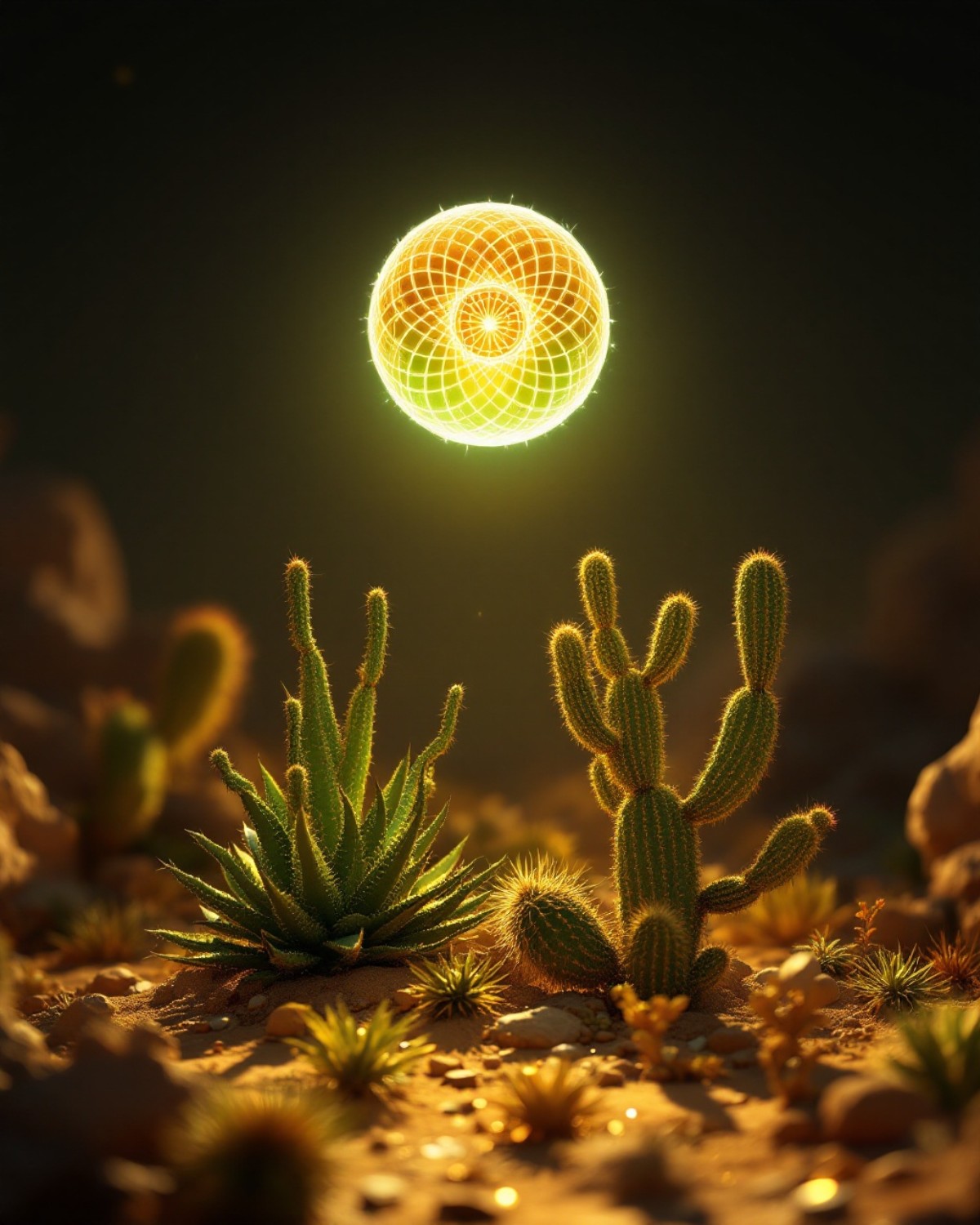
Long before Albert Hofmann ever touched LSD, before the word “psychedelic” existed, a German pharmacologist named Arthur Heffter swallowed a white crystalline powder he had pulled from a desert cactus — and watched the dark behind his eyes fill with colored geometry. The year was 1897, the cactus was peyote, and the molecule was mescaline: the first psychedelic ever chemically isolated, and for half a century the only one science knew by name. It is the oldest, the slowest, and in a strange way the most neglected of the classic psychedelics. This is its neuroscience: the molecule, the receptor it secretly shares with every other psychedelic, the geometry it paints, the cultures that knew it for millennia, and the conspicuous gaps in what modern science has bothered to learn.
The First Psychedelic
Peyote (Lophophora williamsii) is a small, spineless cactus that grows in the limestone deserts of northern Mexico and southern Texas, and humans have been eating it for a very long time. In 2005, researchers radiocarbon-dated two dried peyote “buttons” from a Texas cave and confirmed by GC-MS that they still contained mescaline — the specimens were roughly 5,700 years old (El-Seedi et al., 2005). Western science arrived far later. In 1897 the pharmacologist Arthur Heffter isolated mescaline from peyote and, in a methodical series of self-experiments, proved that this single alkaloid — not the dozens of others in the cactus — produced the visions. It was the first psychedelic ever chemically identified. Two decades later, in 1919, the chemist Ernst Späth synthesised it from scratch (Späth, 1919) — the first psychedelic ever made in a lab. The molecule itself is disarmingly simple: 3,4,5-trimethoxyphenethylamine, a close cousin of the neurotransmitters and stimulants built on the same phenethylamine skeleton.
A Phenethylamine, Not a Tryptamine
This is the first thing that makes mescaline strange. LSD, psilocybin, and DMT are all tryptamines — they share an indole ring borrowed from serotonin itself. Mescaline is a phenethylamine, structurally closer to dopamine and amphetamine than to serotonin. It is also far weaker: an active oral dose is roughly 200 to 400 milligrams, more than a thousand times the microgram doses of LSD, and the experience lasts a marathon 10 to 12 hours — the longest of the classic psychedelics (Ley, Holze et al., 2023). That humble trimethoxy scaffold became the most productive template in psychedelic chemistry: Alexander Shulgin used it as the starting point for an entire family of synthetic phenethylamines — the 2C series (2C-B and its kin) and the amphetamine homologs — tuning the molecule atom by atom to make compounds hundreds of times more potent than the parent.
Precisely-Dosed Psilocybin Mushroom TreatsOOTW Psilocybin Mushroom Treats
Precisely-dosed, lab-tested, quality psilocybin mushroom treats — crafted for daily ritual, neural support, and sustained clarity. Journal readers: 10% off your first order with code JOURNAL10 (applied automatically at checkout).
Claim 10% Off →The Same Receptor: How Mescaline Helped Find 5-HT2A
Here is the deep puzzle mescaline solved. If LSD and mescaline are chemically unrelated — a tryptamine and a phenethylamine — why do they produce such similar states of mind? The answer is that both, despite their different shapes, fit the same molecular lock: the 5-HT2A serotonin receptor. In a landmark 1984 study, Richard Glennon and colleagues showed that across a chemically diverse set of psychedelics, a drug’s binding affinity for the 5-HT2 receptor predicted its hallucinogenic potency with striking precision — a correlation of about r = 0.94 (Glennon et al., 1984). Because mescaline came from a completely different chemical family yet obeyed the same rule, it was crucial evidence that 5-HT2A is “the” psychedelic receptor (Nichols, 2016). The logic still holds today: in rodents the 5-HT2A-driven “head-twitch response” tracks human potency, and in humans the 5-HT2A blocker ketanserin blunts mescaline’s effects, just as it does for the tryptamines.
The Brain on Mescaline — and the Data We Don’t Have
And now the honest part. For a molecule this historically important, the modern neuroscience is astonishingly thin. There is essentially no contemporary fMRI or PET imaging of the mescaline state. The only brain-imaging data are decades old and small: a 1990s German SPECT study that framed mescaline as a “model psychosis” and reported a hyperfrontal pattern of blood flow in twelve volunteers (Hermle et al., 1992). The influential modern frameworks for how psychedelics work — the “entropic brain,” the disintegration of the default mode network — were built almost entirely on psilocybin and LSD (Carhart-Harris et al., 2012, 2014). It is reasonable to assume mescaline does something similar, since it shares the 5-HT2A mechanism, but that is an extrapolation, not a measurement. One of the oldest drugs in science remains, at the level of the living human brain, largely unobserved.
AI That Understands The MedicineOOTW Spirit Guide
Set. Setting. Dose. Integration. The questions you can't bring to your doctor — answered by an AI grounded in every peer-reviewed paper, protocol, and ceremony manual. Private, sober, always there.
Talk to the Spirit Guide → A Sacred 5-MeO-DMT Ceremony · MiamiJoin the OOTW Sacrament
The oldest prayer, remembered — the gentle dissolving of the self into light, held in ceremony by a master facilitator. Sit with our community first: a free, live weekly circle on Zoom. No commitment, simply a conversation.
Join the Weekly Circle →Form Constants: The Geometry Behind the Eyes
What mescaline lacks in brain scans it more than makes up for in description. In 1928 the psychologist Heinrich Klüver, studying mescaline visions, noticed that they were not random: people kept reporting the same four geometric motifs — lattices and honeycombs, cobwebs, tunnels and funnels, and spirals. He called them form constants, and they are now understood as a window onto the architecture of the visual cortex itself, the brain’s wiring made briefly visible. A generation later, in 1954, Aldous Huxley took mescaline in Los Angeles and wrote The Doors of Perception, the book that arguably launched the modern psychedelic imagination. Mescaline is often described as gentler and more “embodied” than LSD — but here caution is warranted: that reputation rests largely on surveys, and the one rigorous head-to-head trial (Ley, Holze et al., 2023) found that, at equivalent doses, the subjective quality of mescaline, LSD, and psilocybin was largely indistinguishable — mescaline simply lasted longer.
Peyote, San Pedro, and the People Who Knew First
Mescaline is not one plant but several. Beyond peyote, it is the active compound in the towering South American columnar cacti — San Pedro, or huachuma (Echinopsis, formerly Trichocereus, pachanoi), and the Peruvian torch. For the Huichol (Wixárika) people of Mexico, the annual pilgrimage to gather peyote in the sacred desert of Wirikuta is among the most important ceremonies in their cosmology. In the United States, peyote is the sacrament of the Native American Church, a pan-tribal faith whose peyotism is protected by a specific federal religious exemption. But reverence now collides with conservation: wild peyote grows agonizingly slowly and is classified as vulnerable and declining, depleted by overharvesting and habitat loss. San Pedro, by contrast, grows quickly from cuttings and is far more sustainable — which is why conservationists and many practitioners now urge that cultivated San Pedro, not wild peyote, be the default for anyone outside the Indigenous traditions that depend on it.
Precisely-Dosed Psilocybin Mushroom TreatsBring the Science Home
Every article here is the why. OOTW's ceremony-ready mushroom confectioneries are the how — precision-crafted to carry the medicine into your daily practice. Journal readers: 10% off your first order with code JOURNAL10 (applied automatically at checkout).
Claim 10% Off →Medicine Without Trials: The Modern Revival
As psychedelic medicine has boomed, mescaline has mostly been left at the station. The largest modern dataset is an anonymous online survey of 452 naturalistic users, in which a majority of people with prior depression, anxiety, PTSD, or addiction reported lasting improvement after a memorable mescaline experience (Agin-Liebes et al., 2021). It is genuinely intriguing — and it is also retrospective, self-selected, and uncontrolled, which means it can generate hypotheses but cannot prove benefit. Mescaline belongs to the broader class of “psychoplastogens,” serotonergic psychedelics that promote structural neuroplasticity (Ly et al., 2018), though it is worth noting mescaline itself was not among the compounds tested in that landmark study. The bottom line is stark: there are no modern Phase 2 or 3 clinical trials of mescaline for any condition, against psilocybin’s 140-plus. The only rigorous modern work is early-phase pharmacology in healthy volunteers. Its very strengths — the long, sacred, twelve-hour arc — are also why a pharmaceutical industry optimized for short, scalable sessions has largely passed it by.
The Synthesis
Mescaline is a paradox wearing a cactus. It is the molecule that started everything — the first isolated, the first synthesized, the one that revealed the receptor every other psychedelic would turn out to share — and yet it is the one we have studied least with modern tools. It carries one of humanity’s oldest continuous spiritual relationships with a plant, and one of its most urgent conservation dilemmas. It promises much and has proven little, not because it failed its trials but because it was never given them. To understand mescaline is to be reminded that the history of psychedelic science is not a straight line of progress but a series of doors — some flung open, some, like this one, still only ajar. This article is education, not medical advice; mescaline is a Schedule I substance, and the cacti that carry it deserve both legal and ecological respect.