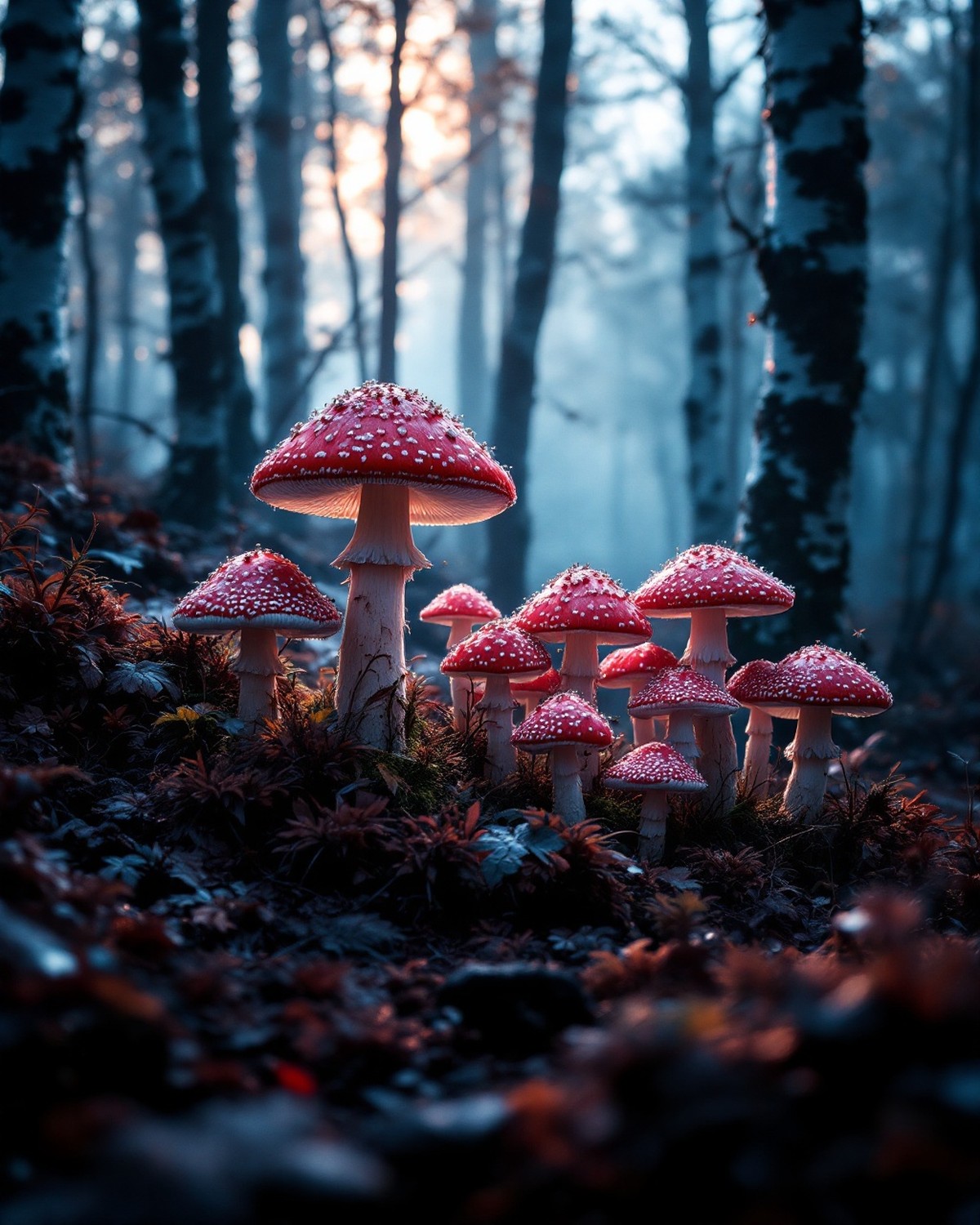
Everyone knows this mushroom. The scarlet cap studded with white warts is the visual shorthand for ‘magic mushroom’ in cartoons, video games, and garden ornaments the world over. And almost everyone gets it wrong. Amanita muscaria — the fly agaric — is not a psychedelic. It does not touch the serotonin machinery that psilocybin and LSD hijack. It works through an entirely different, largely inhibitory chemistry, and the result is not a visionary journey but a dreamlike, deliriant intoxication that has fascinated and poisoned humans for millennia. This is the neuroscience of the world’s most misunderstood mushroom.
The Most Misunderstood Mushroom
The single most repeated error about Amanita muscaria is that it is a ‘psychedelic mushroom’ in the same family as psilocybin. It is not. Classic psychedelics — psilocybin, LSD, DMT — are serotonin 5-HT2A receptor agonists; they excite a specific serotonergic circuit and, in EEG recordings, produce a state of cortical desynchronization, a loosening of the brain’s ordinary rhythms. Fly agaric does almost the opposite. Its decisive compound, muscimol, has essentially no serotonergic activity and instead drives the brain’s primary inhibitory system. In EEG studies it produces cortical synchronization. Pharmacologically, the fly agaric belongs beside alcohol and the sleep drug gaboxadol, not beside magic mushrooms.
The right label is a GABAergic deliriant, or a dissociative-sedative with oneirogenic — dream-inducing — properties. The experience it produces is not the lucid, ego-dissolving clarity people associate with a psilocybin journey, but a fluctuating, sleep-tinged delirium of vivid dreams, distorted perception, and disordered thought. Getting this classification right is not pedantry; it is the difference between understanding the mushroom’s real risks and treating it as an interchangeable ‘shroom.’
Two Molecules Pulling in Opposite Directions
Fly agaric owes its strange, wavering intoxication to a chemical tug-of-war between its two principal compounds. Muscimol is a conformationally restrained structural analog of GABA, the brain’s main inhibitory neurotransmitter, and a potent agonist at the GABA-A receptor. Unlike benzodiazepines or Z-drugs, which bind an allosteric site, muscimol binds the same orthosteric pocket that GABA itself uses, opens the chloride channel, hyperpolarizes the neuron, and damps its firing. It is a superagonist at extrasynaptic δ-subunit receptors, with nanomolar affinity for exactly the receptor population that alcohol engages but benzodiazepines do not — a pharmacological reason the fly-agaric state feels unlike an ordinary sedative.
Ibotenic acid is muscimol’s opposite. It is a structural analog of glutamate, the brain’s main excitatory neurotransmitter, and a potent agonist at NMDA and related glutamate receptors. In excess it is an excitotoxin: overactivation of NMDA receptors floods neurons with calcium and can kill them, which is precisely why neuroscientists use ibotenic acid as a standard tool to lesion specific brain regions in animal studies. In the fresh mushroom, ibotenic acid is the more abundant of the two — a single fresh cap may hold roughly nine times more ibotenic acid than muscimol.
That imbalance sets up the mushroom’s hallmark: an intoxication that waxes and wanes. An excited phase — warmth, tingling, twitching muscles, a floating sensation, agitation, and pseudo-hallucinations — alternates with a comatose, deep-sleep phase, the two often trading places across a single session. The pharmacology maps cleanly onto the phenomenology: ibotenic acid drives the excitation, muscimol drives the depression.
Why Drying Is Chemistry, Not Superstition
Traditional preparers dry the mushroom before use, and there is a real reaction behind the ritual. Ibotenic acid readily loses a molecule of carbon dioxide — it decarboxylates — to become muscimol. Drying, gentle heat, and the acidic environment of the stomach all push this conversion forward. The practical effect is that drying converts the abundant, unstable, excitotoxic ibotenic acid into the more stable, more brain-penetrant, and better-tolerated muscimol. Traditional drying therefore raises usable potency while lowering the harsher toxic load. (A separate traditional route — parboiling in copious water and discarding it — does the reverse, stripping the water-soluble actives out to render the mushroom edible as food. The two practices should never be confused.)
Precisely-Dosed Psilocybin Mushroom TreatsOOTW Psilocybin Mushroom Treats
Precisely-dosed, lab-tested, quality psilocybin mushroom treats — crafted for daily ritual, neural support, and sustained clarity. Journal readers: 10% off your first order with code JOURNAL10 (applied automatically at checkout).
Claim 10% Off →The Wax and the Wane
Onset is slow — anywhere from thirty minutes to two or three hours — and the full course can run most of a day, with the visionary component lasting up to eight hours and total intoxication around twenty-four. The subjective effects are genuinely mixed: sedation and muscle twitching sit alongside a swing between dysphoria and euphoria, altered perception, and, characteristically, macropsia and micropsia, in which objects appear to swell or shrink. Reference dose figures exist — a muscimol threshold near 6 mg, psychoactive effects around 8 to 15 mg — but they are close to unusable in practice, because the active content of a given mushroom varies enormously with specimen, season, geography, which part of the cap is eaten, and how it was dried.
The most famous piece of fly-agaric lore is pharmacologically real. Both muscimol and ibotenic acid are excreted largely unchanged in the urine within hours, which is why Siberian communities practiced ‘secondary intoxication’ — drinking the urine of a person, or a reindeer, that had eaten the mushroom to re-experience its effects while filtering out some of the harsher constituents. The renal pharmacokinetics are established; the folk claim that the body neatly ‘removes the toxins’ is a reasonable interpretation rather than a precisely measured fact, and no reliable human half-life for muscimol has been established.
One popular association deserves a flag. The size-distortion effects — the swelling and shrinking of the world — are genuinely reported for fly agaric, and they surface vividly in Victorian accounts such as Mordecai Cooke’s The Seven Sisters of Sleep (1860). The frequent claim that Lewis Carroll drew Alice’s size-changing directly from the mushroom is, however, literary speculation: there is no evidence Carroll used it, most Carroll scholars reject the reading, and his own migraines may have produced the perceptual distortions now nicknamed ‘Alice in Wonderland Syndrome.’
Toxic, but Rarely Deadly
Fly agaric is toxic, and it can make people very sick — nausea, vomiting, and diarrhea often precede the neurological phase, and severe poisonings can bring agitation, seizures, and a fluctuating loss of consciousness. But its reputation as a killer is largely inherited from its cousins. The truly lethal Amanitas — the death cap (A. phalloides) and the destroying angel (A. bisporigera) — owe their 10-to-20-percent mortality to amatoxins that destroy the liver. Fly agaric contains no amatoxins. Across more than 145,000 US mushroom exposures reported between 1999 and 2018, only 0.04 percent were fatal, and vanishingly few of those involved Amanita muscaria.
The danger that remains is real but manageable and mostly about context. The psychoactive and toxic doses sit close together, content is wildly unpredictable, and muscimol shares the GABA-A system with alcohol, benzodiazepines, and barbiturates, so combining them risks additive central and respiratory depression. There is no specific antidote; management is supportive, with benzodiazepines the mainstay for agitation and seizures. One classic clinical error is worth naming: reflexively giving atropine. Atropine treats only the peripheral effects of the trace muscarine and does nothing for the central GABA-A/NMDA syndrome — it can make things worse, and has a narrow role at best.
Reindeer, Shamans, and the Soma Question
The mushroom’s documented human history is genuinely remarkable. Ritual use is well attested among the Koryak, Chukchi, and Evenki peoples of Siberia, first reported to the West by a Swedish prisoner of war in 1730 and later detailed in the great Jesup Expedition ethnographies of Bogoras and Jochelson. This was specialist, shamanic practice — spirit contact, healing, soul-flight — not casual recreation, and the Koryak dried the mushrooms before use. Reindeer, famously, seek the fly agaric out and behave ‘drunkenly’ after eating it, and herders are recorded drinking reindeer urine or eating intoxicated animals to obtain the effect.
Two beloved stories need honest handling. R. Gordon Wasson’s 1968 hypothesis that fly agaric was Soma, the divine intoxicant of the Rigveda, remains a live but unproven idea, criticized because Soma is described as pressed and filtered and because only a couple of Vedic passages fit the urine motif. And the modern claim that Santa Claus is a secularized fly-agaric shaman — red and white, coming through the smoke-hole, flying reindeer — is a romantic legend that folklorists specializing in Sami and Siberian cultures firmly reject; Santa’s actual lineage runs through Saint Nicholas, Clement Clarke Moore’s 1823 poem, and Thomas Nast’s illustrations. Keep the well-documented Siberian history separate from the fireside myth.
AI That Understands The MedicineOOTW Spirit Guide
Set. Setting. Dose. Integration. The questions you can’t bring to your doctor — answered by an AI grounded in every peer-reviewed paper, protocol, and ceremony manual. Private, sober, always there.
Talk to the Spirit Guide → A Sacred 5-MeO-DMT Ceremony · MiamiJoin the OOTW Sacrament
The oldest prayer, remembered — the gentle dissolving of the self into light, held in ceremony by a master facilitator. Sit with our community first: a free, live weekly circle on Zoom. No commitment, simply a conversation.
Join the Weekly Circle →From Lab Tool to Smoke-Shop Gummy
Ironically, the compound most people have never heard of is one of neuroscience’s workhorses. Muscimol is a standard tool for reversibly silencing a brain region: infuse it locally, and its GABA-A agonism switches off the neurons there for the duration, sparing passing axons and letting researchers ask what a given area actually does. A 2024 study in PNAS, for instance, used muscimol to inactivate face-selective neurons in the primate temporal lobe and watched the animals’ gaze behavior change. This quiet laboratory career is the most rigorous science the mushroom has produced.
The consumer story is far messier. Since roughly 2022, a gray market of fly-agaric gummies, tinctures, and ‘muscimol’ products has appeared in smoke shops and online, marketed for sleep, anxiety, mood, and focus. A 2026 review in Frontiers in Pharmacology is blunt that these claims rest on ‘anecdotal reports, self-reported experiences, and observational social media data, while controlled clinical studies confirming efficacy and safety are currently lacking.’ There are no completed human efficacy trials. Worse, the products are unstandardized and sometimes adulterated: a 2024 CDC field report found that three of five tested ‘Amanita’ gummy brands actually contained unlabeled, Schedule I psilocybin, along with undisclosed caffeine, ephedrine, and kratom.
The legal picture reflects this novelty. In the United States, Amanita muscaria is not federally scheduled — unlike psilocybin — and it is legal in 49 states, with Louisiana the sole outright ban. But in December 2024 the FDA declared the mushroom and its constituents unsafe, unapproved food additives, rendering any food or edible that contains them ‘adulterated.’ That is a food-safety determination, not a drug-scheduling one, and the difference matters: the mushroom itself is not a controlled substance, but selling it in a gummy is now, in the FDA’s view, unlawful. For the most famous mushroom in the world, the science is thin, the market is unregulated, and the honest verdict is that we know far more about how it works than about whether it helps. This article is education, not medical advice.