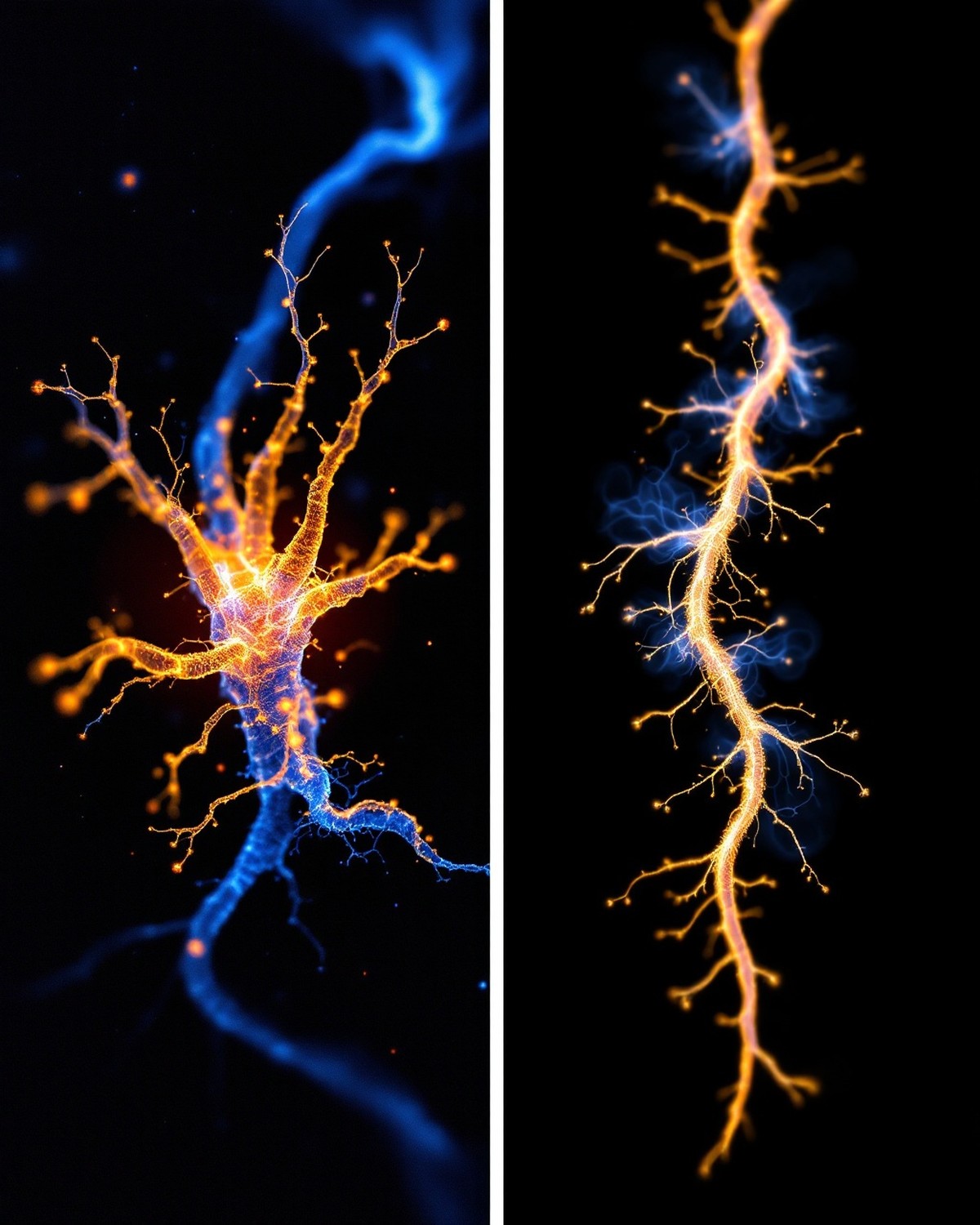
For most of the twentieth century, treating depression meant one chemical story: serotonin, and the drugs that nudged it. Then a different mechanism broke the plot open — blocking the NMDA glutamate receptor lifted severe depression in hours rather than weeks. Two very old molecules embody that mechanism: ketamine, the 1960s battlefield anesthetic, and nitrous oxide, laughing gas synthesized in 1772. This is not a contest to crown a winner; it is a study in contrast — two drugs that reach the same receptor by very different routes, ask very different things of a patient, and carry very different risks.
The shared premise: block glutamate, lift mood
Both drugs belong to a family defined by what it is not. Monoaminergic antidepressants — SSRIs, SNRIs, tricyclics — work by raising levels of serotonin or norepinephrine, and they take weeks to shift mood, if they shift it at all. Ketamine and nitrous oxide skip that system entirely. Both are non-competitive NMDA-receptor antagonists: they block the ion channel of the NMDA receptor, a central gateway for glutamate, the brain’s main excitatory neurotransmitter. That shared identity is why the field has come to study them together, and why nitrous oxide’s antidepressant story was built explicitly on ketamine’s (Izumi et al., 2020). OOTW has covered each on its own: the neuroscience of ketamine and the neuroscience of nitrous oxide.
The counterintuitive part is that blocking an excitatory receptor ends up increasing glutamate signaling downstream — and that surge, not the sedation or the strangeness, appears to be where the therapeutic action lives.
The comparison at a glance
| Dimension | Ketamine (incl. esketamine/Spravato) | Nitrous Oxide (N2O) |
|---|---|---|
| Drug class | Dissociative anesthetic; rapid-acting antidepressant | Inhaled anesthetic gas; investigational rapid antidepressant |
| Primary target | Non-competitive NMDA-receptor antagonist | Non-competitive NMDA-receptor antagonist (multi-target) |
| Other mechanisms | Metabolite HNK (partly NMDA-independent AMPA activation); enantiomer effects | Endogenous opioid system, GABA-A, TREK-1 / SK2 K+ channels, dopamine |
| Metabolism | Hepatic; active metabolites (norketamine, HNK) | Almost none — exhaled unchanged; blood-gas coefficient ~0.47 |
| Route / dosing | IV infusion (~0.5 mg/kg); esketamine nasal spray | Inhaled, ~50% N2O in O2 (research suggests 25% may suffice) |
| Onset of benefit | Hours (~2 h) | Hours (~2 h) |
| Duration of benefit | Transient; single dose fades in ~1–2 weeks, needs maintenance | Signal measured mainly over ~2 weeks; true duration unknown |
| Dissociation | Marked; “K-hole” at higher doses | Milder, brief; fewer psychotomimetic effects |
| Evidence base | Large trial base; FDA-approved esketamine; off-label IV | Small trials (Nagele 2015, 2021); 2025 meta-analysis; investigational |
| Regulatory status (2026) | Approved; Spravato monotherapy for TRD since Jan 2025 | Not approved for depression; not a scheduled controlled substance |
| Key safety risks | Abuse/dependence, bladder toxicity (chronic), raised BP/HR | B12 inactivation → nerve/spinal-cord damage (heavy recreational use), hypoxia |
| Access (2026) | Clinics + telehealth (DEA flexibilities extended through 2026) | Legal but tightening; FDA warnings, growing state restrictions |
| Best understood as | Established, fast rescue with a maintenance requirement | Promising, unproven, near-instant on/off inhalational candidate |
Mechanistic differences: cousins, not twins
Ketamine’s prevailing model is the disinhibition hypothesis. It preferentially silences NMDA receptors on inhibitory GABA interneurons, taking the brakes off nearby excitatory neurons and producing a brief, sharp surge of glutamate in the prefrontal cortex. That surge activates a second glutamate receptor, AMPA, which kicks off a cascade — BDNF release, mTOR activation — that drives rapid growth of new dendritic spines and synapses. Block the AMPA step and the antidepressant effect disappears, strong evidence that the plasticity, not the dissociation, does the work (Kim & Monteggia, 2023).
Two wrinkles complicate the neat NMDA story. First, the enantiomers: racemic ketamine is a 50:50 mix of (S)- and (R)-ketamine. Esketamine — the (S)-form marketed as Spravato — is the more potent NMDA blocker and the one the FDA approved; but (R)-ketamine (arketamine) shows antidepressant activity in models despite weaker NMDA binding, hinting the receptor blockade is not the whole account. Second, the hydroxynorketamine debate: a landmark study argued that ketamine’s metabolite (2R,6R)-HNK produces antidepressant effects in animals through AMPA activation that is largely independent of NMDA inhibition (Zanos et al., 2016). That claim remains genuinely contested a decade on, and reviews through 2024–2025 still frame HNK and the enantiomers as central open questions (Jiang et al., 2025). The honest position: NMDA antagonism is the leading mechanism, not the settled one.
Nitrous oxide shares the NMDA starting point but is even less of a single-mechanism drug. Its analgesia runs substantially through the endogenous opioid system, triggering release of opioid peptides in the periaqueductal grey that activate descending pain-suppressing pathways; some of its painkilling effect can be blunted by naloxone, a surprising fact for a gas. It also weakly potentiates GABA-A, opens TREK-1 potassium channels, and touches dopaminergic reward. Pharmacokinetically it is ketamine’s opposite: an inhaled gas with a blood-gas partition coefficient near 0.47 — among the lowest of any anesthetic — so it equilibrates in lungs, blood, and brain within seconds, and because it is barely metabolized and simply exhaled unchanged, it clears just as fast. Where ketamine is a metabolized injectable acting over hours, nitrous oxide is a near-instant on/off breath. Preclinical work confirms N2O produces ketamine-like effects on excitatory transmission, while newer studies suggest its deeper antidepressant action may involve N2O-specific targets, such as SK2 potassium channels in prefrontal neurons that fire even when NMDA is blocked (PMC, 2023; Mol Psychiatry, 2025). Flag this as preclinical and mechanistic — intriguing, not established.
The “NMDA blockade → glutamate surge → plasticity → lifted mood” story is a compelling and well-supported hypothesis, not settled fact. Much of the synaptogenesis data is from animals, the causal chain in humans is inferred, and for nitrous oxide the human mechanistic data are thinner still. Treat both mechanisms as strong working models.
OOTW Psilocybin Mushroom Treats
Precisely-dosed, lab-tested, quality psilocybin mushroom treats — crafted for daily ritual, neural support, and sustained clarity. Journal readers: 10% off your first order with code JOURNAL10 (applied automatically at checkout).
Claim 10% Off →Onset, duration, dosing, and the experience
The most striking convergence is speed. Ketamine’s antidepressant effect can appear within about two hours — Zarate’s 2006 trial found significant improvement in treatment-resistant patients within roughly 110 minutes (Zarate et al., 2006). Nitrous oxide is in the same range: a single one-hour inhalation produces measurable mood improvement within about two hours. For both, this is genuinely without precedent against the six-week wait of an SSRI, which is why both draw interest for acute, severe depression.
The convergence continues into their shared weakness: durability. A single ketamine dose typically fades within one to two weeks, which is why real-world protocols rely on induction series plus open-ended maintenance (Murrough et al., 2013). Nitrous oxide’s antidepressant benefit has, so far, mostly been measured over about two weeks after a session — a similar window, though the trials are too small and short to map its true duration.
Where they diverge sharply is route and experience. Ketamine reaches the brain by IV infusion (0.5 mg/kg is the classic research dose) or as the esketamine nasal spray (Spravato); nitrous oxide is inhaled, typically as 50% N2O in oxygen, though the research points toward lower doses. Both produce dissociation — a detachment from body and surroundings — but ketamine’s is deeper and longer, and at higher doses tips into the disorienting “K-hole.” Nitrous oxide’s dissociative wave is briefer and milder, and it does not tend to produce the psychotomimetic effects sometimes seen with ketamine. One is a numbing distance held over hours; the other is a compressed burst gone in minutes.
The clinical scoreboard, honestly kept
The two sit at very different stages of the pipeline, so a true head-to-head trial does not yet exist.
Ketamine is the established player. Esketamine (Spravato) was FDA-approved in March 2019 for treatment-resistant depression as an add-on to an oral antidepressant, and in 2020 for depression with acute suicidal ideation. In January 2025 the FDA approved Spravato as a standalone monotherapy for treatment-resistant depression — the first such approval — on trial data showing about 22.5% remission at week 4 versus 7.6% for placebo, with separation from placebo as early as 24 hours (AJMC, 2025; J&J, 2025). Racemic IV ketamine, by contrast, is used widely off-label — not FDA-approved for depression. The honest asterisk: esketamine’s approved benefit is real but modest, with meta-analytic effect sizes in the same range as antipsychotic augmentation and persistent debate over “functional unblinding.”
Nitrous oxide is the investigational upstart. The clinical story starts with Peter Nagele’s team at Washington University. Their 2015 proof-of-concept trial in 20 treatment-resistant patients found that one hour of 50% N2O beat a placebo gas on depression scores (Nagele et al., 2015). The more informative 2021 phase 2 crossover compared 25% N2O, 50% N2O, and placebo in 24 patients depressed for over 17 years on average. Both active doses beat placebo, and — the key finding — the lower 25% dose delivered comparable benefit with far fewer side effects than 50%, where nausea and vomiting were common; effects were sustained for about two weeks (Nagele et al., 2021). A 2025 systematic review and meta-analysis pooling these trials found a signal worth pursuing — but one built on a handful of small, mostly single-site studies with short follow-up (eBioMedicine, 2025).
So the comparison is genuinely lopsided. Ketamine has a large trial base, regulatory approval, and real-world use; nitrous oxide has a promising proof of concept and a plausible dose-response, and nothing more. Any effect-size comparison between them would be premature — different endpoints, tiny nitrous samples, no shared trial.
AI That Understands The MedicineOOTW Spirit Guide
Set. Setting. Dose. Integration. The questions you can’t bring to your doctor — answered by an AI grounded in every peer-reviewed paper, protocol, and ceremony manual. Private, sober, always there.
Talk to the Spirit Guide → A Sacred 5-MeO-DMT Ceremony · MiamiJoin the OOTW Sacrament
The oldest prayer, remembered — the gentle dissolving of the self into light, held in ceremony by a master facilitator. Sit with our community first: a free, live weekly circle on Zoom. No commitment, simply a conversation.
Join the Weekly Circle →The very different hazards
Their safety profiles differ in kind, and it is a disservice to file one as “safe” and the other as “dangerous.” They are dangerous in different directions.
Ketamine’s risks concentrate in the drug itself and in chronic exposure. It is a Schedule III controlled substance with genuine abuse and dependence liability — a concern amplified now that at-home telehealth prescribing has widened access. Heavy, sustained use causes a well-documented bladder toxicity (ketamine-induced ulcerative cystitis), with urinary frequency, pain, and in severe cases irreversible bladder damage. It transiently raises blood pressure and heart rate, and the acute dissociation, while usually brief, can be frightening without support.
Nitrous oxide’s risks split cleanly by setting. In supervised medicine — dentistry, procedural sedation, obstetric Entonox — it has a roughly 175-year safety record, because it is always given with adequate oxygen, under monitoring, briefly (StatPearls). The recreational picture is different and, in 2024–2026, urgent. Nitrous oxide irreversibly oxidizes the cobalt atom of vitamin B12, inactivating the enzyme methionine synthase and producing a functional B12 deficiency even when blood B12 looks normal. Because B12-dependent methylation maintains myelin, heavy repeated use can cause subacute combined degeneration of the spinal cord, peripheral neuropathy, and megaloblastic anemia — sometimes permanent (Neurological diseases review, 2024). Acute risks include hypoxia and frostbite. The CDC reported Michigan nitrous-related poison calls, ER visits, and EMS responses four to five times higher in 2023 than 2019, driven by the shift from small chargers to large flavored “galaxy gas” tanks (CDC MMWR, 2025; FDA, 2025).
The clean summary: ketamine’s tail risks accumulate with repeated exposure and misuse; nitrous oxide is exceptionally safe under supervision but capable of permanent nerve injury in heavy recreational use. Different hazard curves, not a hierarchy.
Access and regulation in 2026
The practical asymmetry is stark. Ketamine is legal medicine — Schedule III, available through IV clinics, the approved esketamine spray, and telehealth. On December 31, 2025, the DEA and HHS published a fourth temporary extension of telemedicine flexibilities, keeping remote ketamine prescribing (without a prior in-person visit) in place through the end of 2026, while permanent rules are still being drafted (DEA, 2025). That access is double-edged: it widens reach while raising real concerns about screening and misuse.
Nitrous oxide is not a federally scheduled controlled substance — its culinary, medical, and industrial uses keep it legal — but that status is tightening fast. The FDA issued a consumer safety alert in March 2025 (updated June 2025) warning against recreational inhalation and naming brands including Galaxy Gas. At the state level the picture is a patchwork in rapid motion, with a growing majority of states adding sales restrictions, age limits, and bans on flavored products; some (Florida, New York) have moved to prohibit recreational retail sale outright (FDA, 2025). None of this is legal advice — check current law where you live.
Precisely-Dosed Psilocybin Mushroom TreatsBring the Science Home
Every article here is the why. OOTW’s precisely-dosed, lab-tested, quality psilocybin mushroom treats are the how — crafted to carry the medicine into your daily practice. Journal readers: 10% off your first order with code JOURNAL10 (applied automatically at checkout).
Claim 10% Off →Which one, for whom?
Resist the urge to crown a winner; the useful question is fit. For approved, monitored treatment of resistant depression today, ketamine — especially esketamine — is the only option that actually exists in clinical practice; nitrous oxide is confined to research. Where the concern is dissociation intensity or a preference for the briefest possible altered state, nitrous oxide’s milder, seconds-long wave is gentler than ketamine’s hours-long detachment. Comorbidities tilt the choice too: a history of substance use disorder weighs against ketamine’s dependence liability, while any pattern of heavy or repeated nitrous inhalation raises the B12 flag. And durability is a shared limitation, not a differentiator — both fade, both raise the question of maintenance that neither has cleanly answered.
The most honest framing is the one the neuroscience keeps pointing to: two drugs at the same receptor, reached by an injection and a breath, teaching the depressed brain to change on very different timescales and at very different costs. It is fit, not a winner — and for nitrous oxide, the more pressing truth is simply that the evidence is not yet in.
Ketamine and nitrous oxide have serious risks and belong in supervised settings; nitrous oxide is not an approved depression treatment. If you are in crisis, contact a local emergency line or the 988 Suicide and Crisis Lifeline in the US. This article is education, not medical advice.