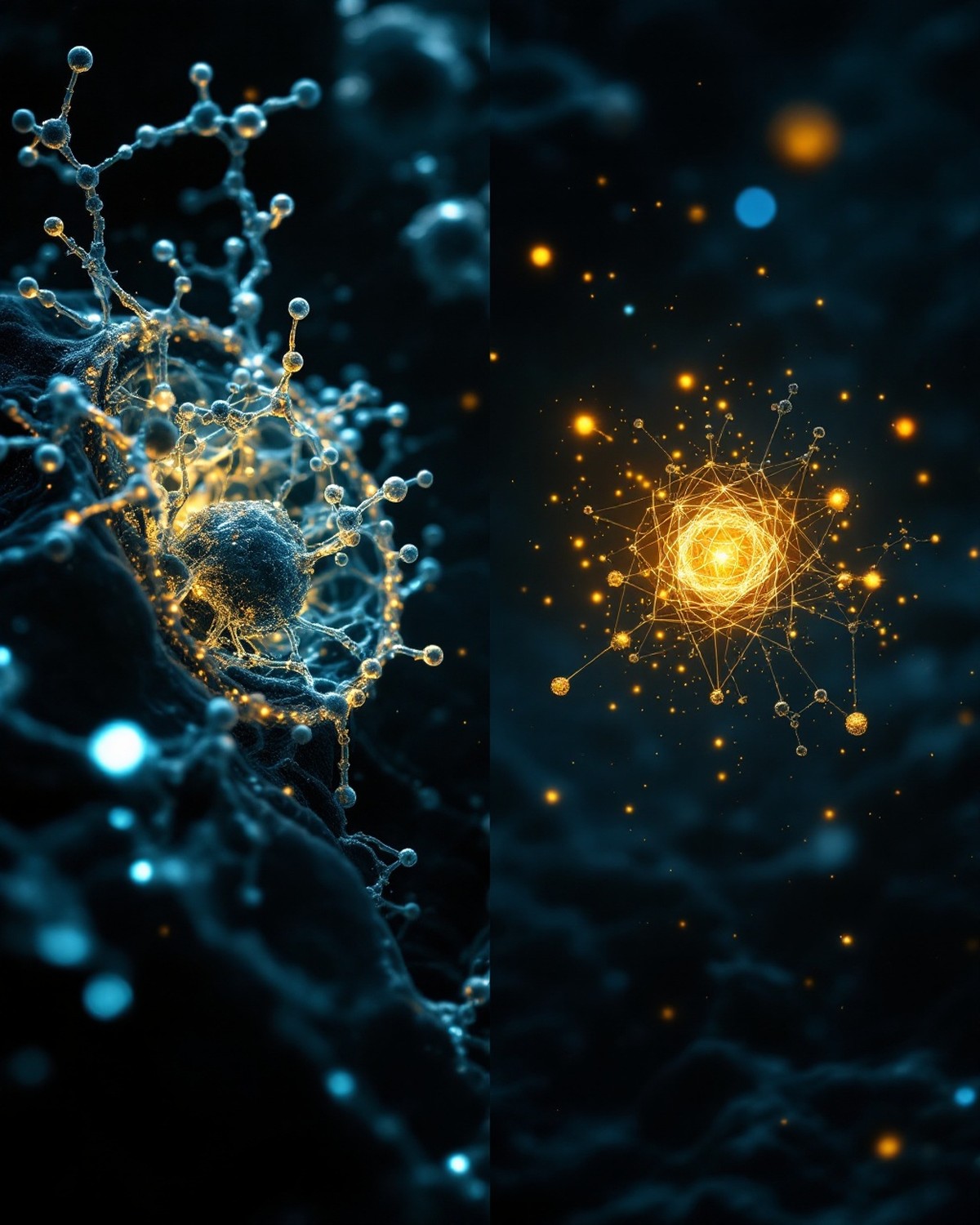
Albert Hofmann synthesized LSD in a Basel lab in 1938 and, five years later, accidentally absorbed enough to take the first acid trip in history — a bicycle ride into the twentieth century’s strangest pharmacology. DMT’s story is older and stranger: the molecule was synthesized in 1931, identified in Amazonian snuffs and brews used for centuries, and later found to occur in trace amounts across the plant and animal kingdoms, including — controversially — in mammalian brain tissue. One is a chemist’s molecule that reshaped a culture; the other is a compound so simple and so widespread that some researchers wondered whether the brain makes its own.
OOTW has covered each on its own: the neuroscience of LSD and the neuroscience of DMT. This piece puts them side by side. It is not a contest to crown a winner. It is a study in contrast — two molecules that reach the same receptor, produce two of the most different experiences in all of psychopharmacology, and, in 2026, sit at different points on the road back to medicine. Understanding where they converge, where they diverge, and what each actually does is the most useful thing a comparison can offer.
Both drugs are Schedule I, carry real psychological risk, and are contraindicated in a personal or family history of psychosis or bipolar disorder. If you are in crisis, contact a local emergency line or the 988 Suicide and Crisis Lifeline in the US.
The shared premise: one receptor, one entropic brain
Start with what they agree on, because it is the foundation of everything. Both LSD and DMT are classic serotonergic psychedelics, a family defined by a single shared action: agonism at the 5-HT2A serotonin receptor, densely expressed on layer-5 pyramidal neurons in the cortex. Switch that receptor on and you get the cascade neuroscience associates with the psychedelic state — increased cortical excitability, a rise in neural entropy (the brain’s activity becomes less predictable, more diverse), and a loosening of the default mode network, the tightly coupled circuit tied to self-referential thought and the ordinary sense of being a fixed self (Nichols, Pharmacol Rev 2016). In the “entropic brain” and REBUS framing, both drugs temporarily flatten the brain’s habitual top-down hierarchies. That shared endpoint is why a high-dose acid trip and a DMT breakthrough, for all their differences, are recognizably members of the same family — and why the 5-HT2A receptor is the through-line of this entire comparison.
They also share, at the whole-brain scale, the same broad signature. LSD’s landmark imaging study found that it increases functional connectivity across normally segregated brain networks — most strikingly a surge of connectivity into the visual cortex that tracked with the intensity of visual imagery, alongside disintegration of the default mode network (Carhart-Harris et al., PNAS 2016). DMT’s imaging shows the same directional story compressed into minutes: global hyperconnectivity, a collapse of the cortex’s normal hierarchical organization, reduced within-network integrity, and a robust rise in signal diversity and entropy (Timmermann et al., PNAS 2023). Different clocks, same music.
The comparison at a glance
| Dimension | LSD (incl. MM120 / lysergide) | DMT (incl. SPL026 / CYB004) |
|---|---|---|
| Drug class | Classic serotonergic psychedelic; semi-synthetic ergoline (lysergamide) | Classic serotonergic psychedelic; simple tryptamine (endogenous, plant-derived) |
| Primary target | Potent 5-HT2A agonist | 5-HT2A partial agonist |
| Other targets | 5-HT1A/2C/6/7, dopamine D1/D2, TAAR1, α-adrenergic (unusually broad) | 5-HT1A/2C, sigma-1 receptor, TAAR1 |
| Origin | Chemist-made (1938) from ergot fungus alkaloids | Widespread in nature; ayahuasca; trace amounts in mammals (endogenous role contested) |
| Receptor kinetics | Very slow off-rate; EL2 “lid” traps it → long residence time (Wacker/Roth 2017) | Rapid on/off; MAO degrades it almost instantly |
| Route | Oral (active in micrograms) | Not orally active alone (MAO); smoked/vaped, IV/IM, or oral with an MAOI (ayahuasca) |
| Onset / duration | Onset ~1 h; peak ~2.5–3 h; ~8–12 h total (half-life ~2.9 h) | Smoked: seconds to onset, ~10–20 min total; IV infusion can be extended |
| Subjective profile | Long, gradual introspective arc; ego dissolution at high dose | Abrupt total immersion; “breakthrough”; reliably reported entity encounters |
| Imaging signature | Increased cross-network connectivity, visual-cortex surge, DMN disintegration (Carhart-Harris 2016) | Collapsed cortical hierarchy, global hyperconnectivity, spiked entropy/signal diversity (Timmermann 2019/2023) |
| Lead 2026 clinical program | MM120 for GAD: JAMA-published Phase 2b; FDA Breakthrough; Phase 3 (Voyage/Panorama/Emerge) reading out 2026 | IV DMT (SPL026) Phase 2a MDD positive (Nature Medicine 2025); deuterated CYB004 Phase 2 GAD data due early 2026 |
| Developer (2026) | Definium Therapeutics (formerly MindMed) | Helus Pharma (formerly Cybin; via Small Pharma) |
| Key safety notes | Low physiological toxicity; challenging experiences, HPPD (most associated with LSD), long mild pressor effect | Low physiological toxicity; steep transient BP/HR spikes; serotonin-syndrome risk in oral MAOI (ayahuasca) form |
| Legal status (2026) | Schedule I; access via clinical trials only (synthetic — not covered by natural-psychedelic decrim) | Schedule I; clinical trials, Colorado Prop 122 decriminalization, religious (ayahuasca) exemptions |
| Best understood as | The longest classic psychedelic — a molecule that won’t let go of its receptor | The shortest classic psychedelic — a molecule that flares and vanishes |
Where they split: the chemistry
Everything that makes them feel like different universes flows from the molecules.
LSD is a semi-synthetic ergoline — a lysergic acid diethylamide, built on the four-ring ergoline scaffold derived from alkaloids of the ergot fungus (Claviceps purpurea). It is a large, rigid, complex molecule, and one of the most potent psychoactive substances ever characterized: a full dose is measured in micrograms, roughly a thousandth of the milligram-scale doses of most psychedelics. Its pharmacology is also unusually broad. Beyond potent 5-HT2A agonism (its main psychoactive driver), LSD binds and activates a wide sweep of targets — serotonin 5-HT1A, 5-HT2C, 5-HT6, 5-HT7, dopamine D1 and D2, the trace-amine receptor TAAR1, and α-adrenergic receptors (Nichols 2016; De Gregorio et al.). The dopaminergic component in particular is thought to shape the later phase of the trip.
DMT is a simple tryptamine — N,N-dimethyltryptamine, structurally close to serotonin itself and to psilocin. It occurs across nature: in the Psychotria viridis leaf brewed into ayahuasca, in numerous other plants, and in trace amounts in mammalian tissue, which fed the popular “spirit molecule” idea that the brain manufactures its own psychedelic. That endogenous story deserves an honest flag: enzymes capable of making DMT (such as INMT) exist in mammalian tissue and DMT has been detected in rat brain, but whether the brain produces it in psychoactively meaningful amounts — and whether it has any physiological function — remains genuinely unresolved and contested (Dean et al., Sci Rep 2019; critical review, Front Psychiatry 2024). DMT is primarily a partial agonist at 5-HT2A (plus 5-HT1A and 5-HT2C), and it also binds the sigma-1 receptor — a molecular chaperone linked in preclinical work to neuroplasticity and neuroprotection — and TAAR1 (Su, Hayashi & Vaupel, Science 2009). The sigma-1 angle is intriguing but preclinical: interesting in a dish and in mice, not shown to drive human clinical outcomes.
Precisely-Dosed Psilocybin Mushroom TreatsOOTW Psilocybin Mushroom Treats
Precisely-dosed, lab-tested, quality psilocybin mushroom treats — crafted for daily ritual, neural support, and sustained clarity. Journal readers: 10% off your first order with code JOURNAL10 (applied automatically at checkout).
Claim 10% Off →The engine of the whole comparison: binding kinetics
Here is the single most illuminating difference, and it is not about which receptors but how long the drug stays.
In 2017, Daniel Wacker, Bryan Roth, and colleagues published the first crystal structure of LSD bound to a human serotonin receptor, and it explained a decades-old puzzle: why LSD lasts so absurdly long for a drug cleared from the blood relatively quickly. The structure revealed that once LSD slots into the binding pocket, a portion of the receptor — extracellular loop 2 (EL2) — folds over the top like a “lid,” trapping the molecule in place. Molecular-dynamics simulations tied this lid to LSD’s exceptionally slow dissociation — a long receptor residence time — and a mutation that loosened the lid sped LSD’s binding kinetics right up (Wacker et al., “A Receptor on Acid,” Cell 2017). In plain terms: LSD gets in, the door shuts behind it, and it keeps signaling long after most drugs would have washed off the receptor. That slow off-rate is a large part of why the effects outlast the plasma half-life.
DMT is the mirror image. It binds and releases rapidly — a quick on, quick off — and, decisively, it is a substrate for monoamine oxidase (MAO), the enzyme that degrades it almost the instant it appears. Taken by mouth on its own, DMT is destroyed in the gut and liver before it can act at all (which is exactly why ayahuasca must pair it with MAO-inhibiting vine alkaloids). Injected or smoked, it reaches the brain, hits 5-HT2A hard and briefly, and is metabolized away within minutes. The contrast is almost poetic: LSD is the guest who will not leave; DMT is gone before the door closes.
The receptor-residence story is a well-supported structural and pharmacological account of why the clocks differ, not a complete theory of the subjective experience. Duration is shaped by kinetics, metabolism, receptor breadth, and dose together — and how a molecular event becomes a felt journey is still only partly understood. Treat the “lid” as a real and elegant piece of the puzzle, not the whole picture.
Pharmacokinetics and routes: micrograms over a day vs a puff that vanishes
The kinetics translate directly into how each drug is taken and how long it runs.
LSD is taken orally, is active at microgram doses, and unfolds slowly. In controlled dosing studies, a 100 µg oral dose produced effects beginning within about an hour, peaking around 2.5–3 hours, and lasting a mean of roughly 8.2 hours — with a range extending past 14 hours at higher doses — even though LSD’s plasma half-life is only about 2.9 hours (Dolder et al., Clin Pharmacokinet 2017). That gap between a short half-life and a long experience is precisely what the “lid” helps explain. The practical upshot: an LSD session is an all-day commitment.
DMT is not orally active on its own. Because MAO shreds it, it must either be combined with an MAO inhibitor (the ayahuasca solution) or delivered by a route that bypasses the gut — smoked or vaporized, or given intravenously/intramuscularly. Smoked at a breakthrough dose, DMT comes on within seconds, peaks in a couple of minutes, and is essentially over in 10–20 minutes — the shortest major psychedelic experience there is. This extreme brevity is also what makes DMT attractive to drug developers: it fits inside a clinic appointment. The frontier here is extended-state DMT — using controlled intravenous infusion to hold a person at a chosen depth for far longer than a single puff allows. Imperial College researchers have run continuous-infusion and self-titration protocols that sustain the state and let participants “steer” its intensity (Luan, Timmermann et al., J Psychopharmacol 2024), and a 2025 trial demonstrated a 6-hour DMT infusion in healthy volunteers with an acceptable safety profile (van der Heijden et al., Clin Transl Sci 2025). Extended infusion is the technology that turns the shortest psychedelic into a tunable, clinic-friendly one.
The experience and the neuroscience of it
Subjectively, these are two of the most different states in psychopharmacology.
LSD is a long, gradually evolving arc. Over 8–12 hours it moves through waves of perceptual change, emotional intensity, associative and conceptual thinking, and — at higher doses — ego dissolution, all with plenty of time for reflection within the experience. The imaging fits: LSD’s increased connectivity into visual cortex tracks the visual richness, and default-mode disintegration tracks the loosening of the ordinary self (Carhart-Harris 2016). It is a marathon of the mind.
DMT is a sudden, total immersion. A smoked breakthrough dose can, within a minute, replace ordinary reality with a fully realized alternate space — and one of its most striking and reliably reported features is the entity encounter: a felt sense of contact with autonomous “beings.” In the largest survey to date, of 2,561 people describing their most memorable DMT entity experience, most reported an emotional and often deeply meaningful encounter, with a majority saying it altered their fundamental conception of reality (Davis et al., J Psychopharmacol 2020). The neuroscience captures the abruptness: EEG shows DMT sharply reducing alpha-band power while spiking signal diversity (Lempel-Ziv complexity), with the changes tracking the rise and fall of subjective intensity in real time (Timmermann et al., Sci Rep 2019), and the EEG-fMRI work shows the cortical hierarchy briefly collapsing (Timmermann 2023). One drug slowly rearranges the furniture of the mind; the other, for a few minutes, replaces the room.
AI That Understands The MedicineOOTW Spirit Guide
Set. Setting. Dose. Integration. The questions you can’t bring to your doctor — answered by an AI grounded in every peer-reviewed paper, protocol, and ceremony manual. Private, sober, always there.
Talk to the Spirit Guide → A Sacred 5-MeO-DMT Ceremony · MiamiJoin the OOTW Sacrament
The oldest prayer, remembered — the gentle dissolving of the self into light, held in ceremony by a master facilitator. Sit with our community first: a free, live weekly circle on Zoom. No commitment, simply a conversation.
Join the Weekly Circle →The clinical scoreboard, honestly kept
Both molecules are back in serious clinical development in 2026 — but at different stages, and it is worth keeping the comparison honest.
LSD has the more advanced program. Its lead candidate is MM120 (lysergide D-tartrate — a pharmaceutically standardized LSD), developed by MindMed, which rebranded to Definium Therapeutics in January 2026 (Definium/MindMed rebrand, 2026). Its Phase 2b trial in generalized anxiety disorder — the first randomized, placebo-controlled trial of LSD in GAD, and notably without accompanying psychotherapy — enrolled 198 adults across four dose levels and met its primary and key endpoints, with the 100 µg dose emerging as optimal and a durable anxiety reduction seen through 12 weeks; the results were published in JAMA in 2025 (Robison et al., JAMA 2025). The FDA granted MM120 Breakthrough Therapy designation for GAD, and a broad Phase 3 program is underway — the Voyage and Panorama trials in GAD and the Emerge trial in major depression, with three Phase 3 readouts anticipated across 2026.
DMT’s clinical program is earlier but real. Intravenous DMT (SPL026, developed by Small Pharma and later Cybin — which rebranded to Helus Pharma in January 2026) was tested in a Phase 2a trial for major depressive disorder: 34 patients received a ~21.5 mg IV infusion producing a 20–30 minute experience, and the drug plus supportive therapy beat placebo with a clinically meaningful reduction in depression scores at two weeks (a −7.4-point MADRS difference), results now published in Nature Medicine (Phase 2a IV DMT for MDD, Nature Medicine 2025). A deuterated DMT candidate, CYB004 (designed for a smoother intramuscular delivery), completed enrollment in a Phase 2 trial for generalized anxiety disorder, with topline data expected in early 2026 (Cybin/Helus CYB004 enrollment, 2025). The DEA also raised its 2026 DMT production quota sharply to support this expanding research pipeline.
So the comparison is real but lopsided in maturity: LSD, for anxiety, is further down the regulatory road (Breakthrough status, three Phase 3 readouts in 2026), while DMT, for depression and anxiety, has promising Phase 2 signals and the intriguing extended-infusion frontier. No head-to-head trial exists, the depression and anxiety endpoints differ, and both still depend on the “assisted” model of a supervised session — so any efficacy comparison between them would be premature.
Safety: low physiological toxicity, real psychological risk
Both LSD and DMT are, by the standards of drugs, remarkably low in physiological toxicity — there is no reliably established lethal dose in humans from the drugs’ direct pharmacology, and neither produces the classic dependence syndrome of opioids or stimulants. But “low toxicity” is not “no risk,” and their hazards are chiefly psychological, with some physiological caveats.
The shared psychological risks are the challenging experience (the “bad trip”) — acute fear, anxiety, paranoia, or destabilization during the session — and, less commonly, hallucinogen persisting perception disorder (HPPD), in which visual disturbances linger afterward. HPPD is most associated with LSD; prevalence estimates vary enormously by definition, with older figures ranging widely and a large web-based survey estimating roughly 4% of psychedelic users report persistent symptoms (HPPD scoping review, Expert Opin Drug Saf 2022). Both drugs carry a firm contraindication in personal or family history of psychosis or bipolar disorder, where they can precipitate prolonged psychotic or manic episodes, and both are inappropriate without screening and support.
Their physiological caveats differ slightly. DMT produces sharp, transient increases in blood pressure and heart rate that peak within minutes and resolve as the drug clears; in controlled studies single IV doses up to 20 mg were generally well tolerated, though one participant given a high weight-based dose had a brief episode of low blood pressure and slow heart rate with no lasting effect (acute IV DMT safety, healthy volunteers, 2023). Its cardiovascular effects are steep but short. LSD’s cardiovascular effects are milder but prolonged, matching its long duration; as with all 5-HT2A/5-HT2B-active agents, chronic or very frequent dosing raises a theoretical valvular-heart concern tied to duration of receptor exposure — relevant to hypothetical repeated microdosing, not to occasional supervised sessions. Neither drug should be combined with serotonergic medications (SSRIs, MAOIs) without expert oversight, and DMT’s MAOI-dependent oral forms (ayahuasca) add a serotonin-syndrome hazard that smoked or IV DMT does not.
The clean summary: both are physiologically forgiving and psychologically potent. LSD’s risks are stretched over a long day; DMT’s are compressed into steep, brief spikes. Different hazard curves, not a hierarchy.
Access and regulation in 2026
The practical picture is nearly symmetrical, and restrictive. Both LSD and DMT remain Schedule I under the US Controlled Substances Act — the most restrictive classification, formally reserved for substances with no accepted medical use — and no federal rescheduling has occurred. Any change hinges on FDA approval of a specific product, which the advancing MM120 and DMT programs could eventually deliver but have not yet.
Legal access today runs through two narrow channels for both. The first is clinical trials: the Definium (LSD/MM120) and Helus (DMT) programs are actively enrolling, and the DEA increased 2026 production quotas to supply them. The second is state-level decriminalization, most notably Colorado’s Proposition 122, which decriminalized personal adult use of several natural psychedelics including DMT (and covers naturally occurring compounds, not LSD, which is fully synthetic). DMT is additionally lawful for a small number of religious groups (such as the UDV and Santo Daime) that use ayahuasca sacramentally under Religious Freedom Restoration Act exemptions. None of this makes either drug legal to buy or sell, and none of it is legal advice — check current law where you live.
Precisely-Dosed Psilocybin Mushroom TreatsBring the Science Home
Every article here is the why. OOTW’s precisely-dosed, lab-tested, quality psilocybin mushroom treats are the how — crafted to carry the medicine into your daily practice. Journal readers: 10% off your first order with code JOURNAL10 (applied automatically at checkout).
Claim 10% Off →Which one, for whom?
Resist the urge to crown a winner; the useful question is fit.
If the interest is a long, introspective, self-directed arc with time to move through and reflect within the experience, that is LSD’s native territory — and, for anxiety specifically, LSD (as MM120) has the more mature evidence and the nearer regulatory horizon. If the draw is the most intense, most compressed psychedelic state — the breakthrough, the entity phenomenology, an experience that fits inside minutes — that is DMT’s signature, and its short duration plus the new extended-infusion technology make it uniquely suited to a controlled clinical window. For depression, DMT has a published Phase 2a signal; for anxiety, both are in play, with LSD ahead on maturity and DMT (CYB004) reading out imminently.
Comorbidities and practicalities tilt the choice further. A history of psychosis or bipolar disorder weighs heavily against either. Cardiovascular vulnerability warrants caution with DMT’s steep acute pressor effects and with LSD’s prolonged exposure. And the sheer duration difference is itself a deciding factor: an 8–12 hour LSD session is a very different logistical and psychological undertaking than a 15-minute DMT experience, whatever their shared molecular root.
The most honest framing is the one the neuroscience keeps pointing to: two classic psychedelics that flip the same 5-HT2A switch and dissolve the same sense of a fixed self, separated by a molecule’s residence time — one that clamps on for half a day, one that flares and is gone. It is fit, not a winner. And for both, the more pressing truth is that the pivotal evidence is arriving right now, in 2026, and deserves to be read as it lands rather than hyped ahead of itself.
LSD and DMT are Schedule I controlled substances with no approved medical use; their therapeutic potential is confined to ongoing clinical trials. Both are contraindicated in a personal or family history of psychosis or bipolar disorder. If you are in crisis, contact a local emergency line or the 988 Suicide and Crisis Lifeline in the US. This article is education, not medical advice.