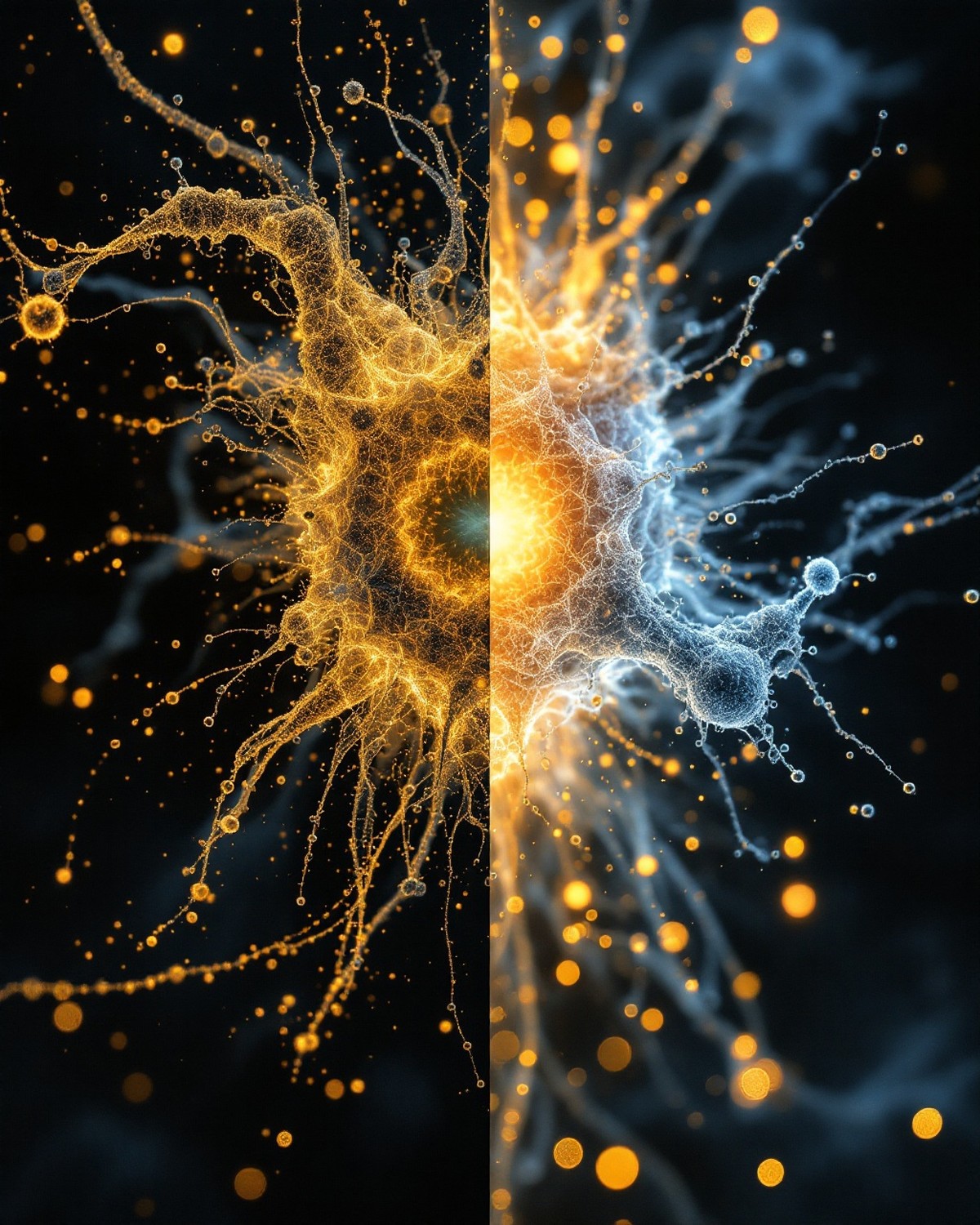
They look almost like twins on paper. N,N-dimethyltryptamine (DMT) and 5-methoxy-N,N-dimethyltryptamine (5-MeO-DMT) differ by a single methoxy group — a chemical footnote — and both are simple tryptamines, cousins of serotonin, that come on within seconds and are gone within minutes. And yet the experiences they produce sit at nearly opposite ends of the psychedelic spectrum. DMT is famous for content: hyper-saturated color, impossible geometry, and the widely reported sense of meeting autonomous “entities.” 5-MeO-DMT is famous for the erasure of content: a sudden white-out in which the visual world and the self both dissolve into a formless, boundaryless “void.” Two molecules, one methoxy group apart, describing two radically different territories.
OOTW has covered each on its own: the neuroscience of DMT and the neuroscience of 5-MeO-DMT, and we have compared 5-MeO-DMT with psilocybin in 5-MeO-DMT vs Psilocybin. This piece puts the two tryptamines side by side. It is not a contest to crown a winner. It is a study in contrast — two short-acting molecules that reach two of the most different states in psychopharmacology, largely because they emphasize different serotonin receptors, and that in 2026 sit at different points on the road toward medicine.
This piece discusses depression, anxiety, cardiovascular and serotonin-syndrome hazards, and intense, destabilizing psychological experiences. If you are in crisis, contact a local emergency line or the 988 Suicide and Crisis Lifeline in the US.
The comparison at a glance
| Dimension | N,N-DMT (incl. SPL026 / CYB004) | 5-MeO-DMT (incl. GH001 / BPL-003) |
|---|---|---|
| Drug class | Short-acting serotonergic tryptamine psychedelic | Short-acting serotonergic tryptamine psychedelic |
| Primary target | 5-HT2A partial agonist | 5-HT1A agonist (≈100–1,000× selectivity over 5-HT2A) |
| Other targets | 5-HT1A, sigma-1, TAAR1 | 5-HT2A (secondary), SERT, other 5-HT sites |
| Signature experience | Vivid visual/geometric content; “breakthrough”; entity encounters | White-out; ego-dissolution; oceanic boundlessness; nondual “void”; little visual content |
| Why the difference | 5-HT2A drives perceptual/visual richness | 5-HT1A dominance dampens visuals, favors dissolution of self |
| Main sources | Ayahuasca, changa, many plants; contested endogenous | Bufo alvarius (Sonoran Desert toad), Anadenanthera snuffs, synthetic; contested endogenous |
| Potency (by weight) | Lower; smoked breakthrough ~40–50 mg | Several-fold higher; inhaled active doses ~single digits–18 mg |
| Routes | Smoked/vaped, IV/IM, or oral with an MAOI (ayahuasca) | Smoked/vaped, insufflated, IV/IM; synthetic in clinic |
| Onset / duration | Seconds to onset; ~10–20 min (smoked); IV can be extended | Seconds to onset; peak 2–5 min; ~baseline by ~30 min |
| Imaging signature | Collapsed cortical hierarchy, spiked entropy/signal diversity (Timmermann 2019/2023) | Less studied in humans; preclinical 5-HT1A/5-HT2A cortical effects (Riga 2018) |
| Lead 2026 depression program | IV DMT (SPL026) Phase 2a MDD (Nature Medicine 2026); CYB004 Phase 2 GAD | GH001 & BPL-003 Phase 2b TRD positive → Phase 3; BPL-003 has FDA Breakthrough Therapy |
| Key safety notes | Acute BP/HR spikes; intense psychological risk; MAOI-dependent oral form (ayahuasca) adds serotonin-syndrome risk | Steeper acute CV/respiratory effects; intense ego-loss; MAOI combo → serotonin toxicity (fatal risk) |
| Legal status (2026) | Schedule I; Colorado decriminalization; ayahuasca religious exemptions | Schedule I; not in Colorado natural-medicine list; no religious exemption |
| Best understood as | The visionary tryptamine — a 5-HT2A “cathedral of content” | The dissolving tryptamine — a 5-HT1A “oceanic void” |
The shared premise: two short tryptamines
Start with what they have in common, because it is real. Both are serotonergic tryptamine psychedelics — small molecules built on the same indole scaffold as serotonin — and both are short-acting, which is the feature that first drew drug developers to them: an entire session can fit inside a clinic appointment. Both are substrates for monoamine oxidase (MAO), so neither is reliably active taken orally on its own; both are typically smoked, vaporized, insufflated, or injected, unless combined with an MAO inhibitor. And both, in preclinical and early human work, engage the plasticity and large-scale network changes now associated with the psychedelic state (Nichols, Pharmacol Rev 2016; Cameron et al., Front Psychiatry 2024). Both are also detectable in trace amounts in mammalian tissue — the same contested “endogenous psychedelic” debate attaches to each, and remains unresolved for both.
That shared foundation is why they are cousins. Everything that makes them feel like different universes flows from a single divergence downstream.
The engine of the comparison: which receptor?
Here is the pivot of the entire piece — not how long the drugs last (both are brief) but which serotonin receptor carries the effect.
DMT is, first and foremost, a 5-HT2A agonist. Like psilocybin and LSD, it works mainly through partial agonism at the 5-HT2A receptor densely expressed on cortical pyramidal neurons — the receptor whose activation produces the classic psychedelic signature of rich perceptual and visual change. DMT also touches 5-HT1A, the sigma-1 receptor (a chaperone protein linked in preclinical work to neuroplasticity), and the trace-amine receptor TAAR1 (Su, Hayashi & Vaupel, Science Signaling 2009; Cameron et al. 2024). But its psychedelic character is a 5-HT2A story.
5-MeO-DMT flips the emphasis. That single methoxy group transforms the pharmacology: 5-MeO-DMT binds the 5-HT1A receptor with very high affinity and shows roughly 100- to 1,000-fold selectivity for 5-HT1A over 5-HT2A — the mirror image of the receptor balance in DMT and psilocin (Reckweg et al., J Neurochem 2022). In animal models, its discriminative-stimulus effects are attenuated by 5-HT1A antagonists, indicating that its actions are primarily mediated by 5-HT1A, with 5-HT2A contributing the residual “hallucinogenic” component (Riga et al., Neuropharmacology 2018). A 2024 Nature study used five cryo-EM structures of 5-HT1A to map exactly how 5-methoxytryptamines engage the receptor, and showed that a 5-HT1A-selective 5-MeO-DMT analogue was devoid of hallucinogenic-like effects while keeping antidepressant- and anxiolytic-like activity in mice — direct evidence that 5-HT1A can be pried apart from the visionary component (Structural pharmacology of 5-methoxytryptamines, Nature 2024).
Precisely-Dosed Psilocybin Mushroom TreatsOOTW Psilocybin Mushroom Treats
Precisely-dosed, lab-tested, quality psilocybin mushroom treats — crafted for daily ritual, neural support, and sustained clarity. Journal readers: 10% off your first order with code JOURNAL10 (applied automatically at checkout).
Claim 10% Off →From receptor to experience: visions vs the void
Why does that receptor difference feel like the difference between a cathedral and an ocean?
DMT — a 5-HT2A drug — is dense with content. A smoked breakthrough dose can, within a minute, replace ordinary reality with a fully realized alternate space, and its most striking reliably reported feature is the entity encounter. In the largest survey to date — 2,561 people describing their most memorable DMT entity experience — most reported an emotional, often deeply meaningful contact with autonomous “beings,” and a majority said it altered their fundamental conception of reality (Davis et al., J Psychopharmacol 2020). Imaging captures the abruptness: EEG shows DMT sharply reducing alpha-band power while spiking signal diversity, with the changes tracking the rise and fall of subjective intensity in real time (Timmermann et al., Sci Rep 2019), and EEG-fMRI shows the cortical hierarchy briefly collapsing under a surge of connectivity (Timmermann et al., PNAS 2023).
5-MeO-DMT — a 5-HT1A drug — subtracts content. It is repeatedly described as producing far less visual and geometric imagery and instead a “white-out”: intense ego-dissolution, oceanic boundlessness, and a nondual sense of merging with everything, spanning awe and love to panic and terror (Ermakova et al., J Psychopharmacol 2022). Real-world data echo this: in a survey of 5-MeO-DMT users, about 90% reported moderate-to-strong mystical-type experiences, with relatively low rates of challenging experiences (Davis et al., J Psychopharmacol 2018), and naturalistic studies link its benefits to the intensity of ego-dissolution and mystical experience rather than to visionary content (Uthaug et al., Psychopharmacology 2019). There is even a plausible mechanistic bridge for the missing visuals: in humans, the 5-HT1A agonist buspirone reduces psilocybin’s visual hallucinations. If 5-HT1A tone damps the visual content that 5-HT2A generates, then the more 5-HT1A-weighted molecule should be the less visual one — which is exactly what 5-MeO-DMT is.
The “5-HT2A = visions, 5-HT1A = the void” mapping is a strong, well-motivated model, not a proven one-to-one law. Both molecules are promiscuous, hitting several receptors at once; dose, route, and setting shape the experience; and the human causal chain from receptor to felt content is still only partly mapped. Treat the receptor story as the best available explanation for the contrast, not a complete theory of either experience.
Sources and chemistry: the vine and the toad
Their origins are as different as their receptors.
DMT is everywhere in the plant world. It is the visionary engine of ayahuasca (paired with MAO-inhibiting vine alkaloids so it survives the gut), a component of the smoking blend changa, and present across numerous plants — plus the trace, contested presence in mammalian tissue that fed the “spirit molecule” idea (Cameron et al. 2024).
5-MeO-DMT is most iconically animal. Its highest-profile source is the parotoid-gland secretion of the Sonoran Desert toad (Bufo alvarius, also called Incilius alvarius), where 5-MeO-DMT can make up a large fraction of the dried secretion; it also occurs in Anadenanthera seeds used in yopo/cohoba snuffs, and is readily synthesized. The toad route has become an ethical and ecological problem: surging demand from the psychedelic-experience industry has driven over-collection and mishandling, and the Sonoran Desert toad is now flagged as a species of conservation concern, prompting conservation biologists and Indigenous leaders to urge a shift to synthetic 5-MeO-DMT — which is also what every clinical program uses (Of shrub, cactus, vine and toad, Front Conserv Sci 2025). It is one of the rare places where the science and the ethics point the same way: the lab-made molecule is chemically identical and spares the animal.
AI That Understands The MedicineOOTW Spirit Guide
Set. Setting. Dose. Integration. The questions you can’t bring to your doctor — answered by an AI grounded in every peer-reviewed paper, protocol, and ceremony manual. Private, sober, always there.
Talk to the Spirit Guide → A Sacred 5-MeO-DMT Ceremony · MiamiJoin the OOTW Sacrament
The oldest prayer, remembered — the gentle dissolving of the self into light, held in ceremony by a master facilitator. Sit with our community first: a free, live weekly circle on Zoom. No commitment, simply a conversation.
Join the Weekly Circle →Pharmacokinetics, routes, and dose
Both are fast, and both must bypass the gut — but 5-MeO-DMT is the more potent by weight.
DMT, smoked or vaporized at a breakthrough dose (typically ~40–50 mg of freebase), comes on within seconds, peaks in 2–5 minutes, and is essentially over in 10–20 minutes. Given intravenously it is similarly brief; the clinical frontier is extended-state DMT, using continuous infusion to hold the state far longer than a single puff (Luan, Timmermann et al., J Psychopharmacol 2024).
5-MeO-DMT is broadly similar in tempo but stronger per milligram. Inhaled, its onset can be almost instantaneous (seconds), with effects peaking within 2–5 minutes and returning to baseline by roughly 30 minutes; blood levels are barely measurable by three hours (Reckweg et al. 2022). Clinical dosing sits far lower than DMT’s: the vaporized formulation GH001 has been studied at single doses of 2, 6, 12, and 18 mg, and the intranasal candidate BPL-003 at 8 and 12 mg — a several-fold potency advantage over DMT’s ~40–50 mg range (Reckweg et al., Phase 1 dose-ranging, Front Pharmacol 2021). Both drugs can be insufflated or injected as well; the shared theme is a very short, very steep pharmacokinetic curve.
The clinical scoreboard, honestly kept
Both are in serious clinical development in 2026 — and here the usual expectation is inverted.
For depression, 5-MeO-DMT is the more advanced of the two. Two independent programs have positive Phase 2b data in treatment-resistant depression. GH Research’s GH001 (inhaled 5-MeO-DMT) met its primary endpoint with a −15.5-point placebo-adjusted MADRS reduction on Day 8 and a 57.5% remission rate versus 0% on placebo; after a period of FDA clinical hold, the agency lifted the hold in January 2026, clearing a path to global Phase 3 (GH Research Phase 2b, 2025; FDA lifts hold, Jan 2026). Separately, AtaiBeckley’s BPL-003 (intranasal mebufotenin, i.e., 5-MeO-DMT benzoate) reported positive Phase 2b topline in a 193-patient dose-finding trial, with a single dose improving MADRS as early as Day 2 and durably through Week 8; the 8 mg dose was selected for Phase 3, an open-label extension confirmed a second dose was well tolerated, and the candidate holds FDA Breakthrough Therapy designation for TRD (atai/Beckley Phase 2b topline, July 2025; OLE topline, Nov 2025).
N,N-DMT’s depression program is earlier. Intravenous DMT (SPL026, developed by Small Pharma and now Cybin/Helus Pharma) was tested in a Phase 2a trial for major depressive disorder: 34 patients received a single ~21.5 mg IV infusion plus supportive therapy, with a clinically meaningful −7.35-point MADRS advantage over placebo and effects persisting up to three months, published in Nature Medicine (SPL026 Phase 2a MDD, Nature Medicine 2026). A deuterated DMT candidate (CYB004) has been in Phase 2 for generalized anxiety disorder. So the picture is lopsided: 5-MeO-DMT is at Phase 2b→3 for depression; N,N-DMT is at Phase 2a plus the extended-infusion frontier. No head-to-head trial exists, the datasets are not directly comparable, and both still depend on the assisted-session model — so any efficacy comparison would be premature.
Safety: two short storms, different steepness
Neither drug is physiologically benign, and it would be a mistake to call either simply “safe.” Their hazards differ in steepness and in one decisive interaction.
Both raise blood pressure and heart rate acutely, and both produce psychologically intense states that can include acute fear, panic, or destabilization — and both carry the standard firm contraindication in personal or family history of psychosis or bipolar disorder. DMT’s cardiovascular effects are sharp but brief, resolving as the drug clears.
5-MeO-DMT’s profile is steeper in two ways. First, its onset is more abrupt and overwhelming, and reported adverse effects in uncontrolled settings include transient hypertension, breathing difficulties, chest pain, fainting, and, rarely, seizures — though in monitored clinical trials cardiovascular changes have generally been transient (5-MeO-DMT short-term safety systematic review, Front Psychiatry 2024). Second, and most important, 5-MeO-DMT combined with an MAO inhibitor can cause life-threatening serotonin toxicity: the harmala alkaloids in ayahuasca and Syrian rue block the enzyme that clears it, letting 5-MeO-DMT rise to dangerous concentrations — a documented, potentially fatal interaction and an absolute contraindication (Reckweg et al. 2022). The clean summary: both are short, steep experiences with genuine cardiovascular and psychological risk; 5-MeO-DMT’s curve is the sharper one, and its MAOI interaction is a specific, serious danger.
Precisely-Dosed Psilocybin Mushroom TreatsBring the Science Home
Every article here is the why. OOTW’s precisely-dosed, lab-tested, quality psilocybin mushroom treats are the how — crafted to carry the medicine into your daily practice. Journal readers: 10% off your first order with code JOURNAL10 (applied automatically at checkout).
Claim 10% Off →Access and regulation in 2026
The regulatory baseline is symmetrical and restrictive: both DMT and 5-MeO-DMT are US Schedule I — the most restrictive federal category — with no approved medical use outside clinical trials, and legal research access runs through the active industry programs.
Below the federal line, the two diverge. N,N-DMT is covered by Colorado’s natural-medicine framework, which decriminalized personal adult use of several naturally occurring psychedelics including DMT, and DMT is additionally lawful for specific religious groups that use ayahuasca sacramentally under Religious Freedom Restoration Act exemptions. 5-MeO-DMT enjoys neither: it is a pharmacologically distinct compound that is not among the substances named in Colorado’s framework, and it has no comparable religious exemption in US law (MindMedicine Law, 2026). None of this makes either drug legal to buy or sell, and none of it is legal advice — check current law where you live.
Which one, for whom?
Resist the urge to crown a winner; the useful question is fit.
If the interest is the most content-rich, visionary psychedelic state — geometry, color, the entity phenomenology — that is DMT’s native territory, a 5-HT2A experience. If the draw is the most complete dissolution of self — the white-out, oceanic boundlessness, the nondual “void,” with comparatively little visual content — that is 5-MeO-DMT’s signature, a 5-HT1A-weighted experience. For treatment-resistant depression specifically, 5-MeO-DMT currently has the more mature evidence (two Phase 2b readouts, moving to Phase 3), while N,N-DMT has a published Phase 2a depression signal and the intriguing extended-infusion frontier.
Comorbidities and practicalities tilt the choice further. A history of psychosis or bipolar disorder weighs heavily against either. Cardiovascular vulnerability warrants particular caution with 5-MeO-DMT’s steeper acute effects, and any MAOI exposure — including ayahuasca or Syrian rue — is a hard stop with 5-MeO-DMT. And sourcing matters ethically: wild-toad 5-MeO-DMT carries a conservation cost that synthetic does not.
The most honest framing is the one the neuroscience keeps pointing to: two short-acting tryptamines, one methoxy group apart, that lean on different serotonin receptors and so arrive at opposite ends of the psychedelic experience — visions and entities on the 5-HT2A side, ego-dissolution and the void on the 5-HT1A side. It is fit, not a winner. And for both, the pivotal clinical evidence is arriving right now, in 2026, and deserves to be read as it lands rather than hyped ahead of itself.
OOTW Journal is educational and does not provide medical advice. DMT and 5-MeO-DMT are Schedule I controlled substances in the United States with no approved medical use outside clinical trials; this article is not a guide to obtaining or using them. Combining 5-MeO-DMT with any MAO inhibitor (including ayahuasca or Syrian rue) can be fatal. If you are struggling or in crisis, contact a local emergency line or the 988 Suicide and Crisis Lifeline in the US.