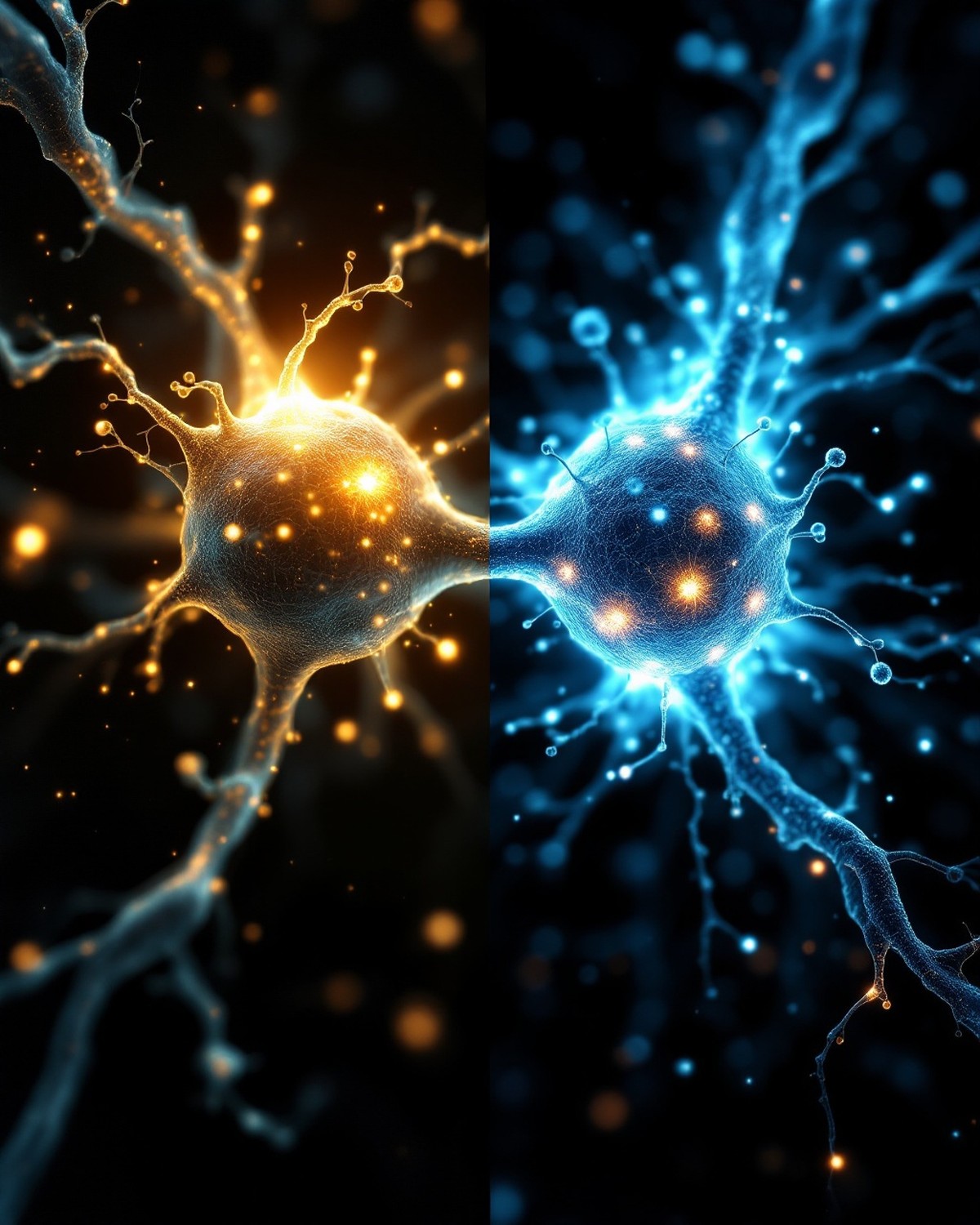
Cannabis and psilocybin are the two substances most likely to come up when someone asks what a “natural” mind-altering plant actually does to the brain. They are routinely lumped together — both botanical, both ancient, both riding a wave of decriminalization and medical interest. But at the level of neuroscience they could hardly be more different. They act on separate receptor systems, produce opposite kinds of change in cortical activity, and sit at different points on the road from folk remedy to approved medicine. This is not a story about which one is better; it is a story about how two unrelated molecules rewire experience through two unrelated mechanisms.
OOTW has covered each on its own: The Neuroscience of THC: How Cannabis Works and Your Brain on Psilocybin. This piece sets them side by side — not to crown a winner, but to make the contrast legible.
This piece discusses depression, anxiety, PTSD, addiction, psychosis risk, and cardiovascular and psychological hazards. If you are in crisis, contact a local emergency line or the 988 Suicide and Crisis Lifeline in the US.
The comparison at a glance
| Dimension | Cannabis (THC) | Psilocybin |
|---|---|---|
| System | Endocannabinoid system | Serotonergic system |
| Primary target | CB1 receptor (partial agonist); also CB2 | 5-HT2A receptor (via active metabolite psilocin) |
| Core action | Retrograde signaling; dampens GABA/glutamate release | Cortical excitation; raises neural entropy, loosens DMN |
| Active form | THC (11-hydroxy-THC after oral use) | Psilocin (after dephosphorylation of psilocybin) |
| Net effect on brain | Quiets/blurs circuits (memory, mood, appetite) | Excites/destabilizes and reorganizes networks |
| Typical use | Titrated by potency (~20–28% flower; concentrates 80–95%) | Fixed dose ~15–30 mg (25 mg in trials) |
| Onset / duration | Inhaled: minutes, 2–4 h; oral: 30–120 min, 6–8 h | 20–40 min onset; 4–6 h total |
| Acute experience | Relaxation/euphoria, altered time, appetite, memory impairment; anxiety dose-dependent | Perceptual change, introspection, emotion, ego dissolution at high dose |
| Tolerance | Builds with chronic use (CB1 downregulation) | Very rapid (tachyphylaxis; 5-HT2A downregulation) |
| Dependence | Cannabis use disorder real (~3 in 10 users; DSM-5) | Low dependence liability; no classic withdrawal |
| Neuroplasticity | eCB system regulates plasticity; THC tends to blunt it | Acute dendritic-spine growth via BDNF/mTOR (preclinical) |
| Best clinical evidence | Chronic pain, chemo nausea, MS spasticity; CBD for epilepsy | Phase 3 depression (COMP360); end-of-life distress; addiction signals |
| Weak/mixed evidence | Anxiety, PTSD, sleep (2026 meta-analysis: no clear benefit) | Broad efficacy beyond mood/addiction still early |
| Key risks | CUD, biphasic anxiety, psychosis link, CHS, cardiovascular | Challenging experiences, rare HPPD; psychosis/bipolar contraindication |
| Legal status (2026) | Medical → Schedule III; recreational/other → Schedule I; state patchwork | Schedule I federally; regulated in Oregon & Colorado |
Two systems, not one doorway
Most psychedelic comparisons are family arguments — two tryptamines, two 5-HT2A agonists, cousins reaching the same receptor by different routes. This one is not. Cannabis and psilocybin belong to different neurochemical systems entirely, and holding that fact in view explains almost everything downstream. THC engages the endocannabinoid system, a lipid-signaling network the brain uses to regulate its own activity. Psilocybin engages the serotonergic system, specifically the 5-HT2A receptor that defines the classic psychedelics (Nichols, Pharmacol Rev 2016). One is a modulator; the other is a driver. That single divergence propagates through their mechanisms, their subjective effects, their risks, and their medical uses.
Cannabis: borrowing the brain’s volume knob
Delta-9-tetrahydrocannabinol (THC) is a partial agonist at the cannabinoid receptor type 1 (CB1), the most widely expressed G-protein-coupled receptor in the human brain (it also binds CB2, concentrated in immune tissue). “Partial” is the whole personality of the drug: THC nudges CB1 rather than slamming it, which underlies both its ceiling effects and its relatively forgiving safety margin. The receptors evolved for the brain’s own cannabinoids — anandamide and 2-AG — which work through an unusual trick called retrograde signaling: made on demand in the postsynaptic neuron, they drift backward across the synapse and bind CB1 on the presynaptic terminal to turn down its release of neurotransmitters, including GABA and glutamate (Castillo et al., Neuron 2012). The system is a precise, local, self-limiting volume knob. THC overrides it — flooding CB1 receptors everywhere at once, for hours. Because CB1 is dense in the hippocampus, cerebellum, and cortex but sparse in the brainstem, cannabis reliably impairs short-term memory and coordination yet very rarely suppresses breathing — the neuroscientific reason for its low overdose lethality.
Psilocybin: flipping the cortical switch
Psilocybin is a prodrug: essentially inert until the body strips off a phosphate group to yield psilocin, the molecule that does the work (Holze et al., Clin Pharmacol Ther 2023). Psilocin is an agonist at the 5-HT2A serotonin receptor, densely expressed on layer-5 pyramidal neurons in the cortex. Switching it on does the opposite of THC’s dampening: it excites these neurons, raising cortical activity and neural entropy — brain activity becomes less predictable and more diverse — and loosening the default mode network, the tightly coupled circuit tied to self-referential thought (Carhart-Harris et al., PNAS 2012). A 2024 precision-fMRI study captured the scale of this, showing psilocybin desynchronizing brain networks far more than a stimulant control, with effects strongest in the default mode network (Siegel et al., Nature 2024). Where cannabis quiets and blurs, psilocybin destabilizes and reorganizes.
Precisely-Dosed Psilocybin Mushroom TreatsOOTW Psilocybin Mushroom Treats
Precisely-dosed, lab-tested, quality psilocybin mushroom treats — crafted for daily ritual, neural support, and sustained clarity. Journal readers: 10% off your first order with code JOURNAL10 (applied automatically at checkout).
Claim 10% Off →The experience: relaxation versus revelation
The phenomenology follows the pharmacology. Cannabis typically produces relaxation or euphoria, altered time perception, heightened appetite, and — its most reliable cognitive signature — impaired formation of new short-term memories during intoxication. Crucially, its effect on anxiety is biphasic and dose-dependent: lower doses can feel calming while higher doses reliably provoke anxiety, paranoia, and panic, a curve that quietly indicts today’s high-potency products. Psilocybin produces something categorically different — perceptual changes, intensified emotion, deep introspection, and, at higher doses, the dissolution of the ordinary sense of self (“ego dissolution”) and experiences many rate as among the most personally meaningful of their lives. One is broadly a relaxant with perceptual coloring; the other is a full alteration of consciousness.
Duration, dosing, and pharmacokinetics
Route rewrites both drugs. Inhaled cannabis reaches the brain within minutes, peaks fast, and fades over two to four hours; oral cannabis passes through the liver first, where a large fraction becomes 11-hydroxy-THC — itself psychoactive and often stronger — so edibles hit late (30–120 minutes) and hard, the classic overconsumption trap. There is no single “dose”: modern flower averages roughly 20–28% THC and concentrates reach 80–95%, so potency, not milligrams, governs intensity (NIDA potency data). Psilocybin is dosed precisely — about 15–30 mg (25 mg in the pivotal depression trials) — with onset in 20–40 minutes and a full arc of 4–6 hours as psilocin clears within hours.
Tolerance and dependence: the clearest divide
Here the two part ways sharply. Chronic heavy THC exposure downregulates and desensitizes CB1 receptors, producing genuine tolerance and a withdrawal syndrome (irritability, sleep disruption, appetite loss) on cessation. Cannabis use disorder is a defined DSM-5 diagnosis and a common one: the CDC estimates it affects roughly 3 in 10 people who use cannabis, with risk climbing steeply for those who begin in adolescence or use daily (CDC, Cannabis Use Disorder). Psilocybin is almost the mirror image. It builds rapid tolerance — 5-HT2A receptors downregulate after a dose (tachyphylaxis), so a second day’s dose does little — which structurally discourages compulsive use, and it has low dependence liability, with no established withdrawal syndrome. Low dependence is not the same as harmless, but on the specific axis of addiction the drugs are not close.
AI That Understands The MedicineOOTW Spirit Guide
Set. Setting. Dose. Integration. The questions you can’t bring to your doctor — answered by an AI grounded in every peer-reviewed paper, protocol, and ceremony manual. Private, sober, always there.
Talk to the Spirit Guide → A Sacred 5-MeO-DMT Ceremony · MiamiJoin the OOTW Sacrament
The oldest prayer, remembered — the gentle dissolving of the self into light, held in ceremony by a master facilitator. Sit with our community first: a free, live weekly circle on Zoom. No commitment, simply a conversation.
Join the Weekly Circle →Neuroplasticity: the same word, two different routes
“Neuroplasticity” appears in the marketing for both, and here honesty matters. Psilocybin’s plasticity case is direct and increasingly well supported in preclinical work: a single dose drives rapid growth of dendritic spines in the frontal cortex — roughly a 10% increase in density within 24 hours, persisting about a month in mice (Shao et al., Neuron 2021) — through a 5-HT2A → BDNF/TrkB/mTOR signaling cascade shared across psychedelics (Ly et al., Cell Reports 2018). This acute pro-growth burst is the leading candidate mechanism for psilocybin’s durable antidepressant effects, though most direct evidence is still from animals. Cannabis reaches plasticity from the opposite direction: the endocannabinoid system is itself a master regulator of synaptic plasticity, but flooding CB1 with exogenous THC tends to override and blunt that precise, on-demand tuning rather than enhance it, and chronic or adolescent exposure is associated with impaired plasticity and cognition. Both touch plasticity — but psilocybin appears to acutely promote structural growth, while THC disrupts the brain’s own finely calibrated system.
The clinical scoreboard, honestly kept
The two lead in different arenas. For cannabinoids, the benchmark 2017 National Academies review found conclusive or substantial evidence in only three areas: chronic pain, chemotherapy-induced nausea and vomiting, and MS spasticity (NASEM 2017). The single most robust cannabis-derived medicine is purified CBD (Epidiolex), FDA-approved for rare epilepsies and essentially THC-free (FDA). Popular uses for anxiety, PTSD, and sleep are far weaker: a 2026 systematic review and meta-analysis of 54 randomized trials found no clear evidence that cannabis improves anxiety, depression, or PTSD (systematic review & meta-analysis, 2026).
Psilocybin leads in psychiatry. Its lead candidate, COMP360, followed a positive Phase 2b trial in treatment-resistant depression (Goodwin et al., NEJM 2022) with two positive Phase 3 trials; the second (COMP006, ~600 patients) met its primary endpoint in early 2026, and 26-week data confirmed a durable response, prompting the FDA to begin a rolling NDA review (Compass Pathways, 2026). Beyond depression, twin 2016 randomized trials showed large, sustained reductions in end-of-life anxiety and depression in cancer patients (Griffiths et al.; Ross et al. 2016), and controlled and pilot trials suggest benefit in alcohol use disorder (Bogenschutz et al., JAMA Psychiatry 2022) and smoking cessation (Johnson et al. 2014). Different problems, different evidence — and, tellingly, addiction is one place cannabis is a risk and psilocybin is a candidate treatment.
Risk profiles, told straight
Both are physiologically far safer than opioids, but their hazards differ. Cannabis carries dependence (above), a biphasic anxiety risk, and a contested but hardening link to psychosis: heavy, high-potency use is repeatedly associated with earlier onset of psychotic disorders, though cannabis appears to be a component cause among genetic vulnerability and other factors, not a sole one (Petrilli et al., Am J Psychiatry 2024). It is also linked to cannabinoid hyperemesis syndrome (AGA clinical update, 2024), and a growing body of observational data associates cannabis use with elevated cardiovascular events such as heart attack and stroke, albeit with confounding caveats (cardiovascular meta-analysis, Heart 2025). Psilocybin’s risks are chiefly psychological — the challenging experience (“bad trip”), transient blood-pressure rises, rare persistent perceptual changes (HPPD), and a firm contraindication in personal or family history of psychosis or bipolar disorder, where it can precipitate prolonged episodes. Both warrant caution with serotonergic and other psychiatric medications.
Precisely-Dosed Psilocybin Mushroom TreatsBring the Science Home
Every article here is the why. OOTW’s precisely-dosed, lab-tested, quality psilocybin mushroom treats are the how — crafted to carry the medicine into your daily practice. Journal readers: 10% off your first order with code JOURNAL10 (applied automatically at checkout).
Claim 10% Off →The law in 2026
The legal pictures diverged in 2026. Following a 2026 rescheduling action, the DEA placed FDA-approved and state-licensed medical cannabis into Schedule III — a historic downgrade — while leaving recreational cannabis and all other marijuana in Schedule I; a broader administrative hearing on rescheduling marijuana generally began in mid-2026 and remains unresolved (DOJ, 2026; Federal Register, 2026). On the ground, cannabis remains a state-by-state patchwork of medical and adult-use programs. Psilocybin remains Schedule I federally with no completed rescheduling, but is available through regulated service-center frameworks in Oregon (Measure 109) and Colorado (Proposition 122). None of this is legal advice — verify current law where you live.
There is no meaningful head-to-head trial comparing cannabis and psilocybin on any brain or clinical outcome. Everything here is a comparison of two separate literatures, drawn largely from different populations, doses, and study designs. The mechanistic contrast is well established; the clinical “scoreboard” reflects where research money and regulatory attention have gone, not a direct competition.
Which one, for whom?
Resist the urge to rank them; the useful question is fit. If the interest is symptom relief with an established evidence base — chronic pain, chemotherapy nausea, MS spasticity, or (as purified CBD) rare epilepsy — that is cannabinoid territory, with the caveat that potency, route, and dependence risk deserve respect and that many popular uses outrun the data. If the interest is a single, supervised, potentially transformative intervention for depression, end-of-life distress, or addiction, psilocybin is where the pivotal evidence is arriving now, in 2026. They are not competitors so much as tools built for different jobs by different systems: one that turns the brain’s volume down, and one that briefly rewires how it is tuned. It is fit, not a winner — and the most honest thing to say is that they were never really running the same race.
OOTW Journal is educational and does not provide medical advice. Cannabis and psilocybin both carry real risks, interact with psychiatric and serotonergic medications, and are contraindicated in some people; psilocybin should be avoided by anyone with a personal or family history of psychosis or bipolar disorder. Verify the law where you live.