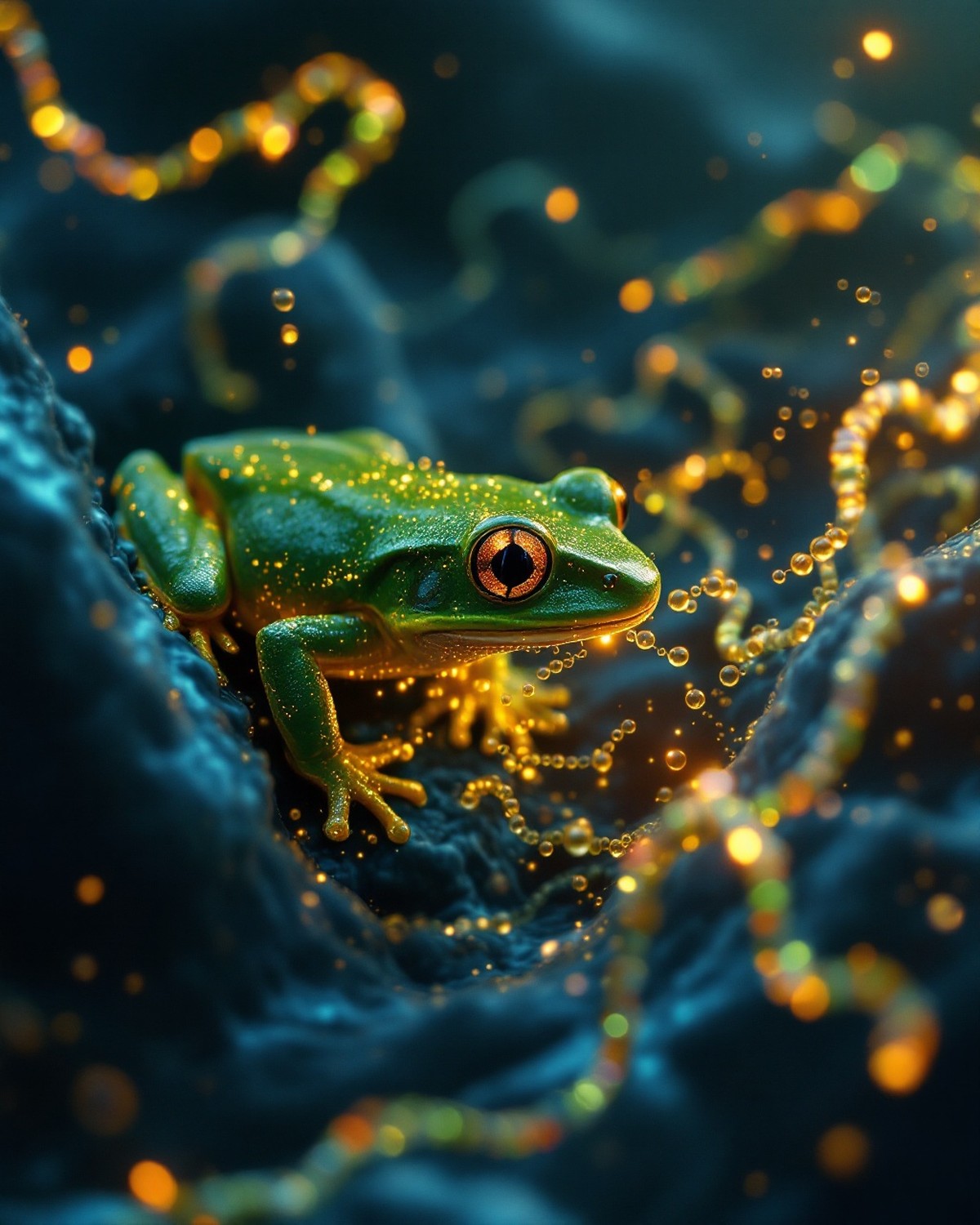
What is kambo? Kambo (also “sapo”) is the dried skin secretion of the Amazonian giant monkey frog, Phyllomedusa bicolor. In the ritual, small superficial burns are made on the skin and the reconstituted paste is dabbed on, sending a wave of bioactive peptides into the lymph and blood. It is not a psychedelic — there are no hallucinations. Instead it causes an intense, brief reaction: facial flushing, racing heart, a plunge in blood pressure, swelling, and forceful vomiting/purging, followed by an afterglow. The effects come from frog peptides — phyllocaerulein, phyllomedusin, phyllokinin, sauvagine, and the powerful opioids dermorphin and deltorphin — acting on the gut, cardiovascular, stress, and opioid systems. It has genuine indigenous roots as Amazonian “hunting magic,” but no clinical trials prove any medical benefit, and it carries real dangers: documented deaths, seizures from water intoxication, and cardiac and oesophageal injury. Education, not medical or use advice.
There is a corner of the psychedelic and sacred-medicine world that involves no psychedelics at all — and kambo sits at its strange, intense center. It is not eaten, not smoked, and not inhaled. It is burned into the skin: a practitioner touches a glowing vine-tip to the arm or leg, lifts off the top layer of skin, and smears on a paste made from the dried secretion of a large green Amazonian tree frog. Within seconds the body reacts as if it has met something genuinely dangerous, because in a sense it has. This is education, not medical advice — and kambo is a substance where that distinction matters more than almost anywhere else we write.
Kambo belongs to the same family of intense, ceremonial, purgative traditions as ayahuasca and the animal-derived medicines like 5-MeO-DMT from the Sonoran toad. But it is pharmacologically unique: where those work on the brain’s serotonin machinery, kambo works on the body — the gut, the blood vessels, the stress axis, and the opioid receptors. Understanding it means setting aside the language of “trips” entirely and looking at one of the most remarkable peptide cocktails in nature. (Educational overview only — not medical or use advice.)
What kambo actually is
Kambo is the dried defensive skin secretion of Phyllomedusa bicolor — the giant monkey frog or giant leaf frog, a large, lime-green, nocturnal tree frog found across the Amazon basin of Brazil, Peru, Colombia, Bolivia, and the Guianas. Like many amphibians, the frog produces a potent chemical cocktail in its skin as a defence against predators and microbes. Indigenous peoples learned to harvest that secretion, dry it onto sticks, and use it — and it is that dried material, reconstituted with a little water or saliva into a paste, that is called kambo (or, in some regions, sapo). Crucially, it is applied to the skin, not ingested: the peptides are too fragile to survive the stomach, so the ritual delivers them through fresh superficial burns straight into the lymphatic system and bloodstream (Schmidt et al., Scientific Reports, 2020).
The most important thing to say up front — because the marketing obscures it — is that kambo is not psychedelic. In the largest survey of users to date, researchers measured participants on standard altered-states and mystical-experience scales and found “no psychedelic-type distortions of perception or thinking” and no serotonergic activity (Schmidt et al., 2020). Whatever kambo is, it is not a cousin of psilocybin or LSD. It is a physiological event, not a visionary one.
The frog and the forest: indigenous origins
Kambo’s documented roots lie with indigenous peoples of the upper Amazon, most firmly the Matsés (also called Mayoruna) of the Peru–Brazil borderlands, with use also described among the Katukina, Kaxinawá (Huni Kuin), and Yawanawá. Traditionally it was hunting magic: taken before a hunt to sharpen the senses, steady the hands, increase stamina, and — in the indigenous framing — to strip away panema, a word originally meaning “bad luck in hunting” that urban practitioners have since broadened toward something like a spiritual heaviness or “laziness” (Schmidt et al., 2020). The scientific study of the frog itself began with the Italian pharmacologist Vittorio Erspamer, who in the late twentieth century isolated and named many of its peptides and recognised that this small frog carried a pharmacological library of startling potency.
One detail that matters ethically and ecologically: in the traditional practice the frog is not killed. It is gently tied by the limbs to four small stakes, the secretion is scraped from its back onto a wooden stick, and the animal is then released, physically unharmed (Williams, Swinburne / The Conversation, 2023). Phyllomedusa bicolor is currently listed as Least Concern by the IUCN, though the global spread of kambo tourism raises reasonable questions about pressure on wild populations and the welfare of the frogs.
The ritual: burns, water, and the purge
A kambo session follows a recognisable shape. The recipient typically drinks a quantity of water beforehand. The practitioner burns several small superficial points into the skin — on the arm, leg, or chest — using a smouldering stick or vine; the survey average was around seven points, though the number varies widely between traditional and neo-shamanic practice. The reconstituted kambo paste is dabbed onto these open points, and absorption begins almost immediately.
What follows is fast and physical. Within seconds to a couple of minutes come a rush of heat and facial flushing, a pounding, racing heart, and a dramatic drop in blood pressure that can cause dizziness or fainting, followed by a compensatory surge in heart rate. The face, lips, and eyelids often swell — practitioners nickname this “frog face.” Then the gut takes over: intense nausea, forceful vomiting, often diarrhoea, streaming eyes and nose. The acute phase is usually brief — on the order of five to thirty minutes, occasionally longer — after which the storm passes and many users report an afterglow of energy, lightness, and mental clarity (Thompson & Williams, Toxicology Research and Application, 2022). In the traditional frame, the purge is understood as expelling panema; in physiological terms, as we will see, it is the direct action of the frog’s peptides on the gut and blood vessels.
Precisely-Dosed Psilocybin Mushroom TreatsOOTW Psilocybin Mushroom Treats
Precisely-dosed, lab-tested, quality psilocybin mushroom treats — crafted for daily ritual, neural support, and sustained clarity. Journal readers: 10% off your first order with code JOURNAL10 (applied automatically at checkout).
Claim 10% Off →The pharmacology: a storm of peptides
Here is what makes kambo genuinely fascinating to a neuroscience-minded reader. Its effects are not mystical and they are not “toxins leaving the body” — they are precise peptide pharmacology, a coordinated assault on several of the body’s signalling systems at once. The secretion contains a suite of bioactive peptides, and each has a job (all figures and effects below from Thompson & Williams, 2022):
- Phyllocaerulein (a caerulein/CCK-type peptide) dilates blood vessels — driving the hypotension and reflex tachycardia — and powerfully stimulates gastric and pancreatic secretion while contracting the stomach, gall bladder, and gut. It is a key engine of the early nausea and vomiting.
- Phyllomedusin (a tachykinin, acting on NK1 receptors) produces strong vasodilation and hypotension and lights up the salivary glands, tear ducts, and intestines — the streaming eyes, runny nose, and bowel-emptying. P. bicolor carries far more of it than related frogs.
- Phyllokinin (a bradykinin-related peptide, B2 receptors) drops blood pressure and increases the leakiness of capillaries — both helping the other peptides cross into the blood at the burn sites and producing the heat, redness, and facial oedema of “frog face.”
- Sauvagine resembles corticotropin-releasing factor (CRF), the master hormone of the stress axis; in animals it raises ACTH, cortisol, catecholamines, glucose, and beta-endorphins, and prolongs the blood-pressure drop.
- Dermorphin is an extraordinarily potent mu-opioid agonist — estimated at 40 to 1000 times the potency of morphine depending on the tissue — and deltorphin I and II are among the most selective delta-opioid agonists known. These opioid peptides likely contribute to the analgesia, the afterglow, and some of the nausea.
- Dermaseptins and adenoregulin are broad-spectrum antimicrobial peptides — the source of much of the “natural antibiotic” hype, though their real clinical relevance from a brief skin application is unproven.
Erspamer’s most celebrated discovery was structural: the opioid peptides dermorphin and deltorphin contain a D-amino acid — a mirror-image building block almost unheard of in animal proteins — at the second position (Erspamer et al., PNAS, 1989). That unusual residue makes these opioids far more resistant to enzymatic breakdown than ordinary peptides, which is exactly why they remain such attractive templates for drug design. It is worth being precise, though: kambo’s peptides as a group are still short-lived and act only briefly at low systemic concentrations. The intense purge is the peptides working on the body for a few minutes — not a mystical “detox.”
Not a psychedelic — and not “toxins leaving the body”
Two myths are worth dismantling directly. The first is that kambo is some kind of powerful hallucinogen; it is not, and the data are clear that it produces no perceptual or thought distortions and engages no serotonergic pathway — the opposite of the classic psychedelics that act on the 5-HT2A receptor. The second is that the vomiting represents “purging toxins.” The vomiting is a direct pharmacological effect of phyllocaerulein and the tachykinins on the gut and brainstem — a peptide-triggered reflex, not evidence of poison being cleansed. Naming the mechanism honestly does not diminish the experience; it just replaces folklore with physiology.
AI That Understands The MedicineOOTW Spirit Guide
Set. Setting. Dose. Integration. The questions you can’t bring to your doctor — answered by an AI grounded in every peer-reviewed paper, protocol, and ceremony manual. Private, sober, always there.
Talk to the Spirit Guide → A Sacred 5-MeO-DMT Ceremony · MiamiJoin the OOTW Sacrament
The oldest prayer, remembered — the gentle dissolving of the self into light, held in ceremony by a master facilitator. Sit with our community first: a free, live weekly circle on Zoom. No commitment, simply a conversation.
Join the Weekly Circle →The experience: intense, brief, and not for everyone
Users consistently describe kambo as one of the most physically intense experiences they have had — and also one of the shortest. The reaction crescendos quickly, the purge arrives, and within a half hour or so the acute phase subsides, often into a reported sense of lightness, energy, and clarity. Advocates value it precisely for that contrast: a brief ordeal followed by a clear-headed afterglow. But it is emphatically not a gentle wellness ritual. The cardiovascular swing alone — a sharp drop in blood pressure followed by racing heart — is a serious stress on the body, and the intensity that enthusiasts prize is the same intensity that makes kambo dangerous for the wrong person in the wrong setting.
The danger is real: water, the heart, and death
This is the part the marketing tends to skip, and it is the reason we treat kambo with unusual caution. Documented case reports link kambo participation to hepatitis, psychosis, prolonged vomiting, hyponatremia, seizures, oesophageal rupture, cardiac arrest — and death (Thompson & Williams, 2022; Williams, 2023). Two mechanisms of serious harm stand out.
Water intoxication (hyponatremia / SIADH). The single best-documented lethal pathway has nothing to do with the frog directly and everything to do with the pre-ritual water drinking. Practitioners often instruct participants to drink large volumes of water, and kambo’s peptides can drive the body to retain that water (the syndrome of inappropriate antidiuretic hormone secretion, SIADH). The result is dangerously diluted blood sodium, which swells the brain. In a 2016 case in Toxicon, a woman who drank roughly six litres of water during a kambo ritual developed severe hyponatremia with confusion, seizure, and loss of consciousness before being corrected (Leban et al., Toxicon, 2016). In 2025, physicians reported the first case of kambo-linked brain death from exactly this cascade — overhydration, hyponatremia, and fatal cerebral oedema (Cureus, 2025).
Cardiac and oesophageal injury. In Australia, two deaths brought kambo into the courts and the headlines: Natasha Lechner, 39, died during a home kambo session in 2019 after an acute cardiac event, and Jarrad Antonovich, 46, died in 2021 with an inquest pointing to a perforated oesophagus, likely caused by the violent vomiting. A 2025 systematic review of kambo-associated fatalities underscored the pattern — sudden cardiac death and oesophageal rupture against a backdrop of tachycardia, blood-pressure swings, and gastrointestinal distress (Cureus systematic review, 2025). People with heart conditions, and anyone pregnant or on interacting medications, are at particular risk, and there is no antidote once a reaction goes wrong.
And the benefit side of that ledger? As of 2026 there are still no controlled clinical trials demonstrating that kambo treats any disease. The health claims — that it cures depression, addiction, chronic illness, or “cleanses” the body — remain anecdotal. That combination, real and occasionally fatal risk against unproven benefit, is why we cover kambo as a subject to understand rather than a practice to recommend. (Educational context only — not medical or use advice.)
Precisely-Dosed Psilocybin Mushroom TreatsBring the Science Home
Every article here is the why. OOTW’s precisely-dosed, lab-tested, quality psilocybin mushroom treats are the how — crafted to carry the medicine into your daily practice. Journal readers: 10% off your first order with code JOURNAL10 (applied automatically at checkout).
Claim 10% Off →Legality in 2026
Kambo occupies a legal grey zone that varies sharply by country. In the United States it contains no scheduled compounds and is not federally controlled, which leaves it largely unregulated — practitioners operate in the same murky space as other alternative treatments, and enforcement has generally come through practising-medicine-without-a-license or health-claim rules rather than drug law. U.S. authorities have, however, warned about the risks: the U.S. Embassy in Peru issued a health alert in January 2025 advising citizens against kambo and ayahuasca. Australia went furthest: after the deaths noted above, the Therapeutic Goods Administration listed kambo as a Schedule 10 poison in October 2021 — a category reserved for substances “of such danger to health as to warrant prohibition” — effectively banning it (The Guardian, 2021). Even in Brazil, kambo’s homeland, its commercial marketing is restricted. Elsewhere the picture is patchy and evolving. (Verify current law where you live; this is not legal advice.)
The honest bottom line
Kambo is one of the most striking substances in the whole sacred-medicine landscape precisely because it breaks the usual rules. It is not a psychedelic. It produces no visions. Its power is not in the mind but in the body — a brief, brutal, tightly choreographed peptide storm that a green Amazonian frog evolved to repel predators, repurposed by human beings into ritual. The science is genuinely remarkable: dermorphin and deltorphin rank among the most potent and selective opioids ever found, and the frog’s antimicrobial peptides remain of real research interest. But the honest reckoning has two sides. The traditional lineage is real and deserves respect; the modern wellness framing that sells kambo as a safe, cleansing cure-all is not. There are documented deaths, a plausible and preventable water-intoxication mechanism, real cardiac and oesophageal risk, and no clinical evidence of benefit. Understand the frog medicine for the extraordinary piece of natural pharmacology it is — and take its dangers exactly as seriously as the pharmacology deserves.
OOTW Journal is educational and does not provide medical advice.Kambo is a physically intense practice with documented serious harms, including hyponatremia from over-drinking water, seizures, cardiac events, oesophageal rupture, and death. It is banned in some jurisdictions and has no proven medical benefit. It should never be combined with excessive water loading, and it is especially dangerous for people with heart conditions, those who are pregnant, or those on interacting medications. This article is not a guide to using any substance. If you are in crisis, contact a local emergency line or the 988 Suicide and Crisis Lifeline (US).