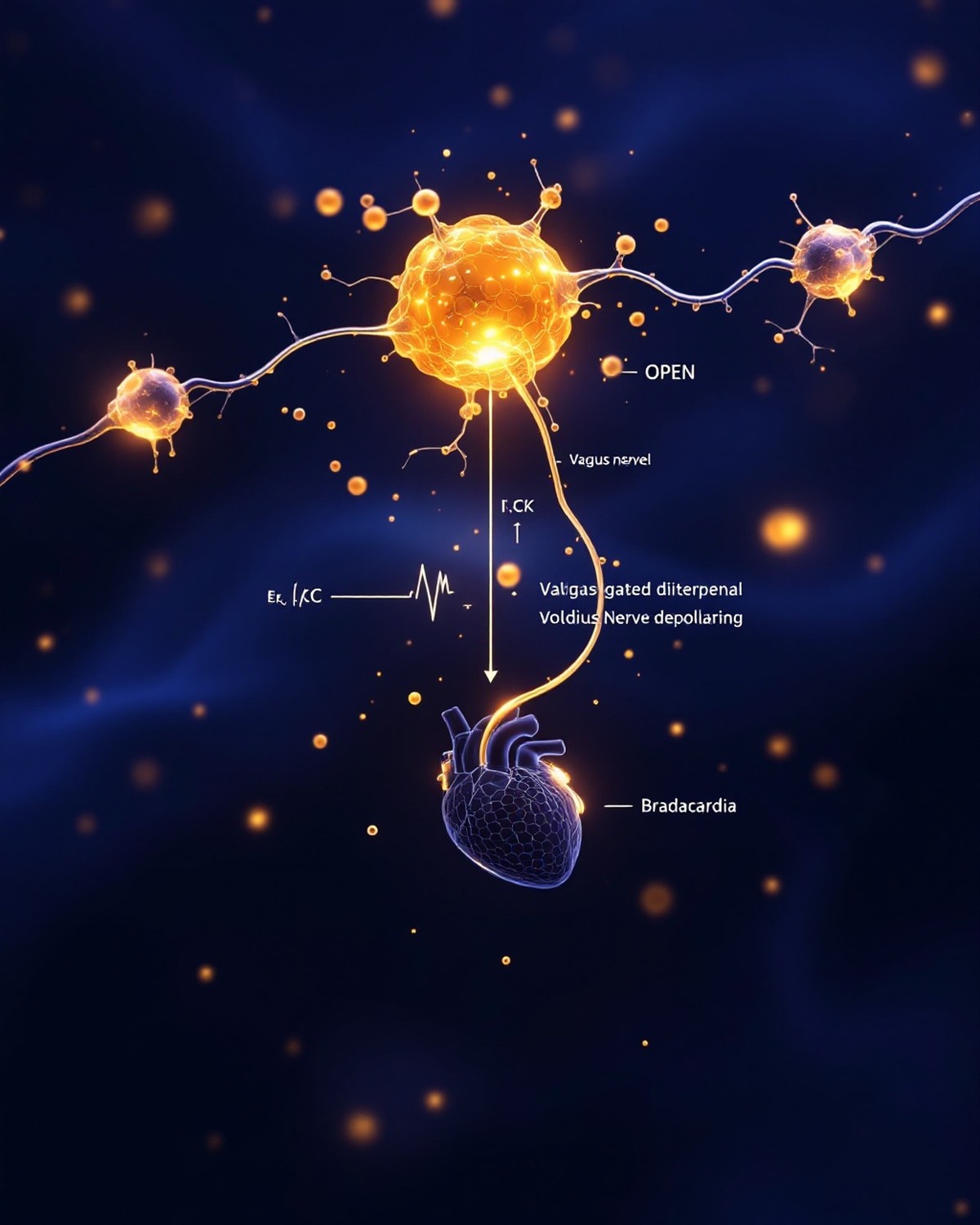
What is mad honey? It is honey made by bees that forage on the nectar of certain Rhododendron flowers (notably R. ponticum and R. luteum), which carries plant toxins called grayanotoxins. Known as “deli bal” in Turkey, it is sought for a mild drunken “buzz” — but it is really a cardiotoxin, not a classic psychedelic. Grayanotoxins bind voltage-gated sodium channels and hold them open, over-firing the vagus nerve. Low doses cause dizziness, tingling and euphoria; higher doses cause vomiting, a slow heart rate (bradycardia) and dangerously low blood pressure, sometimes fainting or heart block. It usually resolves within about a day, and deaths are rare — but the dose is wildly unpredictable, so it lands people in the emergency room. Education, not medical or use advice.
There is a honey that can make you hallucinate, slow your heart to a crawl, and drop your blood pressure through the floor — and people have been eating it, on purpose and by accident, for at least 2,400 years. It looks like ordinary honey, a little darker and more bitter. But it is made by bees foraging on the flowers of certain rhododendrons, and it carries their toxin into the comb. The Turks call it deli bal — “mad honey” — and its story runs from ancient war zones to Himalayan cliff faces to modern hospital wards.
Mad honey sits alongside the other strange natural intoxicants we have covered — the blue lotus, the kambo frog, the ergot fungus — substances that are as much natural history as pharmacology. But mad honey is unusual even in that company, because its danger and its allure come from the same molecule. Here is how it works, where it comes from, and why it is genuinely more dangerous than it sounds. (Educational overview only — not medical or use advice.)
What mad honey actually is
Honey is only ever as safe as the flowers the bees visit. Most nectar is harmless, but the nectar of certain Rhododendron species contains grayanotoxins — and when bees concentrate that nectar into honey, the toxin comes with it. The bees themselves are essentially unaffected; the danger is entirely for whoever eats the honey. The species that matter most are Rhododendron ponticum and Rhododendron luteum, which grow densely around the Black Sea coast of Turkey and the Caucasus, and related rhododendrons in the Himalayas. The resulting honey is darker, reddish, and slightly bitter, and in Turkey it has its own name: deli bal, mad honey (Wikipedia: Mad honey).
The toxin: grayanotoxin
The active agents are grayanotoxins — a family of over two dozen diterpene molecules the rhododendron plant produces. Two forms do most of the damage: grayanotoxin I (also called andromedotoxin or acetylandromedol) and grayanotoxin III. Unlike the classic psychedelics, these are not nitrogen-containing alkaloids and they do not act on serotonin receptors. They are neurotoxins and cardiotoxins, and they work on one of the most fundamental machines in the body: the voltage-gated ion channel that lets nerves and muscles fire (Wikipedia: Grayanotoxin).
The mechanism: switches jammed open
Every nerve impulse and heartbeat depends on voltage-gated sodium channels that snap open to fire and then quickly inactivate to reset. Grayanotoxins bind to a specific site on these channels — the same site targeted by toxins like aconitine and batrachotoxin — but only when the channel is already open, and once bound they prevent it from inactivating. The switch is jammed on. Sodium keeps pouring in, the cell stays persistently depolarized, and nerves and muscle cells fire uncontrollably (Jansen et al., 2012). The body’s response is dominated by the vagus nerve — the great parasympathetic nerve to the heart — which fires excessively and, through M2 muscarinic receptors, slams the brakes on the heart. That vagal over-activation is why the two most reliable signs of mad-honey poisoning are a slow heart rate and low blood pressure, and why the antidote is atropine, a drug that blocks exactly those muscarinic receptors (Gunduz et al., 2023).
Precisely-Dosed Psilocybin Mushroom TreatsOOTW Psilocybin Mushroom Treats
Precisely-dosed, lab-tested, quality psilocybin mushroom treats — crafted for daily ritual, neural support, and sustained clarity. Journal readers: 10% off your first order with code JOURNAL10 (applied automatically at checkout).
Claim 10% Off →What it actually does to you
The effects are steeply dose-dependent — and because grayanotoxin content varies enormously, the same spoonful can be trivial or dangerous. At low doses, people report a mild drunken feeling: dizziness, lightheadedness, tingling and numbness (often around the mouth and hands), sweating, and a euphoric “buzz” with altered perception. This is the effect a few thrill-seekers actually chase. At higher doses, the picture turns medical: nausea and vomiting, excessive salivation, blurred or double vision, and then the cardiovascular signature — bradycardia, hypotension, fainting, and heart-rhythm disturbances including atrioventricular block. In the largest pooled review of 900 cases, bradycardia appeared in about 88% and hypotension in about 76%; severe cases can bring on seizures (Gunduz et al., 2023). Despite the “hallucinogenic honey” branding, frank hallucinations are relatively uncommon; the dependable effect is on the heart, not the visual field. Mad honey is best understood as a cardiotoxin and deliriant, not a serotonergic psychedelic.
The ancient honey traps
Mad honey has one of the best-documented histories of any intoxicant, because it kept showing up in war. The earliest account is Xenophon’s Anabasis (401 BC): as his “Ten Thousand” Greek soldiers retreated along the Black Sea near Trabzon, they raided local hives and ate the honey — and the whole camp went down. Those who ate a little seemed drunk; those who ate a lot behaved like madmen or lay as if dead. There were no fatalities; the army recovered in a few days and marched on (Xenophon, Anabasis 4.8). Roughly three centuries later, the same honey became a deliberate weapon. During the Third Mithridatic War (first century BC), allies of King Mithridates known as the Heptakometes reportedly left combs of mad honey along a path where Pompey’s Roman soldiers would find them; the troops ate it, collapsed, and were attacked — Strabo claims three Roman units were wiped out (Turner, 2023). (The exact date and casualty figures come from ancient historians and should be read as such, but the episodes themselves are genuine ancient accounts.)
AI That Understands The MedicineOOTW Spirit Guide
Set. Setting. Dose. Integration. The questions you can’t bring to your doctor — answered by an AI grounded in every peer-reviewed paper, protocol, and ceremony manual. Private, sober, always there.
Talk to the Spirit Guide → A Sacred 5-MeO-DMT Ceremony · MiamiJoin the OOTW Sacrament
The oldest prayer, remembered — the gentle dissolving of the self into light, held in ceremony by a master facilitator. Sit with our community first: a free, live weekly circle on Zoom. No commitment, simply a conversation.
Join the Weekly Circle →From Turkish cliffs to Himalayan hunts
Mad honey is still very much a living tradition. The heart of production is the Black Sea region of Turkey, where deli bal from R. ponticum and R. luteum is harvested and sold. The other great source is Nepal, where the enormous Himalayan giant honeybee (Apis laboriosa) builds its nests on sheer cliff faces, and the Gurung honey hunters climb hundreds of feet on handmade rope ladders through smoke and swarming bees to cut the combs down — a breathtaking, genuinely dangerous practice that has become one of the most photographed rituals on Earth. The spring honey from high rhododendron slopes is the most potent, and the most prized (Wikipedia: Mad honey).
Why people still eat it
Despite — or because of — its edge, mad honey is used as a folk medicine across its range: for high blood pressure, diabetes, stomach complaints, sore throats and arthritis, taken in tiny amounts, usually a spoonful on an empty stomach. It is also widely sold as an aphrodisiac and sexual-performance enhancer, and it is precisely this use that drives most modern poisonings: the documented victims are overwhelmingly middle-aged men who took too much chasing that effect (Wikipedia: Grayanotoxin). None of these traditional medicinal claims are proven; what is proven is that the honey causes real poisonings. Systematic reviews have compiled well over a thousand documented cases, the great majority traced to honey from Turkey, with the rest largely from Nepal and from imported honey turning up in Europe, Korea, Hong Kong and the US (Gunduz et al., 2023).
Precisely-Dosed Psilocybin Mushroom TreatsBring the Science Home
Every article here is the why. OOTW’s precisely-dosed, lab-tested, quality psilocybin mushroom treats are the how — crafted to carry the medicine into your daily practice. Journal readers: 10% off your first order with code JOURNAL10 (applied automatically at checkout).
Claim 10% Off →The real danger
Here is the honest safety picture. Mad honey is a genuine cardiac toxin, and its most dangerous feature is not potency but unpredictability. Grayanotoxin content swings wildly with the rhododendron species, the season, the elevation, and even from one part of a comb to another — and raw, single-hive honey is far stronger than blended commercial honey, which dilutes any toxin. There is simply no way for a consumer to know how much they are taking. Deaths are rare in the modern era — one review of 1,199 cases recorded none — but “rare” is not “harmless”: the profound bradycardia, hypotension and heart block that mad honey causes are dangerous, land people in emergency rooms, and can be fatal, especially in older people or those with heart conditions (Silici & Atayoglu, 2015). (Educational context only — not medical or use advice.)
Treatment
Mad-honey poisoning is very treatable, which is part of why it is so rarely fatal today. The mainstay is supportive care with cardiac monitoring. Because the poisoning is driven by vagal over-activation, atropine — which blocks the muscarinic receptors the vagus acts through — reliably reverses the dangerous slow heart rate, and intravenous fluids and, if needed, vasopressors restore blood pressure. Since the effect is self-limiting as the toxin clears, most patients recover fully within a day (Wikipedia: Mad honey). The key, as with so many natural intoxicants, is recognising what is happening — a mysterious sudden bradycardia after eating exotic honey is a classic, and easily missed, presentation.
The honest bottom line
Mad honey is a small marvel of natural chemistry: a plant toxin, ferried by bees into something as innocent as honey, that reaches straight into the electrical machinery of your nerves and heart. It has drunk armies into the ground, been laid as a trap for legions, and is still cut from Himalayan cliffs today. But strip away the “hallucinogenic honey” romance and what remains is a cardiotoxin with a narrow, unknowable margin — the buzz and the danger are the same molecule, and there is no way to taste the difference. It is a fascinating thing to understand, and a genuinely risky thing to eat.
OOTW Journal is educational and does not provide medical advice.Mad honey contains grayanotoxins that can cause dangerous slowing of the heart, very low blood pressure, fainting, and heart-rhythm disturbances; the dose is unpredictable and it can be especially hazardous for older people and anyone with heart disease. This article is not a guide to using any substance. If you or someone else may have mad-honey poisoning — unexplained dizziness, fainting or a very slow heartbeat after eating honey — seek emergency medical care.