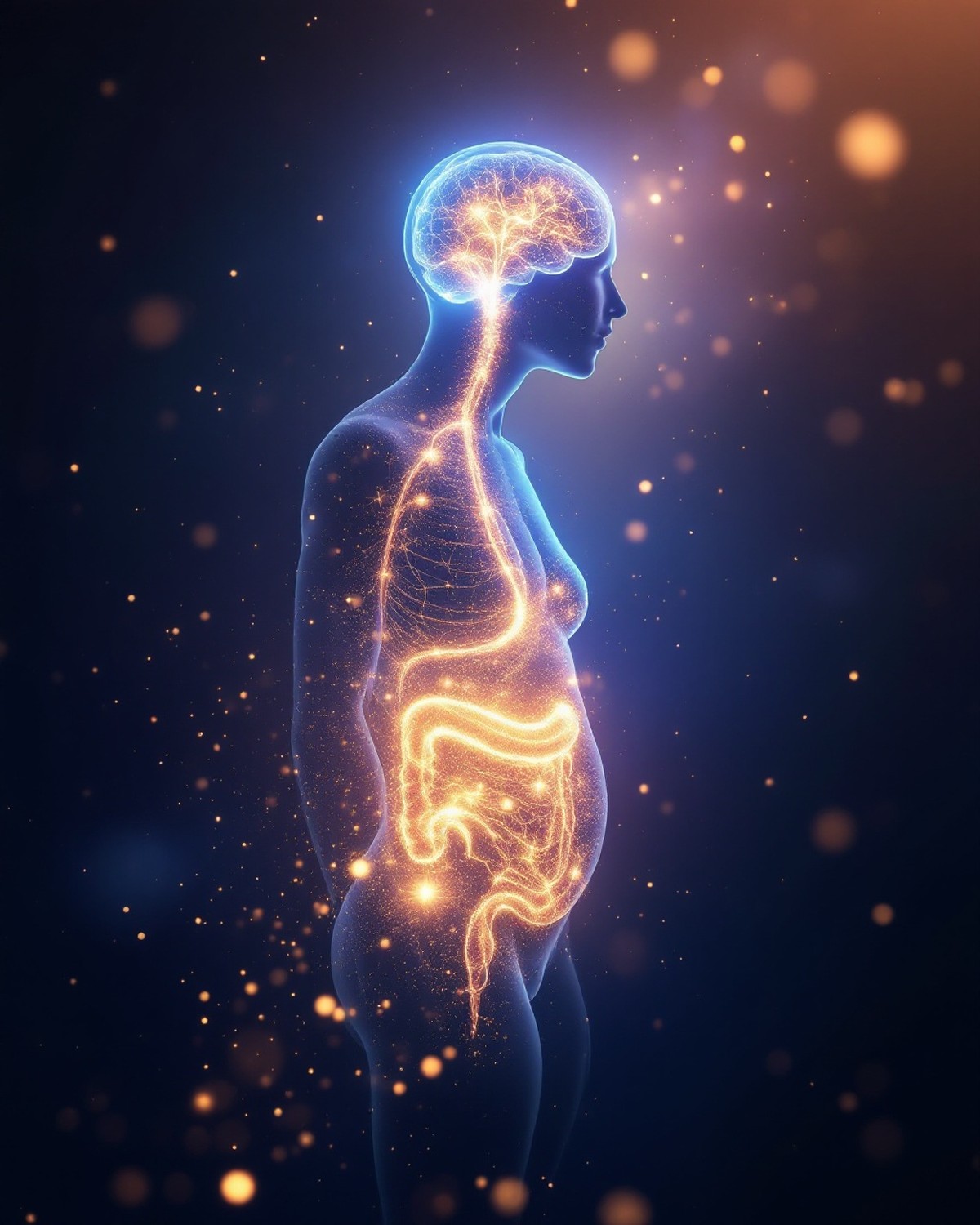
Do psychedelics act on the gut, not just the brain? Almost certainly yes. Roughly 90–95% of the body’s serotonin is made and stored in the gut, home to an enteric nervous system of about 100 million neurons — the “second brain.” Psilocybin is a broad serotonin agonist, and serotonin receptors (including the 5-HT2A receptor) are densely expressed in the gut. Activating them there may signal the brain through the vagus nerve, and the gut microbiome appears to influence 5-HT2A density — meaning your microbes may help shape your response. Gut inflammation is tightly linked to depression, one of the conditions psychedelics are trialed for.
There is a reason we say we “trust our gut,” feel butterflies before something big, or get sick to our stomach with dread. The gut is not a passive tube; it is a sensing, signaling, feeling organ wired directly into the brain. And when it comes to psychedelics — which work through the exact chemical the gut traffics in more than any other — ignoring the belly means missing half the story. The frontier of psychedelic science is quietly moving downward, from the cortex to the colon. Here is why.
The second brain, explained
Lining your gastrointestinal tract, from esophagus to rectum, is the enteric nervous system (ENS) — a mesh of roughly 100 million neurons woven into the gut wall. That is more neurons than in the spinal cord. The ENS can run digestion largely on its own, without instructions from the brain, which is why it earned the nickname the “second brain.” It senses stretch, chemistry, and the presence of microbes; it releases neurotransmitters; and it talks constantly to the head. The single most important fact for our purposes: the gut is the body’s great reservoir of serotonin. Depending on the estimate, 90 to 95% of all the serotonin in your body is found there — not floating in your cortex, but working in your bowels, where it helps orchestrate gut movement, secretion, and signaling.
Why this matters for psychedelics
Here is where it becomes striking. Psilocybin and the other classic psychedelics work by activating serotonin receptors — above all the 5-HT2A receptor. We usually picture that happening in the cortex. But serotonin receptors, including 5-HT2A, are expressed densely throughout the gut, and psilocybin, taken orally, passes directly through that serotonin-rich tissue. In other words, a psychedelic does not politely skip the gut on its way to the brain — it bathes the second brain in a signal it is exquisitely tuned to receive. A growing view in the field is that some of a psychedelic’s effects on mood and even on cortical plasticity may be initiated in the gut and relayed upward, not generated in the head alone.
Precisely-Dosed Psilocybin Mushroom TreatsOOTW Psilocybin Mushroom Treats
Precisely-dosed, lab-tested, quality psilocybin mushroom treats — crafted for daily ritual, neural support, and sustained clarity. Journal readers: 10% off your first order with code JOURNAL10 (applied automatically at checkout).
Claim 10% Off →The vagus nerve: the superhighway
How would a signal in the gut reach the mind? Through the vagus nerve — the long, wandering cranial nerve that connects the brainstem to the heart, lungs, and gut, and the main physical cable of the gut–brain axis. Crucially, the vagus is mostly a bottom-up road: the large majority of its fibers carry information from the body to the brain, not the other way around. When gut serotonin receptors are activated, they can stimulate vagal signaling, and that vagal input is known to influence mood circuits — which is exactly why electrical vagus nerve stimulation is an approved treatment for hard-to-treat depression. The emerging hypothesis is that psilocybin’s activation of gut serotonin receptors could send a wave up the vagus nerve, nudging the very brain networks that psychedelic therapy aims to reach. The belly rings the bell; the brain hears it.
The microbiome: your inner ecosystem
Now add the trillions of bacteria living in your gut — the microbiome. Gut microbes help regulate how much serotonin the gut produces, and, remarkably, specific bacterial populations have been associated with the density of 5-HT2A receptors — the psychedelic’s main target. Researchers have started calling this intersection the “psilocybiome.” The implication is provocative: because your microbiome is as individual as a fingerprint, it may partly explain why the same dose lands so differently for different people — why one person melts open and another feels little. Set and setting shape the experience from the outside; your inner ecosystem may be shaping it from within. This is early, hypothesis-stage science — but it reframes the body as an active participant, not a passive vessel.
AI That Understands The MedicineOOTW Spirit Guide
Set. Setting. Dose. Integration. The questions you can’t bring to your doctor — answered by an AI grounded in every peer-reviewed paper, protocol, and ceremony manual. Private, sober, always there.
Talk to the Spirit Guide → A Sacred 5-MeO-DMT Ceremony · MiamiJoin the OOTW Sacrament
The oldest prayer, remembered — the gentle dissolving of the self into light, held in ceremony by a master facilitator. Sit with our community first: a free, live weekly circle on Zoom. No commitment, simply a conversation.
Join the Weekly Circle →Inflammation, mood, and the healing link
The gut–brain axis also runs through the immune system. A disrupted gut — dysbiosis — drives low-grade inflammation, and inflammation is now firmly linked to depression. Tellingly, disturbances in gut–brain signaling show up across the very conditions psilocybin is being trialed for: depression, anxiety, addiction, and anorexia. That overlap is a clue. If psychedelics can act on gut serotonin, calm inflammatory signaling, and re-tune the vagal conversation between belly and brain, then part of their therapeutic power may be working from the bottom up — healing the mind partly by way of the body that carries it. It fits a larger theme in this journal: the psychedelic state is not just a brain event, it is a whole-system one.
Precisely-Dosed Psilocybin Mushroom TreatsBring the Science Home
Every article here is the why. OOTW’s precisely-dosed, lab-tested, quality psilocybin mushroom treats are the how — crafted to carry the medicine into your daily practice. Journal readers: 10% off your first order with code JOURNAL10 (applied automatically at checkout).
Claim 10% Off →What the nausea is telling you
This finally makes sense of the most physical part of the psychedelic experience. The nausea before a mushroom trip, the churning stomach, ayahuasca’s famous purge (“la purga”) — these aren’t just side effects to endure. They are the second brain responding, a gut lit up with serotonin activity, a body registering the medicine before the visions arrive. Traditional cultures have always treated the purge as meaningful — a release, a cleansing — and the gut–brain science gives that intuition a physiological spine. The butterflies, the queasiness, the deep somatic waves: your belly is not interrupting the journey. In a real sense, it is beginning it.
The honest limits
A necessary dose of caution. Much of this is early and hypothesis-stage: the vagal-relay and microbiome mechanisms are supported by biology and animal work but not yet by clean human causal trials showing that gut action drives the psychedelic’s benefits. The “90–95% of serotonin is in the gut” figure is real, but gut serotonin and brain serotonin are largely separate pools — the gut’s serotonin does not simply flood the brain. What the evidence supports is this: the gut is a serotonin-rich, receptor-dense, vagally-wired organ that psychedelics unavoidably act upon, that the microbiome plausibly modulates that action, and that gut–brain dysfunction sits at the heart of the disorders these medicines treat. The picture of a psychedelic as a purely “head” phenomenon is almost certainly incomplete. The medicine, like us, has a body.
OOTW Journal is educational and does not provide medical advice. Psychedelics remain controlled substances in most countries and are not safe for everyone, including people with a personal or family history of psychosis or bipolar disorder, and those taking serotonergic medications. Nothing here is a recommendation to use any psychedelic. If you are struggling with your mental or physical health, please reach out to a qualified professional.