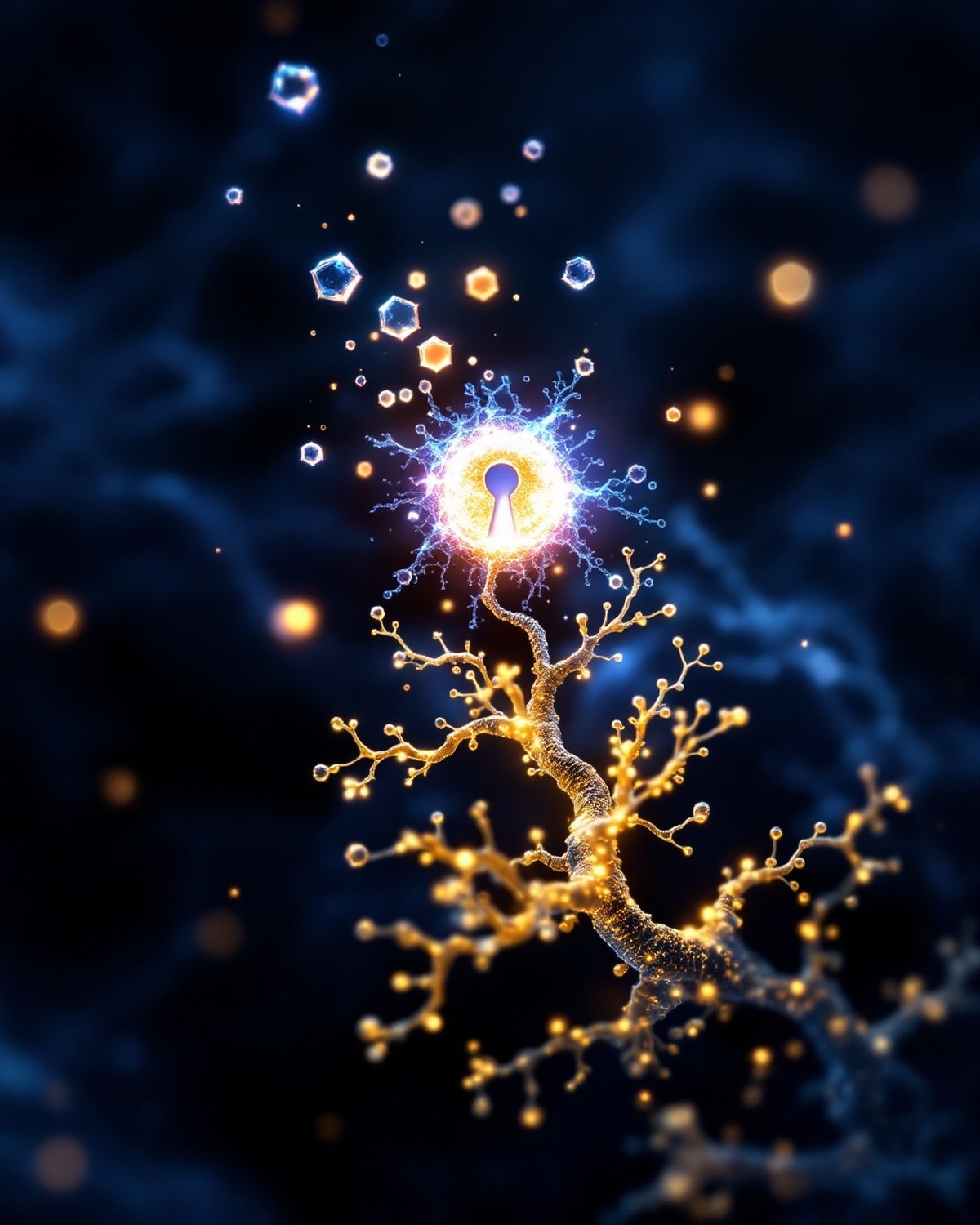
What is the 5-HT2A receptor, and why does it matter? It is a serotonin receptor — a Gq-protein-coupled receptor densely packed on the deep-layer “thinking cells” of the cortex — and it is the single molecular target that every classic psychedelic converges on. LSD, psilocybin, DMT and mescaline all switch it on, and blocking it with a drug called ketanserin abolishes the psychedelic experience entirely. Downstream, 5-HT2A activation drives a surge of cortical excitation and, remarkably, a burst of structural neuroplasticity — new dendritic spines and synapses grown through a BDNF → TrkB → mTOR cascade. It is, in the truest sense, the keyhole the whole field is cut to fit.
Four molecules. An ergoline, two tryptamines, a phenethylamine. Under a chemist’s eye, LSD, psilocybin, DMT and mescaline look like they belong to different worlds. And yet they all end up in exactly the same place: a single serotonin receptor, 5-HT2A, studded across the deepest thinking-cells of the cortex. It is the keyhole every classic psychedelic is cut to fit — and, as it turns out, possibly the switch that lets the adult brain rewire itself.
We’ve followed how psilocybin quiets the default mode network and how ketamine rebuilds synapses through a different door. This is the story one level down — the receptor itself, the master switch under all of it. Here is what it is, how we know it’s the one that matters, and what happens in the cortex when it turns on.
What the receptor actually is
Serotonin doesn’t act through one receptor but through a family of at least fourteen. The 5-HT2A subtype is the principal excitatory one in the cortex, and it is a Gq-protein-coupled receptor — meaning that when something switches it on, it triggers an internal cascade (Gq → phospholipase C → IP3/DAG → calcium and PKC) that makes the host neuron more excitable. What makes 5-HT2A special is where it lives: densely, on the apical dendrites of layer-5 pyramidal neurons in the prefrontal cortex — the large, deep-lying cells that serve as the brain’s association hubs, integrating information and carrying the high-level predictions we use to model the world (Nichols, Pharmacological Reviews 2016). In ordinary life, serotonin nudging these receptors helps tune attention, mood and cognitive flexibility. Flood them with a psychedelic and something far more dramatic happens.
One keyhole, four keys — and the proof
Here is the fact that anchors the entire field. Take four psychedelics that share almost no chemical resemblance — LSD (an ergoline), psilocin and DMT (tryptamines), and mescaline (a phenethylamine) — and each one, despite its shape, fits the 5-HT2A binding pocket and turns the receptor on. That convergence alone is suggestive. But the decisive evidence is what happens when you block the lock.
Ketanserin is a selective 5-HT2A antagonist — it sits in the pocket without activating it. In 1998, Franz Vollenweider’s group in Zurich gave volunteers ketanserin before psilocybin, and the psychedelic effects didn’t appear: the drug was circulating in the body, but its target was plugged (Vollenweider et al., NeuroReport 1998). Two decades later, Katrin Preller and Vollenweider repeated the trick with LSD and a brain scanner: ketanserin fully abolished not only LSD’s subjective effects and its uncanny sense that everything feels personally meaningful, but also the sweeping changes LSD makes to brain connectivity — and the map of where LSD acted in the cortex matched the map of where the 5-HT2A gene is expressed (Preller et al., Current Biology 2017; Preller et al., eLife 2018). Block the receptor, and the trip doesn’t happen. That is as close to a smoking gun as neuroscience gets: 5-HT2A activation is necessary for the psychedelic experience.
Precisely-Dosed Psilocybin Mushroom TreatsOOTW Psilocybin Mushroom Treats
Precisely-dosed, lab-tested, quality psilocybin mushroom treats — crafted for daily ritual, neural support, and sustained clarity. Journal readers: 10% off your first order with code JOURNAL10 (applied automatically at checkout).
Claim 10% Off →The mechanism: excitation, and a surprise from inside the cell
When a psychedelic switches on 5-HT2A on those layer-5 neurons, the immediate consequence is cortical excitation: the Gq cascade raises the cells’ excitability and drives a late, asynchronous release of glutamate, the brain’s main excitatory messenger, in the prefrontal cortex. The tidy top-down order of normal cortical activity gives way to something noisier and more richly interconnected.
But the deeper surprise came in 2023. Serotonin itself binds 5-HT2A perfectly well — so why doesn’t your own serotonin make you trip, or grow new synapses the way psychedelics do? David Olson’s lab at UC Davis found the answer hiding in chemistry. Psychedelics are lipophilic — fat-soluble — so they slip straight through the neuron’s membrane and reach a pool of 5-HT2A receptors located inside the cell, on the Golgi apparatus. Serotonin, being water-loving and membrane-impermeant, largely can’t get there. When the team made serotonin artificially able to cross the membrane, it too triggered growth; when they made psychedelics less able to, the growth faded. The conclusion reframed the whole question: it is the activation of intracellular 5-HT2A receptors that drives the structural rewiring (Vargas, Olson et al., Science 2023). Same receptor, different address — and the address is what matters.
The plasticity revolution
That structural rewiring is the reason 5-HT2A has become one of the most exciting targets in all of psychiatry. In a landmark 2018 study, Olson’s group showed that LSD, DMT and other 5-HT2A agonists caused cortical neurons to grow — more dendritic branches, more dendritic spines (the tiny knobs where synapses form), more connections. LSD nearly doubled the number of spines. And the effect required a specific molecular chain: 5-HT2A → BDNF → TrkB → mTOR, the same growth-signalling machinery that ketamine recruits by a different route (Ly et al., Cell Reports 2018). Olson coined a word for compounds that do this: psychoplastogens — molecules that rapidly promote structural plasticity. The idea is that a psychedelic doesn’t just produce an experience; it opens a window in which the brain can physically remodel the circuits that depression, addiction and trauma had worn into rigid ruts.
Which raises an irresistible question: can you keep the rewiring and drop the hallucination? Olson’s answer was tabernanthalog (TBG), an engineered, water-soluble, non-toxic cousin of ibogaine that promotes the same plasticity and shows antidepressant- and anti-addiction-like effects in animals — apparently without a full trip (Cameron, Olson et al., Nature 2021). Whether a trip-free psychoplastogen can deliver real, lasting benefit in humans is one of the biggest open bets in the field.
AI That Understands The MedicineOOTW Spirit Guide
Set. Setting. Dose. Integration. The questions you can’t bring to your doctor — answered by an AI grounded in every peer-reviewed paper, protocol, and ceremony manual. Private, sober, always there.
Talk to the Spirit Guide → A Sacred 5-MeO-DMT Ceremony · MiamiJoin the OOTW Sacrament
The oldest prayer, remembered — the gentle dissolving of the self into light, held in ceremony by a master facilitator. Sit with our community first: a free, live weekly circle on Zoom. No commitment, simply a conversation.
Join the Weekly Circle →The shape of the switch
To design better molecules you need to see the lock itself, and Bryan Roth’s lab at UNC has been photographing it atom by atom. Their 2017 structure of LSD bound to a closely related serotonin receptor revealed why LSD’s effects last so extraordinarily long: a floppy part of the receptor, extracellular loop 2, folds down over the bound drug like a “lid,” trapping LSD in the pocket so it dissociates agonizingly slowly — a molecular explanation for a ten-hour trip (Wacker, Roth et al., Cell 2017). In 2020 the team captured the 5-HT2A receptor itself in its active, Gq-coupled state by cryo-EM — the first direct look at the master switch mid-flip, and a template for building the next generation of compounds (Kim, Roth et al., Cell 2020). The receptor also signals through more than one internal pathway — Gq versus beta-arrestin — and different agonists lean on these arms differently, a phenomenon called biased agonism. Tuning that bias may be how chemists eventually separate the therapy from the hallucination.
From a receptor to a mind
How does a switch on a single receptor become the vast, world-dissolving experience people describe? The bridge is where the switch sits. Robin Carhart-Harris’s entropic brain and REBUS (Relaxed Beliefs Under pSychedelics) models note that 5-HT2A is densest on exactly the deep-layer neurons that carry the brain’s high-level “priors” — its confident predictions about reality (Carhart-Harris et al., 2014; Carhart-Harris & Friston, Pharmacological Reviews 2019). Exciting those cells desynchronises the cortex and loosens the grip of those top-down beliefs, letting bottom-up sensory information flow up and revise them. In predictive-coding language, the psychedelic turns down the confidence on our fixed models of the world — which is why entrenched patterns of self and perception can briefly come unstuck and be seen differently. The molecule sits precisely on the neurons that encode how sure we are of everything.
Precisely-Dosed Psilocybin Mushroom TreatsBring the Science Home
Every article here is the why. OOTW’s precisely-dosed, lab-tested, quality psilocybin mushroom treats are the how — crafted to carry the medicine into your daily practice. Journal readers: 10% off your first order with code JOURNAL10 (applied automatically at checkout).
Claim 10% Off →The honest open questions
For all its elegance, the 5-HT2A story is not finished. We know activation is necessary for the subjective experience; whether it is sufficient, and whether it is even required for the therapeutic plasticity, is genuinely contested — some 2025 work reports lasting synaptic changes even in neurons lacking the usual postsynaptic 5-HT2A receptors, hinting at parallel routes. Nor does 5-HT2A act alone: classic psychedelics also engage 5-HT1A and 5-HT2C receptors, other targets like TAAR1, and may even touch the growth-factor receptor TrkB directly, all of which shape the full experience and its aftermath (“Beyond the 5-HT2A Receptor,” J Neurosci 2023). So the fairest way to put it is this: 5-HT2A is the master switch for the experience, but the therapeutic story is a broader circuit that switch sets in motion.
The honest bottom line
The 5-HT2A receptor is one of neuroscience’s most satisfying keystones: a single serotonin receptor, sitting on the brain’s deepest thinking-cells, that four unrelated molecules all reach for — and that, when blocked, takes the entire psychedelic experience with it. Turn it on and the cortex lights up, beliefs loosen, and, through an ancient growth cascade, neurons begin to build. It is at once the explanation for why psychedelics feel the way they do and the reason they may help the brain change. The frontier now is precision: seeing the switch clearly enough to flip only the parts we want — the healing without the hazard. That work is well underway, and it all comes back to this one small receptor.
OOTW Journal is educational and does not provide medical advice. Classic psychedelics are controlled substances in most countries, and the clinical results described here come from carefully screened, supervised research settings. Nothing in this article is a recommendation to seek or use any psychedelic. If you are struggling with your mental health, please reach out to a qualified professional.