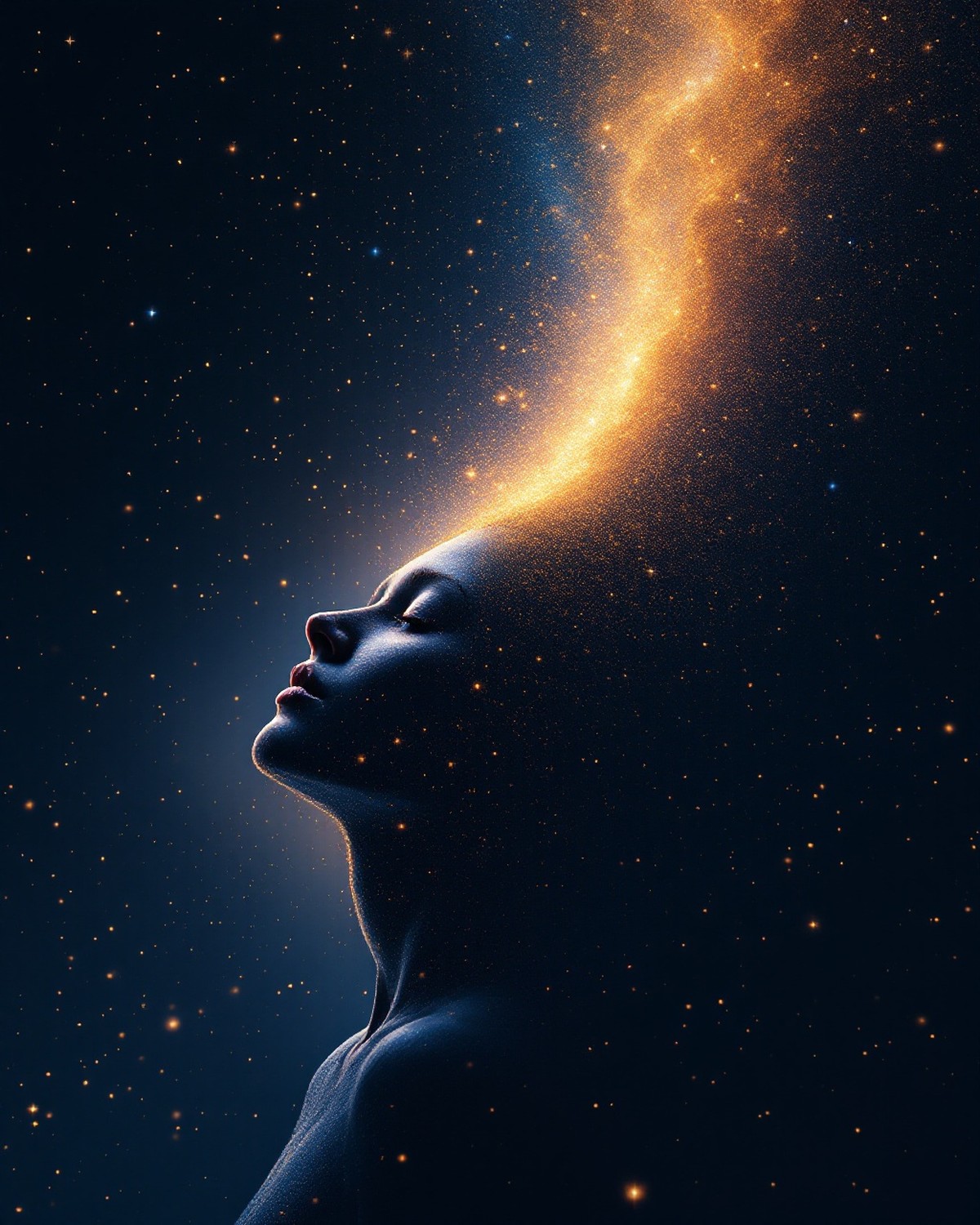
What is the mystical experience, and why does it matter? It's a specific, measurable state a psychedelic can occasion — marked by a sense of unity, sacredness, transcendence of time and space, a noetic sense of encountering truth, deeply positive mood, and ineffability. In the landmark Johns Hopkins trial, psilocybin reliably occasioned such experiences, rated by many volunteers among the most personally meaningful of their lives (Griffiths et al., 2006). It's quantified with the MEQ30 (Barrett et al., 2015), and its intensity predicts therapeutic outcome in depression and addiction (Roseman et al., 2018). Whether it is strictly necessary is now hotly debated (Olson, 2021).
For most of a century, the “mystical experience” belonged to religion, not the laboratory — the province of saints and seekers, not scientists. Then researchers did something audacious: they built a questionnaire for it, gave people psilocybin under controlled conditions, and discovered that the intensity of this supposedly unmeasurable state was one of the most reliable predictors of healing in all of psychiatry. In doing so they turned a mystery into a variable — and opened the deepest question in the whole field: is the experience the medicine, or just its shadow?
What the mystical experience actually is
Strip away the religious connotations and the mystical-type experience has a remarkably consistent, describable structure — one the philosopher William James and later W.T. Stace mapped long before neuroscience arrived. Its hallmarks: a sense of unity, the dissolving of the boundary between self and world into an oceanic oneness; a quality of sacredness or reverence; a noetic sense of directly encountering truth or reality “as it really is”; transcendence of time and space; a deeply felt positive mood of peace, joy or awe; and ineffability — the conviction that it cannot be put into words. Crucially, these features cut across cultures and eras, which is exactly what let researchers argue it is a genuine, natural brain state rather than a doctrine — and therefore something science could actually study.
The experiment that changed everything
In 2006, Roland Griffiths and colleagues at Johns Hopkins published a rigorous double-blind study that reopened psychedelic science after decades of silence. Healthy volunteers received psilocybin or an active comparison under supportive conditions. The result was seismic: psilocybin reliably occasioned mystical-type experiences, and at a two-month follow-up, a majority of participants rated the session among the five most personally meaningful and spiritually significant experiences of their entire lives — comparable, many said, to the birth of a first child (Griffiths et al., 2006). A 14-month follow-up found the changes had lasted. This wasn’t drug intoxication that faded; it was an experience that reorganized lives.
Precisely-Dosed Psilocybin Mushroom TreatsOOTW Psilocybin Mushroom Treats
Precisely-dosed, lab-tested, quality psilocybin mushroom treats — crafted for daily ritual, neural support, and sustained clarity. Journal readers: 10% off your first order with code JOURNAL10 (applied automatically at checkout).
Claim 10% Off →Turning the ineffable into a number
To study something scientifically, you must measure it — even if its defining feature is that it resists description. The tool is the Mystical Experience Questionnaire, refined into the validated MEQ30 (Barrett, Johnson & Griffiths, 2015). It scores an experience across the core dimensions — unity, sacredness, noetic quality, positive mood, transcendence of time and space, and ineffability — and yields a “complete mystical experience” threshold. It sounds almost paradoxical to put a number on the ineffable, but it works: MEQ30 scores are reliable, dose-dependent, and — the key point — they predict what happens next. That single move, quantifying the peak, is what let the field ask whether the experience is doing the healing.
Why it may be where the healing lives
And the data kept saying yes. In treatment-resistant depression, Roseman, Nutt and Carhart-Harris found that the quality of the acute experience predicted the outcome: greater oceanic boundlessness (the expansive, unitive, mystical pole) predicted larger reductions in depression, while dread of ego dissolution predicted worse response (Roseman et al., 2018). The same pattern appeared elsewhere: in smoking cessation, the strength of the mystical experience tracked who stayed abstinent. The emerging model is that a psychedelic works by occasioning an experience powerful and meaningful enough to reset a person’s relationship to themselves — and that the depth of that experience, not merely the milligrams, is the active ingredient. It fits the entropic-brain picture: the mind reaching peak flexibility, the default mode network dissolving, the self briefly rebuilt.
AI That Understands The MedicineOOTW Spirit Guide
Set. Setting. Dose. Integration. The questions you can’t bring to your doctor — answered by an AI grounded in every peer-reviewed paper, protocol, and ceremony manual. Private, sober, always there.
Talk to the Spirit Guide → A Sacred 5-MeO-DMT Ceremony · MiamiJoin the OOTW Sacrament
The oldest prayer, remembered — the gentle dissolving of the self into light, held in ceremony by a master facilitator. Sit with our community first: a free, live weekly circle on Zoom. No commitment, simply a conversation.
Join the Weekly Circle →The debate: is the experience necessary?
Here the field splits, and it is the most important argument in psychedelic medicine. One camp — call it the experience-first view — holds that the mystical experience is the mechanism: the felt meaning, the ego dissolution, the sense of the sacred is what heals, and any attempt to remove it guts the therapy. The other camp, led forcefully by chemist David Olson, argues the opposite: the durable benefit may come from the drug’s effect on neuroplasticity — the physical regrowth of synapses — and the mystical experience may be a correlated side effect, not the cause (Olson, 2021). His evidence: non-hallucinogenic psychoplastogens that produce antidepressant-like effects in animals with no trip at all. The counter, from David Yaden and Griffiths, is that the human evidence overwhelmingly links the experience to lasting change, and that correlational or not, no one has yet shown durable human healing without it. The honest answer today: the mystical experience is the best predictor we have, but prediction is not proof of necessity — and the question is being actively tested right now.
Precisely-Dosed Psilocybin Mushroom TreatsBring the Science Home
Every article here is the why. OOTW’s precisely-dosed, lab-tested, quality psilocybin mushroom treats are the how — crafted to carry the medicine into your daily practice. Journal readers: 10% off your first order with code JOURNAL10 (applied automatically at checkout).
Claim 10% Off →The honest limits
Real caution is warranted on every side. The strongest claims rest on correlation: mystical-experience scores predict outcomes, but the people who have the most profound experiences may also differ in other ways (expectancy, openness, rapport with the guide), and expectancy effects are notoriously strong in this field. The MEQ itself has been critiqued — for smuggling positive religious framing into what it measures, and for possibly capturing intensity or emotional breakthrough as much as anything specifically “mystical.” “Mystical” language also makes some clinicians uneasy, which is why neutral terms like oceanic boundlessness and ego dissolution are often preferred. And a powerful experience is not automatically a safe or benign one — the same intensity that heals can, in the wrong set and setting, harm. What is solidly established is remarkable enough: psychedelics can reliably occasion a measurable, cross-cultural peak state; people rank it among the most meaningful events of their lives; and its intensity is, so far, the best single predictor we have of who gets better. Whether it is the cause or the companion of healing is one of the great open questions science is racing to answer.
OOTW Journal is educational and does not provide medical advice. Psychedelics remain controlled substances in most countries and are not safe for everyone, including people with a personal or family history of psychosis or bipolar disorder, and those on serotonergic medications. Nothing here is a recommendation to use any psychedelic. If you are struggling with your mental health, please reach out to a qualified professional.