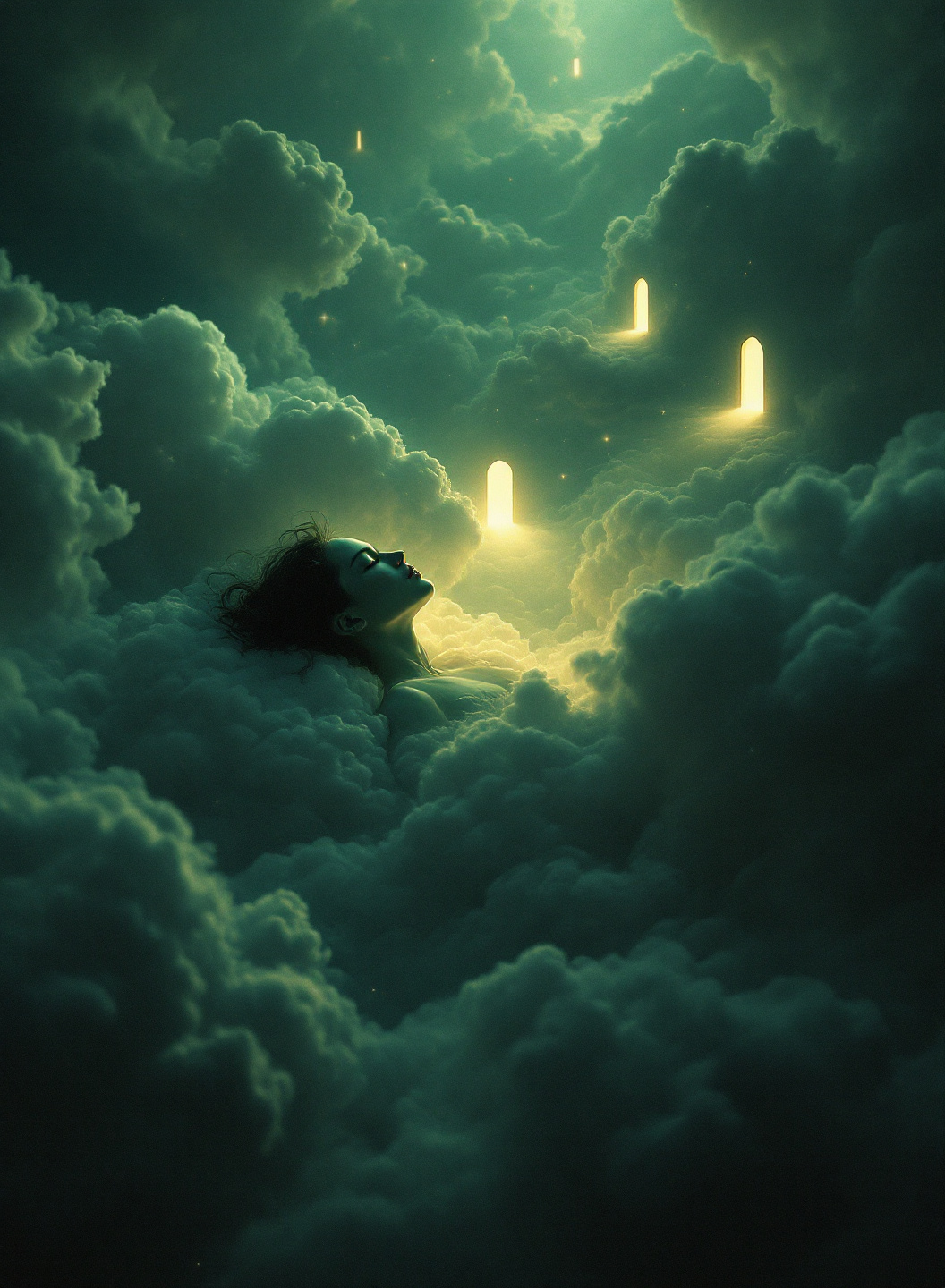
Is a psychedelic trip really a waking dream? As experience, remarkably so. When researchers ran latent-semantic analysis on more than 15,000 drug reports, serotonergic psychedelics came out closest to dreams of any class (Sanz & Tagliazucchi, 2016), and LSD pushes waking imagery to dream-like “bizarreness” through the 5-HT2A receptor — block that receptor and the dreaminess vanishes (Kraehenmann et al., 2017). Both states run on an entropic brain with a loosened default mode network. But the neurochemistry diverges — REM dreaming is cholinergic and serotonin-quiet, while psychedelics add serotonin signaling — and acutely they actually suppress REM sleep (Barbanoj et al., 2008). The trip is a waking dream you can remember and steer.
There is a sentence that surfaces again and again in accounts of strong psychedelic experiences, and it always arrives with a shrug of inadequacy: it was like a dream — but I was awake for it. The rooms that breathe, the dead who return to speak, the impossible logic that feels not just plausible but obvious, the sense that meaning is leaking from every surface. All of it carries the unmistakable grammar of dreaming. The intuition is old, the phenomenology is uncanny, and the neuroscience has spent the last two decades turning that intuition into data — and then complicating it in the most interesting way.
A two-hundred-year-old intuition
The comparison is not a product of the 1960s. In 1845, the French psychiatrist Jacques-Joseph Moreau de Tours published Du hachisch et de l’aliénation mentale, built on a startling premise: that the hashish state and the dream state were, at bottom, the same phenomenon — and that a sane observer could take the drug to study madness from the inside. For Moreau, dream, delirium and drug-state formed a single family. That lineage runs straight through the 20th century into Allan Hobson’s influential model of dreaming, which described conscious states along axes of brain activation, information input, and chemical modulation — a vocabulary that let later researchers place the psychedelic state on the same map as REM sleep (Hobson et al., 2000). The waking dream, in other words, was a scientific hypothesis long before it was a slogan.
The dream fingerprint in the data
The strongest modern bridge is the entropic brain theory, which groups the psychedelic state and REM dreaming together as “primary states” of consciousness — both defined by elevated neural entropy, a loosened default mode network, and a decoupling of that self-network from the memory systems of the medial temporal lobe (Carhart-Harris et al., 2014). Two studies pin the analogy to evidence. Kraehenmann and colleagues gave people LSD and had them generate mental imagery: the images became markedly more dream-like in their bizarreness — the fluid, illogical, emotionally charged quality of dreaming — and the effect was completely abolished by ketanserin, a 5-HT2A blocker, proving the dreaminess ran through that one receptor (Kraehenmann et al., 2017). And in a study of language itself, Sanz, Tagliazucchi and colleagues used semantic analysis to compare thousands of written trip reports against a database of dream reports and drug accounts; of every substance class, serotonergic hallucinogens produced narratives closest to dreams — and closest, tellingly, to lucid dreams (Sanz & Tagliazucchi, 2016).
Precisely-Dosed Psilocybin Mushroom TreatsOOTW Psilocybin Mushroom Treats
Precisely-dosed, lab-tested, quality psilocybin mushroom treats — crafted for daily ritual, neural support, and sustained clarity. Journal readers: 10% off your first order with code JOURNAL10 (applied automatically at checkout).
Claim 10% Off →The gate in the middle of the brain
Why should a drug and a sleep stage produce the same kind of mind? One answer sits in the thalamus, the deep hub through which nearly all sensory and internal information passes on its way to the cortex. Franz Vollenweider and Mark Geyer’s cortico-striato-thalamo-cortical (CSTC) model casts the thalamus as a filter — a gate that decides what floods into conscious awareness and what stays out. Psychedelics, by ramping up serotonergic drive, weaken the inhibition that normally keeps that gate half-closed, so more inner and outer signal pours through at once: the sensory overload, the porousness of the self, the sense that everything is significant (Vollenweider & Geyer, 2001). Brain-imaging work supports the picture — under LSD, the flow of information from the striatum to the thalamus drops, exactly as an opening gate would predict (Preller et al., 2019). Dreaming, too, is a state of radically altered thalamic gating — the outside world locked out, the inside world let loose. Two doors, opened by different keys, onto a similar room.
Where the metaphor breaks — beautifully
And here is the twist that makes the whole story worth telling. If a trip were literally REM sleep, psychedelics should deepen and lengthen dreaming. They do the opposite. In a controlled study, daytime ayahuasca lengthened REM latency and reduced REM duration while largely sparing deep slow-wave sleep (Barbanoj et al., 2008); daytime psilocybin likewise delayed REM and suppressed slow-wave activity in the first sleep cycle (Dudysová et al., 2020). The neurochemistry explains why. REM dreaming is generated when cholinergic “REM-on” neurons fire while the brain’s serotonin and noradrenaline systems fall silent — a serotonin-quiet state. Classic psychedelics do the reverse: they are direct 5-HT2A agonists, flooding the system with serotonergic-receptor signaling. So a trip does not become a dream by copying its chemistry; it arrives at a dream-like cortical dynamic by an entirely different pharmacological road. That is why the closest match in the data was the lucid dream (Kraehenmann, 2017) — a hybrid in which the dreaming brain is joined by a waking witness. The trip is not you asleep. It is the dream logic of REM running in a mind that is still home, still watching, still able to remember.
AI That Understands The MedicineOOTW Spirit Guide
Set. Setting. Dose. Integration. The questions you can’t bring to your doctor — answered by an AI grounded in every peer-reviewed paper, protocol, and ceremony manual. Private, sober, always there.
Talk to the Spirit Guide → A Sacred 5-MeO-DMT Ceremony · MiamiJoin the OOTW Sacrament
The oldest prayer, remembered — the gentle dissolving of the self into light, held in ceremony by a master facilitator. Sit with our community first: a free, live weekly circle on Zoom. No commitment, simply a conversation.
Join the Weekly Circle →A dream you can remember — and steer
That difference — presence, recall, agency — is exactly what makes the waking dream therapeutically interesting. Ordinary dreams do real work: the slow-wave and REM cycle is when the brain consolidates and reorganizes memory, filing the day’s emotional residue into longer-term storage (Diekelmann & Born, 2010). But we cannot usually remember that processing, let alone direct it. Psychedelics open a similar window of heightened plasticity — acutely driving the same BDNF-and-TrkB machinery that builds new synapses and updates emotional memory (Ly et al., 2018) — while the person stays conscious enough to feel it, narrate it, and carry it into the next day. The clinical payoff is clearest in trauma, where the target is emotional-memory updating itself: MDMA-assisted therapy is thought to work by letting a traumatic memory be recalled inside a felt sense of safety and re-filed with less fear — the waking, steerable analogue of the emotional processing that REM performs in the dark, and a direct answer to the nightmares that define PTSD (Feduccia & Mithoefer, 2018). A dream does its work while you sleep through it. A guided psychedelic session lets you stay in the room while the filing happens.
Precisely-Dosed Psilocybin Mushroom TreatsBring the Science Home
Every article here is the why. OOTW’s precisely-dosed, lab-tested, quality psilocybin mushroom treats are the how — crafted to carry the medicine into your daily practice. Journal readers: 10% off your first order with code JOURNAL10 (applied automatically at checkout).
Claim 10% Off →The dream molecule that probably isn’t
No essay on this theme can avoid the most seductive idea in it: that the brain makes its own psychedelic, and that a trickle of endogenous DMT is what lights the dreaming mind — the “dream molecule,” often pinned romantically on the pineal gland. It is a beautiful story, and it is not established science. DMT is genuinely present in mammalian tissue, but whether it rises during dreaming, whether the brain ever reaches psychoactive concentrations, and what function (if any) it serves remain open questions; the most careful reviews call its endogenous role unproven (Barker, 2018). Treat it as an evocative hypothesis, not a fact. The honest version of the waking-dream story does not need it. The overlap between tripping and dreaming is real at the level of experience and cortical dynamics, partial at the level of the thalamus and the self-network, and broken at the level of sleep chemistry — and that layered, imperfect resemblance is far more interesting than a single magic molecule. A psychedelic does not send you to sleep. It brings the dream to you, in daylight, with the lights on and someone still home to remember it.
OOTW Journal is educational and does not provide medical advice. Psychedelics remain controlled substances in most countries and are not safe for everyone, including people with a personal or family history of psychosis or bipolar disorder, and those taking serotonergic medications. Nothing here is a recommendation to use any psychedelic. If you are considering this work, please consult a qualified professional.