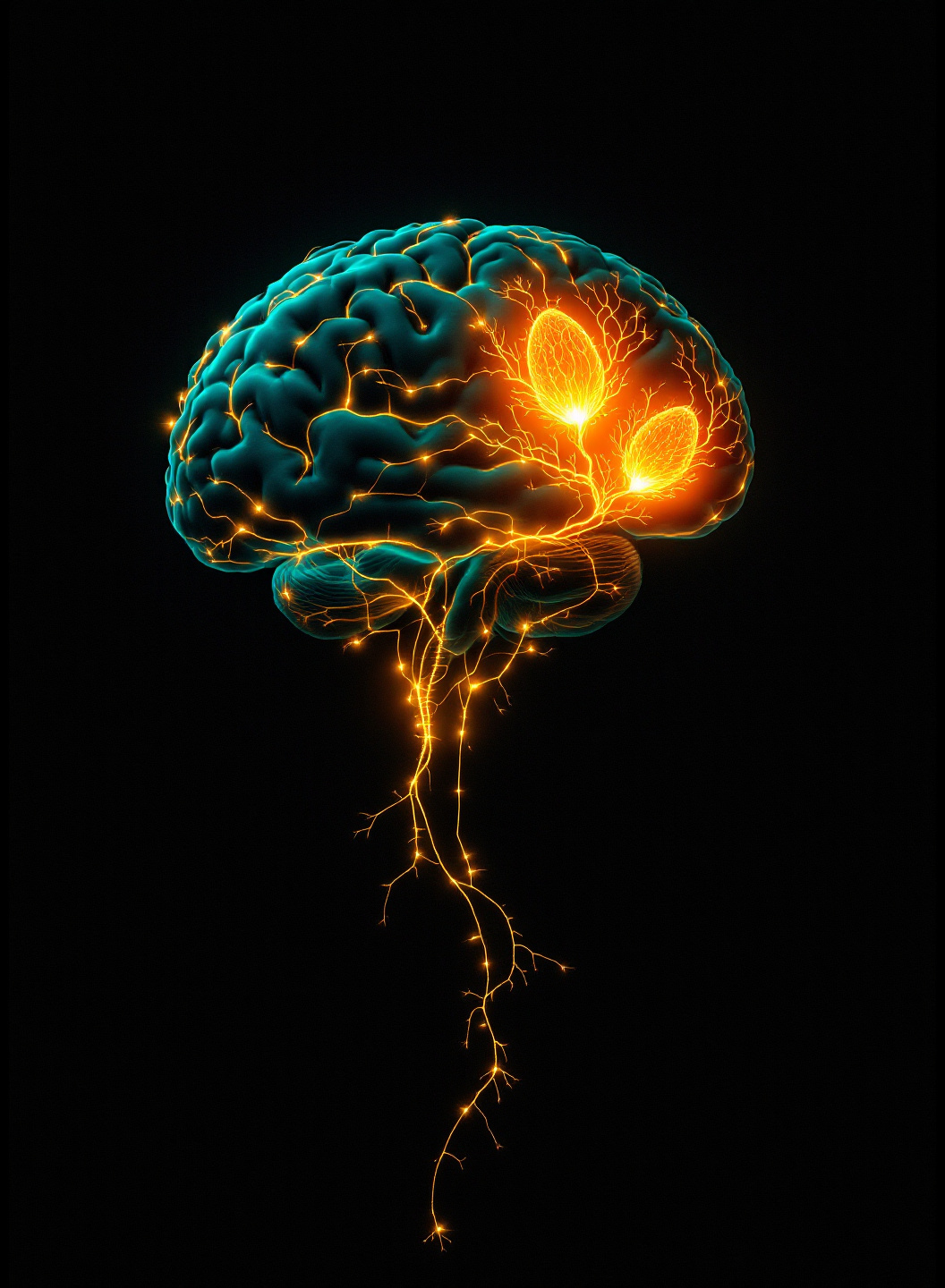
What does the amygdala do, and how do psychedelics affect it? The amygdala is the brain’s threat detector — a fast, automatic alarm that drives fear and vigilance, and that runs hyperactive in anxiety, PTSD and depression. In the acute state, psilocybin reduces amygdala reactivity to fearful and negative images, and that calming tracks with improved mood (Kraehenmann et al., 2015). But the deeper surprise came from therapy: the day after psilocybin, amygdala responses to emotional faces went up, not down — and the bigger the increase, the better patients did (Roseman et al., 2018). The emerging picture: unlike SSRIs, which can blunt emotion, psychedelics may heal by helping people feel again.
Evolution gave you an alarm before it gave you reason. Long before the thinking cortex weighs the evidence, a deep, fast circuit has already decided whether to freeze, flee, or fight — and it is usually right often enough to have kept your ancestors alive. But an alarm that is too sensitive, or that will not switch off, becomes its own kind of danger. Trauma, anxiety, and depression are in large part disorders of an alarm bell that rings when there is no fire. Understand the amygdala, and you understand the machinery of fear itself — and why the drugs that seem to loosen its grip do something far more interesting than simply turning the volume down.
The brain’s smoke detector
Deep in each temporal lobe, roughly behind the eyes and toward the ears, sits the amygdala — from the Greek for almond, which is about its size and shape. It is not a single thing but a cluster of nuclei, and its job, above all, is salience and threat: to flag what matters and what might hurt you, and to do it fast. When it fires, it recruits the whole body into readiness — heart rate up, stress hormones released, attention narrowed to the danger — often before you consciously know what set it off.
The neuroscientist Joseph LeDoux mapped how this speed is achieved. Sensory information can reach the amygdala by two routes: a slow, accurate “high road” up through the cortex, and a quick, crude “low road” that runs almost directly from the sensory thalamus to the amygdala, bypassing conscious analysis. The low road is why you can leap back from a curved stick on the trail a full second before the cortex confirms it was never a snake. The amygdala would rather be wrong a hundred times than miss the one real threat. In a dangerous world, a jumpy alarm is cheap insurance.
When the alarm won’t stop
That bargain turns costly when the alarm loses its off switch. In anxiety disorders and PTSD, the amygdala is measurably hyperactive and hyper-responsive, wired to see threat in neutral faces and safe rooms; the fear memory, instead of fading, is re-triggered and reinforced. In major depression, too, the amygdala tends to over-respond to negative information and under-respond to positive, tilting the whole emotional world toward the bleak. A great deal of psychiatric suffering can be read as a threat-detection system that has become miscalibrated — stuck in a state of alarm long after the danger has passed.
This is exactly where conventional treatment aims. SSRIs, the standard antidepressants, are thought to work in part by dampening this amygdala hyperactivity over weeks — a “normalization” of the overactive fear center. It helps many people. But it comes with a well-known cost that patients describe again and again: emotional blunting. The alarm is quieter, but so is everything else — joy, tears, the sharp edges of feeling. The fire is out, but so are some of the lights.
Turning the volume down
The first clean look at psychedelics and the amygdala seemed to tell a simple, encouraging story. In a 2015 study, Rainer Kraehenmann and colleagues gave healthy volunteers psilocybin or placebo and showed them fearful, negative, and neutral images inside an fMRI scanner. Under psilocybin, amygdala reactivity dropped — the alarm rang more softly — and, tellingly, the more the right amygdala was quieted in response to negative images, the more the person’s mood lifted (Kraehenmann et al., 2015). A follow-up found that psilocybin also loosened the amygdala’s threat-driven grip on the rest of the brain.
Read on its own, this looks like a gentler SSRI: a molecule that calms the overactive fear center, delivered in an afternoon rather than over months. And in the acute window — the hours of the experience, when the world can feel unusually safe and open — that is roughly what happens. Through 5-HT2A receptors, psilocybin appears to relax the amygdala’s reflexive alarm. If the story ended here, psychedelics would simply be a faster way to quiet fear.
Precisely-Dosed Psilocybin Mushroom TreatsOOTW Psilocybin Mushroom Treats
Precisely-dosed, lab-tested, quality psilocybin mushroom treats — crafted for daily ritual, neural support, and sustained clarity. Journal readers: 10% off your first order with code JOURNAL10 (applied automatically at checkout).
Claim 10% Off →The paradox: to heal, the alarm came back louder
But the story does not end there, and the twist is the most important part. When Leor Roseman and colleagues at Imperial College London scanned patients with treatment-resistant depression before and after a course of psilocybin therapy, they expected the SSRI pattern: less amygdala response, a normalized alarm. They found the opposite. The day after the dosing session, patients’ amygdala responses to emotional faces had increased — and, remarkably, the patients whose amygdala lit up more were the ones who improved the most (Roseman et al., 2018).
This is a genuine puzzle, and it reframes everything. If depression is an overactive amygdala, why would a bigger amygdala response predict recovery? The researchers’ interpretation is elegant: depression is not only an alarm that rings too loud, it is also an emotional system that has gone numb — feelings walled off, muffled, held at a distance. SSRIs may relieve the ringing by further muffling the whole system, which is why they can leave people feeling flat. Psychedelics appear to do the reverse: they re-open emotional responsiveness. The amygdala comes back online not as a malfunctioning alarm but as a reawakened capacity to feel — and it is that reconnection, patients report, that lets grief finally move and joy return. As the Imperial team put it, the drugs seemed to help people reconnect with their emotions rather than suppress them.
Quieted in the moment, reopened for good
The two findings are not a contradiction once you separate the timescales. During the experience, the amygdala’s reflexive threat response is dampened — a window of safety in which frightening material can be approached without being overwhelmed. After, in the days that follow, emotional responsiveness rebounds and even rises, but now attached to a mind that has, ideally, done some work on the fear rather than simply fleeing it. It is the difference between numbing a wound and actually cleaning it: the anesthetic and the healing are not the same event.
This dovetails with what the rest of the field has found about psychedelics and fear. The amygdala is the seat of fear memory and extinction — the process by which the brain learns that an old danger is no longer dangerous — and the same circuitry is central to how MDMA helps people with PTSD revisit trauma without being retraumatized. In each case the mechanism is not deletion but reconsolidation: an old alarm re-opened under conditions safe enough that it can be updated and laid back down changed. The amygdala is not being silenced. It is being taught something new.
AI That Understands The MedicineOOTW Spirit Guide
Set. Setting. Dose. Integration. The questions you can’t bring to your doctor — answered by an AI grounded in every peer-reviewed paper, protocol, and ceremony manual. Private, sober, always there.
Talk to the Spirit Guide → A Sacred 5-MeO-DMT Ceremony · MiamiJoin the OOTW Sacrament
The oldest prayer, remembered — the gentle dissolving of the self into light, held in ceremony by a master facilitator. Sit with our community first: a free, live weekly circle on Zoom. No commitment, simply a conversation.
Join the Weekly Circle →Feeling again, not feeling less
This is why the amygdala story matters beyond the laboratory. The dominant model of psychiatric medication for a generation has been subtraction: turn down the pain, the anxiety, the ringing alarm, and accept some flattening of everything else as the price. The psychedelic findings hint at a different logic — restoration rather than subtraction. The goal is not an amygdala that never rings but one that rings appropriately: alive to real feeling, no longer trapped in a loop of false alarm, able to move through fear instead of being frozen by it.
It connects, too, to the larger picture emerging across this journal. The amygdala does not act alone; it is tuned by the insula’s reading of the body, gated by the thalamus, and interpreted by a cortex running its own predictions about what is dangerous. A relaxed, more plastic brain is one in which an over-learned fear — a prior held with too much certainty that the world is threatening — can finally be revised. The alarm bell is one instrument in that orchestra. What psychedelics seem to change is not the bell alone but the mind’s whole relationship to it.
Precisely-Dosed Psilocybin Mushroom TreatsBring the Science Home
Every article here is the why. OOTW’s precisely-dosed, lab-tested, quality psilocybin mushroom treats are the how — crafted to carry the medicine into your daily practice. Journal readers: 10% off your first order with code JOURNAL10 (applied automatically at checkout).
Claim 10% Off →The honest cautions
These are early and human-small findings, and precision matters. The acute-calming result comes from a modest sample of healthy volunteers; the “increased amygdala predicts recovery” result comes from a small, open-label trial in depression without a placebo control, which makes it a striking signal rather than proof. Neuroimaging measures indirect connectivity and reactivity, not the raw firing of neurons, and the two headline findings — down in the moment, up the next day — are still being reconciled and replicated. The elegant “reconnection” story is a compelling interpretation, not a closed case.
And the deeper caution is the one the amygdala itself teaches. A system built to detect threat exists for good reason; loosening it is not automatically healing. For someone in the wrong setting, or with the wrong history, a re-opened alarm can mean a wave of raw fear rather than a safe reprocessing of it — which is precisely why set, setting, and skilled support are treated as part of the medicine, not optional extras. That psychedelics can re-open the fear circuit is a reason for care and containment, not for casual use.
The bell and the fire
We tend to want our fear turned off. But a life without an alarm is not peace; it is danger unnoticed. The amygdala’s gift — the flinch before thought, the memory that keeps us from the edge — is inseparable from its curse, the false alarm that will not quiet. What the psychedelic research quietly suggests is that healing may not lie in silencing the bell at all, but in restoring the difference between a bell and a fire: the capacity to feel fear fully and then, when the danger has truly passed, to set it down. Not less feeling. Feeling that finally moves again.
OOTW Journal is educational and does not provide medical advice. The studies described are early, small, and in several cases uncontrolled, and their findings are being actively debated and replicated. Psychedelics are controlled substances, are not safe for everyone — including people with a personal or family history of psychosis or bipolar disorder, or those on serotonergic medications — and nothing here is a recommendation to use them.