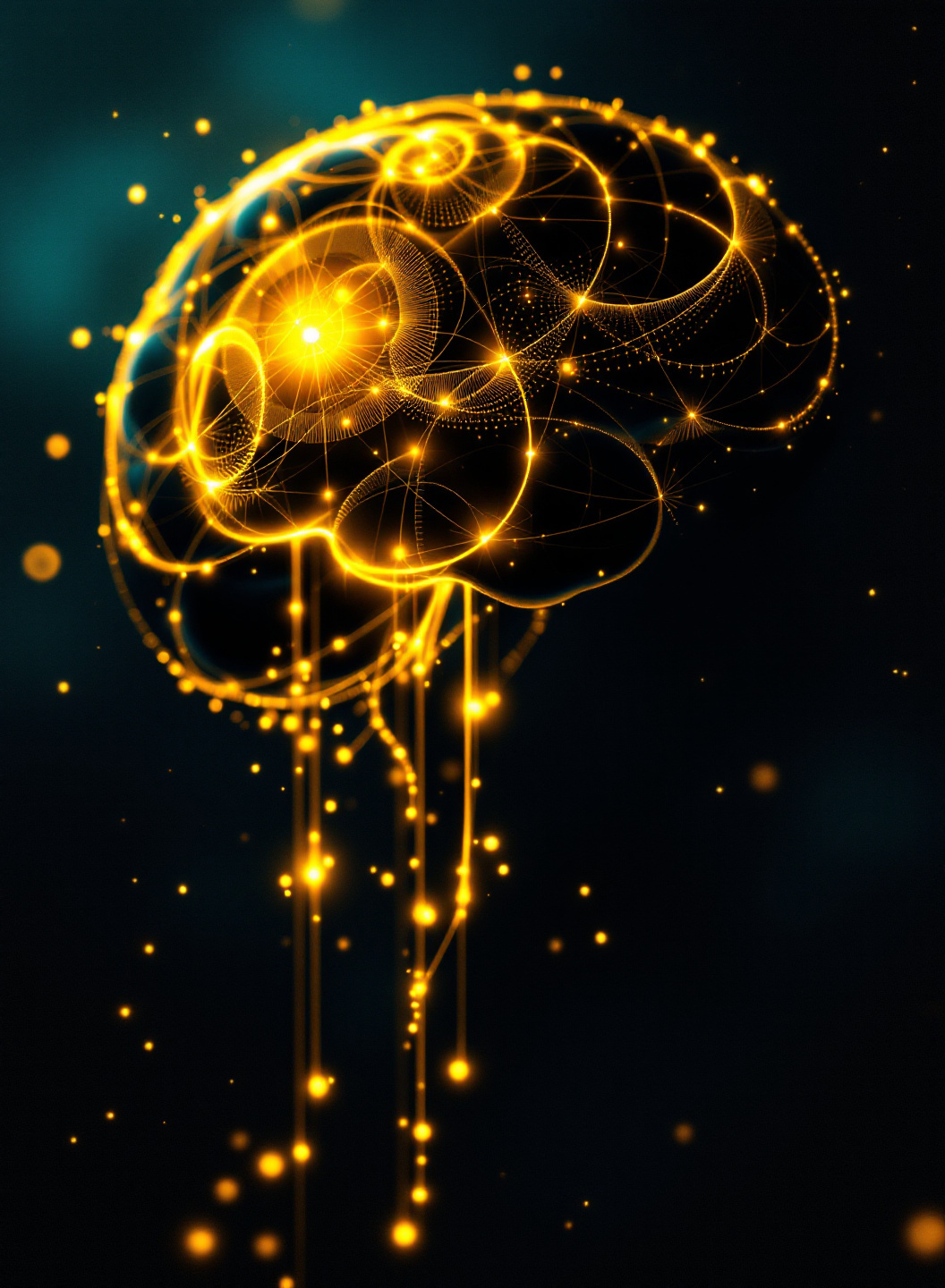
What are connectome harmonics? They are the brain’s natural vibrational patterns. Just as a violin string or a drumhead can only vibrate in a specific set of standing-wave shapes determined by its physical form, the neuroscientist Selen Atasoy showed that brain activity can be decomposed into “connectome harmonics” — harmonic wave patterns shaped by the wiring diagram of the human connectome (Atasoy et al., 2016). Any brain state is a combination of these harmonics, like a chord built from pure tones. When researchers applied this “harmonic decomposition” to brains on LSD, they found the drug enriched the repertoire of harmonics, boosted the total energy, activated normally-quiet high-frequency harmonics, and pushed brain activity toward the critical “edge of chaos” (Atasoy et al., 2017).
There is an old intuition, running from Pythagoras to the present, that reality is fundamentally musical — that beneath the surface of things lies harmony, proportion, vibration. For most of history that was philosophy, or poetry. But in the last decade a group of neuroscientists has given it a startlingly literal form. They have shown that the activity of the human brain can be read as music — not metaphorically, but mathematically — as a superposition of harmonic waves whose shapes are dictated by the brain’s own architecture. And when they used this new language to look at the brain on psychedelics, they didn’t just find noise or disorder. They found the brain playing a richer, higher, more complex chord, tuned to the exact edge where order meets chaos.
The shapes a thing can make when it vibrates
Every physical object has a set of natural ways it can vibrate. Pluck a guitar string and it doesn’t just move — it settles into a fundamental tone plus a series of overtones, standing waves that fit its length exactly. Strike a drumhead or a bell and it rings with its particular set of modes. In the 18th century, Ernst Chladni made these invisible patterns visible: he bowed metal plates covered in sand and watched the grains gather along the still lines of each resonant mode, tracing exquisite geometric figures. The shapes were not imposed from outside. They were the plate expressing the harmonics latent in its own form.
The mathematics behind this is universal. Any wave that lives on a structure — a string, a plate, a planet, a network — can be broken down into that structure’s harmonic modes, the elementary patterns of vibration allowed by its shape. This is one of the deepest ideas in physics: complex activity is a sum of simple harmonics, and the harmonics are set by the geometry of the thing itself.
Playing the connectome
Selen Atasoy’s insight was to ask: what if you apply this to the brain? The brain has a structure — the connectome, the vast map of white-matter connections linking every region to every other. If harmonic patterns are set by geometry, then the connectome should have its own natural harmonics: standing waves of neural activity whose shapes are dictated by the brain’s wiring, exactly as a drum’s modes are dictated by its shape.
In 2016, Atasoy and colleagues showed this is not just an analogy. Extending the mathematics of harmonics (the Fourier transform) to the connectome, they computed the brain’s connectome harmonics — and found that the well-known functional networks of the resting brain, the very patterns neuroscientists had spent decades mapping, emerged naturally as harmonic wave patterns of particular frequencies (Atasoy et al., 2016). The brain’s activity really can be decomposed into a set of fundamental vibrational modes. Any brain state — any moment of experience — is a chord: a specific combination of these harmonics, each contributing its own pure tone.
Precisely-Dosed Psilocybin Mushroom TreatsOOTW Psilocybin Mushroom Treats
Precisely-dosed, lab-tested, quality psilocybin mushroom treats — crafted for daily ritual, neural support, and sustained clarity. Journal readers: 10% off your first order with code JOURNAL10 (applied automatically at checkout).
Claim 10% Off →The brain on LSD, in a harmonic language
This gave researchers something remarkable: a way to describe an entire state of consciousness as a piece of music — which harmonics are active, how strongly, in what balance. So Atasoy’s team, working with Robin Carhart-Harris, Morten Kringelbach and Gustavo Deco, applied the harmonic decomposition to fMRI scans of people on LSD versus placebo (Atasoy et al., 2017). The result was a clean, quantitative signature of the psychedelic state written in the language of harmonics.
Under LSD, the brain’s music changed in specific ways. The total energy rose — the instrument was played more powerfully. The repertoire of harmonics expanded — more of the brain’s possible vibrational modes were brought into play, and in particular the high-frequency harmonics, the fine, intricate, normally-quiet patterns, became far more active. Where the ordinary brain plays a limited, familiar set of low chords, the LSD brain reached for the whole keyboard, adding higher, more complex overtones. It is the harmonic portrait of a mind whose expressive range has suddenly widened.
Tuned to the edge of chaos
The most profound finding was about balance. Physical systems can sit anywhere on a spectrum from rigid order (everything locked, predictable, frozen) to pure chaos (everything random, uncorrelated, noise). In between lies a special regime that physicists call criticality, or the “edge of chaos” — the poised boundary where a system is maximally flexible, maximally sensitive, and able to support the richest, most complex patterns. Many researchers believe the healthy waking brain hovers near this critical point, and that it is the sweet spot for information processing.
Atasoy’s analysis found that LSD pushed the brain’s harmonic activity toward this critical edge — the state self-organized right at the boundary between order and chaos (Atasoy et al., 2017). This is a beautiful convergence with the entropic brain hypothesis, which independently proposes that psychedelics raise the brain toward a higher-entropy, more critical state. Two different mathematical lenses — entropy and harmonics — pointing at the same thing: the psychedelic brain moving to the edge where it is most alive, most expressive, most capable of novel configurations.
AI That Understands The MedicineOOTW Spirit Guide
Set. Setting. Dose. Integration. The questions you can’t bring to your doctor — answered by an AI grounded in every peer-reviewed paper, protocol, and ceremony manual. Private, sober, always there.
Talk to the Spirit Guide → A Sacred 5-MeO-DMT Ceremony · MiamiJoin the OOTW Sacrament
The oldest prayer, remembered — the gentle dissolving of the self into light, held in ceremony by a master facilitator. Sit with our community first: a free, live weekly circle on Zoom. No commitment, simply a conversation.
Join the Weekly Circle →Why the music metaphor is more than a metaphor
It is tempting to treat “the brain is music” as a poetic flourish. What makes connectome harmonics extraordinary is that it is not. The harmonics are computed, not imagined; the decomposition is exact, not evocative. When we say the LSD brain adds higher harmonics and moves to the edge of chaos, we are stating a measured result, in the same rigorous sense that a physicist says a struck bell contains particular overtones. The ancient intuition that consciousness has something to do with harmony turns out to have a precise mathematical shadow.
And it reframes what a psychedelic experience is. Ego dissolution, the collapse of ordinary boundaries, the flood of geometric visions, the sense of profound interconnection — in the harmonic language, these become a shift in which modes of the whole brain are resonating together. The self may be one habitual chord the brain plays; loosen it, add the higher harmonics, and the music opens into something vaster. It connects naturally to the broadcasting of information across the brain, to the loosening of the default mode network, and to the dissolving of the ego — all of it, perhaps, a change in the brain’s resonance.
Precisely-Dosed Psilocybin Mushroom TreatsBring the Science Home
Every article here is the why. OOTW’s precisely-dosed, lab-tested, quality psilocybin mushroom treats are the how — crafted to carry the medicine into your daily practice. Journal readers: 10% off your first order with code JOURNAL10 (applied automatically at checkout).
Claim 10% Off →The honest cautions
Connectome harmonics is one of the most elegant frameworks in modern neuroscience — and it is also young, and should be held with appropriate humility. It is a model: a way of mathematically re-describing brain activity that has produced striking, coherent results, but that rests on simplifying assumptions (about how to build the connectome, how neural activity relates to structural harmonics, and how fMRI signals map onto the underlying dynamics). The LSD findings are based on a modest number of participants, as psychedelic imaging studies necessarily are, and await broad replication and extension to other compounds.
Most importantly, the beauty of the framework is not evidence for any particular metaphysics. That the brain can be decomposed into harmonics, and that psychedelics enrich them, is a genuine and remarkable empirical result. What it means — for consciousness, for the nature of the self, for the reality of what is seen — remains open, and the harmonic language does not settle it. It is a powerful new instrument for measuring the mind, not a proof of the cosmos’s song.
The instrument and the song
We are used to thinking of the brain as a machine — circuits, signals, computation. Connectome harmonics offers a different and stranger picture: the brain as a resonant body, its architecture a kind of instrument, its every state a chord struck from the harmonics that its own wiring allows. In ordinary life we play a small, familiar repertoire. What the psychedelic studies suggest is that the instrument is capable of far more — higher harmonics, richer chords, a state of exquisite balance at the edge of chaos where the music becomes most complex and most alive. Whatever consciousness ultimately is, this much now has mathematical form: the mind has a music, the brain can be made to play in a wider key, and for a few hours a molecule can open the whole keyboard.
OOTW Journal is educational and does not provide medical advice. Connectome harmonics is a young and evolving research framework; the psychedelic findings come from small imaging studies and are interpretations, not settled fact. Psychedelics are controlled substances, are not safe for everyone — including people with a personal or family history of psychosis or bipolar disorder — and nothing here is a recommendation to use them.