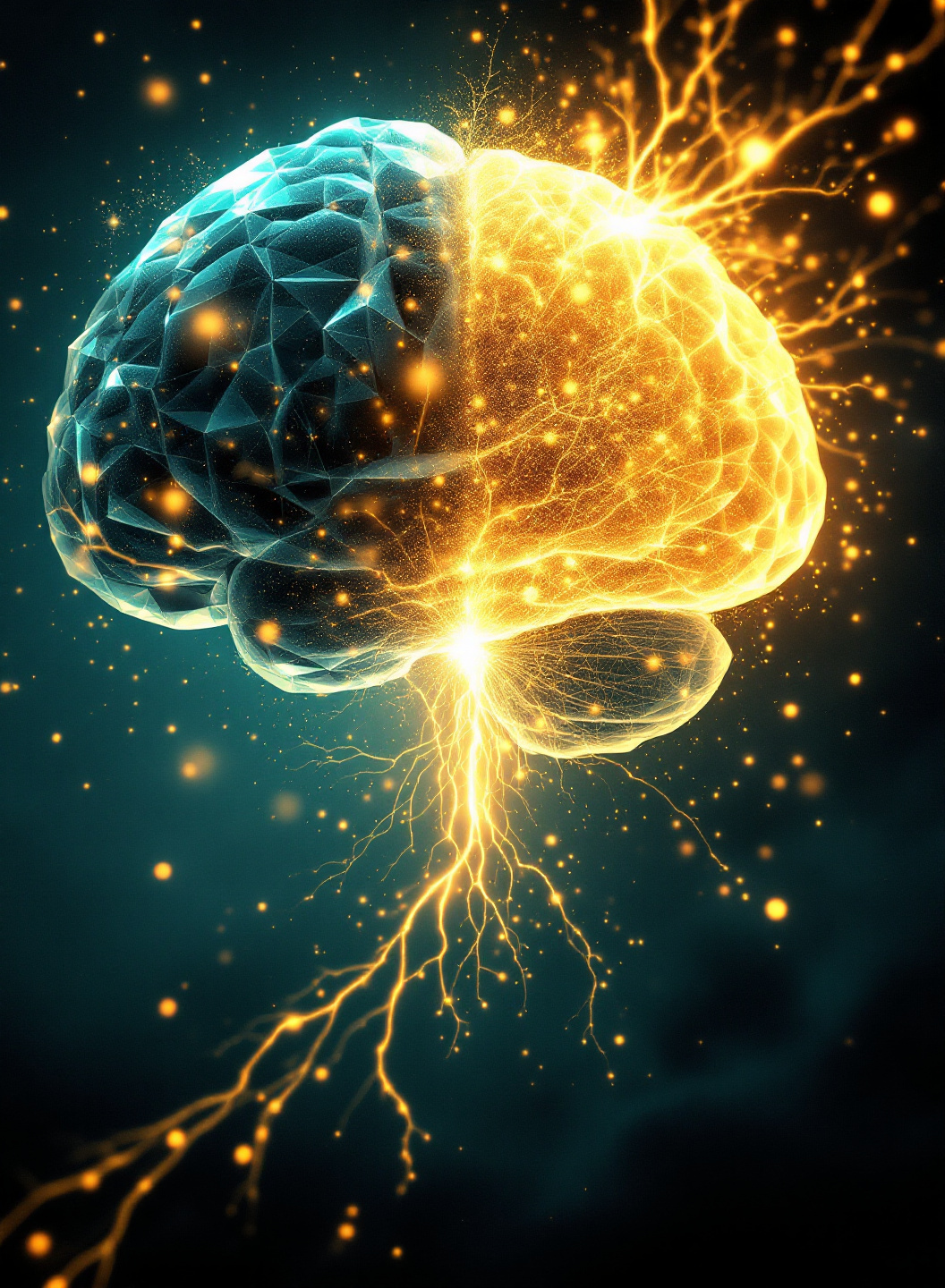
What is neural criticality? It is the idea that the brain operates at — or very near — a critical point, the knife-edge phase transition between order and disorder. The first hard evidence came in 2003, when Beggs and Plenz recorded spontaneous bursts of cortical activity that propagated in “neuronal avalanches” whose sizes followed a power law — the mathematical fingerprint of a system balanced at criticality (Beggs & Plenz, 2003). At this critical point a network is thought to be optimal: maximal dynamic range, maximal information capacity, maximal flexibility. More recent work suggests consciousness itself tracks how close the cortex sits to criticality (Toker et al., 2022). And psychedelics? LSD and psilocybin increase the fractal dimension of brain activity, evidence that they nudge the cortex closer to the critical edge (Varley, Carhart-Harris et al., 2020).
There is a number that keeps appearing where you would least expect it. Drop grains of sand one at a time onto a pile and measure the avalanches: most are tiny, a few are medium, and every so often a single grain triggers a collapse of the whole slope. Plot how often avalanches of each size occur and you get a straight line on a log-log graph — a power law. The same signature shows up in earthquakes, in forest fires, in extinctions, in the flickering of financial markets. It is the calling card of a system that has tuned itself to the boundary between stability and collapse. In 2003, two neuroscientists found that exact signature in living cortex. The brain, it seems, keeps itself perpetually balanced on the same edge.
The sweet spot between frozen and formless
Imagine a vast grid of elements — call them neurons — each able to switch on and, when it does, to nudge its neighbours toward switching on too. Everything depends on one number: how reliably one firing tends to trigger the next. Physicists call it the branching parameter. If it is low, activity dies out almost as soon as it starts; a spark lands and fizzles, and the network sits frozen and unresponsive. If it is high, every spark ignites a runaway explosion, a seizure of activity that swamps everything and erases any pattern. Both extremes are useless for computation.
But set that number to exactly one — where each firing triggers, on average, exactly one more — and something special happens. Activity neither dies nor explodes. Instead it propagates in cascades of every possible size: mostly small, occasionally medium, rarely enormous, in the precise proportions of a power law. This is the critical point, and a system tuned to it enjoys a suite of near-magical properties. It has the largest possible dynamic range, able to respond to both the faintest whisper and the loudest shout. It can transmit and store the most information. It is exquisitely sensitive to input, yet stable enough not to shatter. It is, in a precise mathematical sense, the configuration at which a network is most capable.
Avalanches in the cortex
For decades this was elegant theory with no proof that brains actually did it. Then John Beggs and Dietmar Plenz placed slices of cortex on grids of electrodes and simply watched the spontaneous activity. What they saw were bursts — cascades of firing that swept across the electrodes and then fell silent. When they measured the sizes of those cascades, the distribution was not random and not uniform. It was a power law with an exponent close to −3/2 — the exact value predicted for a critical branching process (Beggs & Plenz, 2003). They named the cascades neuronal avalanches, and the finding lit a fuse under systems neuroscience.
The signature has since been found again and again — in cultured neurons, in the intact cortex of awake animals, in human brain recordings from EEG, MEG and fMRI. The brain, across scales and species, produces avalanches that hug the critical line. It appears the cortex actively tunes itself toward criticality and holds itself there, a process of self-organized criticality: the same principle that keeps a sandpile perpetually at its angle of repose, always one grain from an avalanche of any size.
Precisely-Dosed Psilocybin Mushroom TreatsOOTW Psilocybin Mushroom Treats
Precisely-dosed, lab-tested, quality psilocybin mushroom treats — crafted for daily ritual, neural support, and sustained clarity. Journal readers: 10% off your first order with code JOURNAL10 (applied automatically at checkout).
Claim 10% Off →Why the brain would want to live on the edge
Why would evolution park the most important organ you own at the brink of instability? Because the brink is where the brain works best. A network at criticality maximizes the range of stimuli it can represent, the amount of information it can hold and transmit, and the repertoire of distinct states it can visit. It is the setting that best balances two competing demands every brain faces: it must be stable enough to hold a thought, a memory, a stable perception of the world — but flexible enough to switch, adapt, and generate something new. Order gives you reliability. Chaos gives you novelty. Criticality gives you both at once, and this is why many researchers now regard it as a fundamental organizing principle of neural computation rather than a curiosity.
Criticality and the light of consciousness
If sitting near criticality is what makes the brain computationally powerful, a natural and radical question follows: is it also what makes the brain conscious? A growing line of evidence says the distance from the critical point tracks the level of consciousness with striking fidelity. When Daniel Toker and colleagues analyzed cortical activity across wakefulness, sleep and anesthesia, they found that the brain sits closest to a critical transition precisely when consciousness is present and richest, and drifts away from it as awareness fades into deep sleep or anesthesia (Toker et al., 2022). Lose consciousness, and the cortex slides off the edge toward order; regain it, and the cortex climbs back to the brink.
This reframes the critical point as something close to a physical correlate of the “on” state of the mind. It is not that criticality is consciousness — that leap is not warranted — but that the two travel together so tightly that the edge of chaos may be the dynamical regime in which experience becomes possible at all.
Psychedelics: nudging closer to the edge
Here the story meets the psychedelic thread that runs through this journal. If the healthy waking brain hovers near criticality, where does the psychedelic brain go? The prediction, drawn from the entropic brain hypothesis, is that psychedelics push the cortex toward the critical edge — toward higher entropy, greater flexibility, a wider repertoire of states. And when researchers tested it, that is what they found.
Thomas Varley, working with Robin Carhart-Harris and colleagues, measured the fractal dimension of brain activity — a mathematical index of how intricate and scale-rich a signal is, which peaks near criticality — in people under LSD and under psilocybin. Both drugs increased the fractal dimension of cortical activity, in space and in time, relative to normal waking rest (Varley, Carhart-Harris et al., 2020). In the language of this field, the psychedelic brain became more scale-free, more complex, nearer to the poised critical state. It converges beautifully with the finding from connectome harmonics that LSD tunes brain activity to the edge of chaos, and with the collapse of the brain’s dominant rhythms that loosens its habitual order. Three different mathematical lenses — harmonics, entropy, and criticality — all point to the same place: the psychedelic mind moving nearer to the edge.
AI That Understands The MedicineOOTW Spirit Guide
Set. Setting. Dose. Integration. The questions you can’t bring to your doctor — answered by an AI grounded in every peer-reviewed paper, protocol, and ceremony manual. Private, sober, always there.
Talk to the Spirit Guide → A Sacred 5-MeO-DMT Ceremony · MiamiJoin the OOTW Sacrament
The oldest prayer, remembered — the gentle dissolving of the self into light, held in ceremony by a master facilitator. Sit with our community first: a free, live weekly circle on Zoom. No commitment, simply a conversation.
Join the Weekly Circle →What it might feel like from the inside
If this is right, it gives an unexpectedly concrete gloss on the texture of the psychedelic experience. A brain closer to criticality is a brain in which a small perturbation can cascade further than usual — where a thought, an image, a feeling can propagate across the whole system instead of staying local. That is a plausible dynamical shadow of the phenomenology so many describe: the sense that everything is connected, that meaning floods in from everywhere, that the boundaries between ideas, senses and self grow porous. Loosen the brain toward the edge, and its habitual, rigid patterns — including the pattern we call the self — can give way to configurations it does not ordinarily allow. The critical brain is a brain in which more of what is latent can, briefly, become actual.
The honest cautions
Criticality is one of the most exciting ideas in modern neuroscience — and it is also genuinely contested, and should be held with care. Not everyone agrees the brain is truly critical; some argue it operates slightly away from the exact critical point, in a “quasi-critical” or “sub-critical” regime, and that power laws can arise for mundane reasons that have nothing to do with a real phase transition. A prominent review pointedly asked “how critical is brain criticality?” and catalogued the ways the evidence can be over-read (O’Byrne & Jerbi, 2022). Measuring criticality is hard, the statistics are subtle, and a clean power law on a graph is suggestive but not proof.
The psychedelic findings inherit these caveats and add their own: they rest on small imaging samples, use indirect measures like fractal dimension as a proxy for criticality, and describe a correlation, not a mechanism. That LSD increases the complexity of brain activity is a solid result; that this is a move toward a genuine critical point, and that this move explains the experience, are interpretations — compelling, convergent, but not settled fact.
Precisely-Dosed Psilocybin Mushroom TreatsBring the Science Home
Every article here is the why. OOTW’s precisely-dosed, lab-tested, quality psilocybin mushroom treats are the how — crafted to carry the medicine into your daily practice. Journal readers: 10% off your first order with code JOURNAL10 (applied automatically at checkout).
Claim 10% Off →The brink where mind happens
Strip away the mathematics and a simple, strange picture remains. The brain is not a stable machine humming along in a safe middle. It is a system that has climbed to the very edge of its own instability and learned to live there, because the edge is where it can feel the most, hold the most, and become the most. Consciousness may be what it is like to be a piece of matter balanced at that critical point. And the psychedelic state may be, in part, what happens when the balance shifts a little further out — when the brain leans toward the edge of chaos and, for a few hours, discovers how much more it contains. Whatever else is true, the old opposition between order and chaos turns out to be the wrong frame. The mind lives in the seam between them.
OOTW Journal is educational and does not provide medical advice. The critical-brain hypothesis is an active and debated area of research; the psychedelic findings come from small imaging studies and are interpretations, not settled fact. Psychedelics are controlled substances, are not safe for everyone — including people with a personal or family history of psychosis or bipolar disorder — and nothing here is a recommendation to use them.