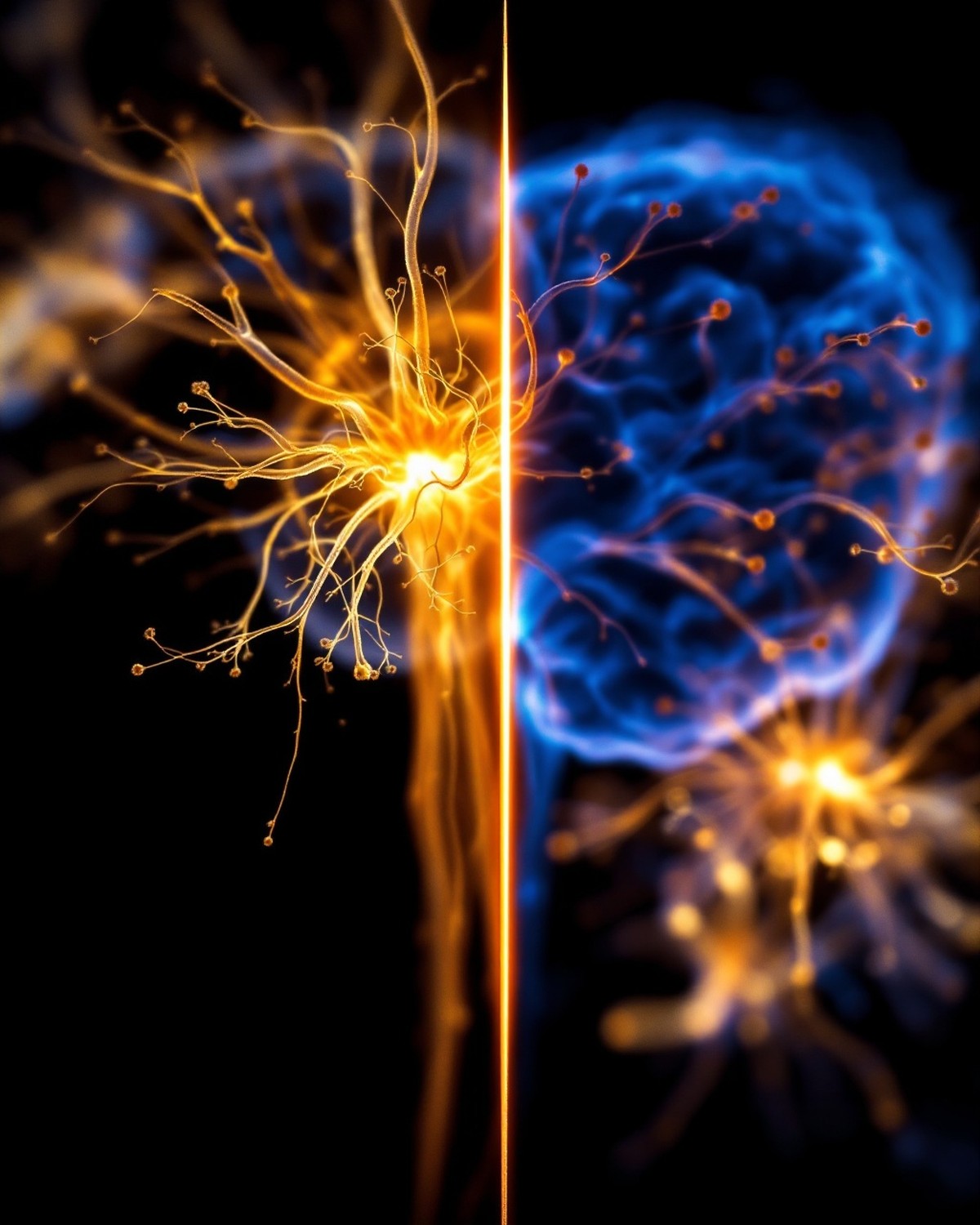
Two molecules could hardly be less alike. Ibogaine is a complex indole alkaloid concentrated in the root bark of Tabernanthe iboga, a shrub used for centuries in the Bwiti spiritual tradition of Gabon and Cameroon, and pulled into Western attention in the 1960s by reports that a single dose could switch off opioid withdrawal. Ketamine is a synthetic dissociative anesthetic, first made in 1962, a battlefield and emergency-room workhorse that became, half a century later, the flagship of a new kind of psychiatry. One is a plant medicine with a fearsome safety reputation; the other is approved hospital medicine repurposed for the mind.
Yet they keep appearing in the same conversation, because both are being pushed — off-label, experimentally, at the edge of what regulators allow — against the hardest problems in psychiatry: addiction that resists every standard treatment, and depression that will not lift. OOTW has covered each on its own: the neuroscience of ibogaine and the neuroscience of ketamine. This piece puts them side by side.
This piece discusses addiction, opioid withdrawal, depression, suicidality, and cardiac death. If you are struggling with substance use or in crisis, contact a local emergency line, a clinician, or the 988 Suicide and Crisis Lifeline in the US.
This is not a contest to crown a winner. It is a study in contrast — two agents that reach a shared frontier by wildly different routes, ask very different things of a patient, and carry risks that are not merely different in degree but opposite in kind. Understanding where they converge, where they diverge, and what each actually demands is the most useful thing a comparison can offer.
The comparison at a glance
| Dimension | Ibogaine (incl. noribogaine) | Ketamine (incl. esketamine/Spravato) |
|---|---|---|
| Origin / class | Indole alkaloid from Tabernanthe iboga root bark; oneirogenic psychedelic | Synthetic dissociative anesthetic; rapid-acting antidepressant |
| Primary targets | Polypharmacology: NMDA antagonist, kappa-/mu-opioid, sigma-2, SERT, nicotinic antagonist | Non-competitive NMDA-receptor antagonist (glutamatergic) |
| Signature molecular effect | GDNF induction in reward circuitry; long-lived active metabolite noribogaine | Glutamate surge → AMPA → BDNF/TrkB/mTOR synaptogenesis |
| Metabolism | CYP2D6 → noribogaine (half-life ~28–49 h); long tissue tail | Hepatic; active metabolites norketamine and HNK; enantiomer (S/R) effects debated |
| Primary use case | Addiction, esp. opioid dependence; emerging trauma/TBI/PTSD | Treatment-resistant depression; acute suicidality; growing off-label use |
| Dosing model | Single overwhelming session (~24–36 h experience) | Repeated brief infusions / nasal-spray doses + maintenance |
| Onset of benefit | Withdrawal/craving drop within ~48 h; craving relief reported over weeks–months | Hours (~2 h) |
| Durability | Long single-session tail (noribogaine + GDNF); observational | Transient; single dose fades in ~1–2 weeks |
| Evidence base | Small, mostly open-label/observational; no large RCTs | Large RCT base; FDA-approved esketamine; off-label IV |
| Defining safety risk | Cardiac: hERG block → QT prolongation → torsade → documented deaths | Bladder toxicity (chronic), abuse/dependence, dissociation |
| Key mitigation | Cardiac screening/monitoring; magnesium co-administration (Stanford MISTIC) | Screening for misuse; dose/frequency limits; supervised setting |
| Regulatory status (2026) | US Schedule I; legal clinics in Mexico; Colorado research pilot, Texas $50M trials | Schedule III; esketamine approved; IV off-label; telehealth extended through 2026 |
| Best understood as | A single-session polypharmacological reset with a cardiac price | An established, fast, repeatable glutamate antidepressant |
Two problems, two centres of gravity
The cleanest way to hold these drugs apart is by the problem each is built around. Ibogaine’s centre of gravity is addiction — above all, opioid dependence. Its signature, reported since the 1960s and documented in open-label series, is the interruption of opioid withdrawal after a single dose, followed by a drop in craving that users describe as lasting weeks or months (Brown & Alper, 2018). Its newer frontier is trauma. Ketamine’s centre of gravity is mood — treatment-resistant depression and acute suicidality. Its signature is speed: relief within hours in people who have failed multiple antidepressants (Zarate et al., 2006). The interesting wrinkle is that each is now edging into the other’s territory — ketamine trialed for substance use disorders, ibogaine studied for trauma and depression — but their pharmacology, evidence, and hazards remain worlds apart.
Precisely-Dosed Psilocybin Mushroom TreatsOOTW Psilocybin Mushroom Treats
Precisely-dosed, lab-tested, quality psilocybin mushroom treats — crafted for daily ritual, neural support, and sustained clarity. Journal readers: 10% off your first order with code JOURNAL10 (applied automatically at checkout).
Claim 10% Off →Ibogaine: the polypharmacological reset
Ibogaine is not a clean, single-target drug — it is closer to a shotgun. At once it acts as a non-competitive NMDA-receptor antagonist, an agonist and modulator at kappa- and mu-opioid receptors, a ligand at sigma-2 sites, an inhibitor of the serotonin transporter, and an antagonist at nicotinic acetylcholine receptors — a spread of activity that touches the opioid, glutamate, serotonin, and cholinergic systems simultaneously (Glick et al., 1996; Litjens & Brunt, 2021). No single receptor explains its effects; the anti-addiction action is thought to emerge from the combination.
Two features stand out from that thicket. First, ibogaine induces glial cell line-derived neurotrophic factor (GDNF). In a landmark experiment, microinjecting ibogaine into the ventral tegmental area — a hub of the brain’s reward circuitry — raised GDNF and sharply reduced alcohol self-administration in rats, and blocking GDNF abolished the effect. GDNF also triggers a self-amplifying loop that sustains its own expression, offering a plausible molecular route to a durable change from a single dose (He et al., J Neurosci 2005). Second, ibogaine is rapidly converted by the liver enzyme CYP2D6 into noribogaine, an active metabolite that is a serotonin-reuptake inhibitor and a kappa-opioid ligand and that persists far longer than the parent drug — a plasma half-life estimated at roughly 28–49 hours versus ibogaine’s few hours (Litjens & Brunt, 2021). Much of ibogaine’s prolonged after-effect is thought to be noribogaine’s work.
Ketamine: the glutamate lever
Ketamine’s mechanism, by contrast, is one of the better-told stories in modern neuroscience. It is a non-competitive NMDA-receptor antagonist, but the antidepressant action is not simple blockade. The prevailing disinhibition model holds that ketamine preferentially silences NMDA receptors on inhibitory GABA interneurons, releasing the brake on nearby excitatory neurons and producing a brief surge of glutamate in the prefrontal cortex. That surge activates a second receptor, AMPA, which sets off a cascade — BDNF release, TrkB and mTOR activation — that drives rapid growth of new dendritic spines and synapses (Kim & Monteggia, 2023). Block the AMPA step and the antidepressant effect disappears — strong evidence that the plasticity, not the dissociation, does the therapeutic work.
Two active debates complicate the tidy picture. The enantiomers: esketamine — the (S)-form, marketed as Spravato — is the more potent NMDA blocker and the one the FDA approved, but (R)-ketamine (arketamine) shows antidepressant activity despite weaker NMDA binding, and a Phase 2a trial of arketamine notably missed its primary endpoint in 2023 (atai / Perception, 2023). The hydroxynorketamine debate: a 2016 study argued that ketamine’s metabolite (2R,6R)-HNK produces antidepressant effects largely independent of NMDA inhibition (Zanos et al., Nature 2016); HNK reached a Phase 1 trial in 2024, appearing safe and free of dissociation (NIMH/NCATS, 2024). NMDA antagonism is the leading account of ketamine’s action, not the settled one.
Both mechanistic stories are strong working models, not closed cases. Ketamine’s “glutamate surge → AMPA → BDNF/mTOR → synaptogenesis” chain rests heavily on animal data, with the human causal links inferred. Ibogaine’s picture is thinner still — the GDNF and noribogaine findings are compelling and largely preclinical, and no one has cleanly shown which of ibogaine’s many actions carries its clinical effect in humans. Treat both as leading hypotheses.
OOTW Spirit Guide
Set. Setting. Dose. Integration. The questions you can’t bring to your doctor — answered by an AI grounded in every peer-reviewed paper, protocol, and ceremony manual. Private, sober, always there.
Talk to the Spirit Guide → A Sacred 5-MeO-DMT Ceremony · MiamiJoin the OOTW Sacrament
The oldest prayer, remembered — the gentle dissolving of the self into light, held in ceremony by a master facilitator. Sit with our community first: a free, live weekly circle on Zoom. No commitment, simply a conversation.
Join the Weekly Circle →Onset, durability, and the shape of a dose
Here the two diverge almost completely in rhythm. Ibogaine is a single, immersive event. A therapeutic dose (commonly 10–20 mg/kg in clinic settings) produces an acute oneirogenic — waking-dream — state lasting several hours, inside a total experience of roughly 24–36 hours, with residual effects for days. In opioid-dependent people, objective withdrawal signs and craving fall steeply within about 48 hours: in one prospective series, 78% showed no objective withdrawal signs and 79% reported minimal cravings two days after a single dose (Malcolm et al., 2018). Ketamine is fast but transient. A standard research infusion (0.5 mg/kg IV over 40 minutes) can lift depression within about two hours (Zarate et al., 2006), but a single dose typically fades within one to two weeks, which is why real-world protocols use an induction series followed by open-ended maintenance. Where ibogaine asks for one enormous session, ketamine asks for many small, repeated ones — a difference that shapes everything from logistics to dependence risk.
The clinical scoreboard, honestly kept
The two sit at opposite ends of the evidence pipeline, and no head-to-head trial exists. Ketamine is the established, regulated player. Esketamine (Spravato) was FDA-approved in 2019 for treatment-resistant depression and in 2020 for depression with acute suicidal ideation; in January 2025 the FDA approved it as a standalone monotherapy for treatment-resistant depression — the first such approval (AJMC, 2025). Racemic IV ketamine is used widely off-label. The honest asterisk: the approved benefit is real but modest, and “functional unblinding” (patients can tell they got the active drug) complicates interpretation.
Ibogaine’s human evidence is early and mostly uncontrolled. The anti-addiction case rests on open-label series and observational cohorts — for example, a 191-person case series reporting that ibogaine detoxification helped transition opioid and cocaine users toward abstinence (Brown & Alper, 2018). The most-discussed recent study is the 2024 Magnesium–Ibogaine: the Stanford Traumatic Injury to the CNS (MISTIC) protocol: 30 US special-operations veterans with traumatic brain injury, treated with ibogaine plus magnesium at a clinic in Mexico, showed large drops in PTSD, depression, and anxiety, with average disability (WHODAS) falling from 30.2 to 5.1 one month after a single treatment (Cherian et al., Nature Medicine 2024). It is a striking signal — but observational, uncontrolled, self-selected, and small. There are no large randomized ibogaine trials, which is exactly the gap the newest programs aim to fill.
Safety: opposite hazards, not a hierarchy
It would be a disservice to file one drug as “safe” and the other as “dangerous.” They are dangerous in different directions. Ibogaine’s defining risk is the heart. Ibogaine and noribogaine block the cardiac hERG potassium channel, delaying repolarization, prolonging the QT interval, and raising the risk of torsade de pointes — a potentially fatal arrhythmia (Koenig et al., 2014). This is not theoretical: a 2012 review documented 19 fatalities temporally associated with ibogaine, clustered around pre-existing cardiovascular disease, concurrent depressants, and inadequate cardiac screening (Alper et al., 2012; Brunt et al., Addiction 2026). This hazard is the whole reason the Stanford protocol added magnesium, which can buffer the QT effect. Rigorous cardiac screening and monitoring are non-negotiable wherever it is used.
Ketamine’s risks concentrate in chronic exposure and behavior. It is a Schedule III controlled substance with genuine abuse and dependence liability — a concern amplified by at-home telehealth prescribing. Heavy, sustained use causes a well-documented bladder toxicity (ketamine-induced ulcerative cystitis); roughly a quarter of long-term heavy users develop lower-urinary-tract symptoms (uropathy review, J Clin Psychiatry 2023). Acutely it raises blood pressure and heart rate and produces dissociation that, at higher doses, becomes the disorienting “K-hole.” What it does not carry is ibogaine’s acute risk of sudden cardiac death. The clean summary: ibogaine can kill acutely through the heart, so its safety hinges on screening, dosing, and cardiac protection; ketamine’s serious harms accrue with repeated misuse, chiefly in the bladder and through dependence. Different hazard curves, not a ranking.
Precisely-Dosed Psilocybin Mushroom TreatsBring the Science Home
Every article here is the why. OOTW’s precisely-dosed, lab-tested, quality psilocybin mushroom treats are the how — crafted to carry the medicine into your daily practice. Journal readers: 10% off your first order with code JOURNAL10 (applied automatically at checkout).
Claim 10% Off →Access and regulation in 2026
The practical asymmetry is stark. Ketamine is legal medicine — Schedule III, available through IV clinics, the approved esketamine spray, and telehealth; the DEA has extended telemedicine prescribing flexibilities through the end of 2026 while permanent rules are drafted (DEA, Dec 2025). That reach is double-edged, widening access while raising real questions about screening and misuse.
Ibogaine remains US Schedule I — no accepted medical use, the most restrictive category — and is unavailable in ordinary US medicine. Legal treatment has for years meant travelling abroad, most visibly to unregulated clinics in Mexico (where the Stanford veterans were treated) and to jurisdictions such as New Zealand. But 2025–2026 marked a genuine shift in momentum. Colorado passed HB26-1325 in 2026, creating a first-of-its-kind state ibogaine research pilot program (up to five sites, routed through the FDA’s investigational-drug process, with benefit-sharing for Indigenous communities) — a deliberately research-gated path, not open healing-center access, reflecting the cardiac risk (Colorado HB26-1325; Colorado Sun, 2025). Texas went further, committing $50 million to state-funded ibogaine clinical trials led by UTHealth Houston with UTMB — one of the largest public investments in psychedelic research to date (UTHealth Houston, 2026). None of this is legal advice — and none of it yet makes ibogaine an approved treatment.
Which one, for whom?
Resist the urge to crown a winner; the useful question is fit. For approved, monitored treatment of resistant depression today, ketamine — especially esketamine — is the only option that actually exists in mainstream practice; ibogaine is confined to clinics abroad and emerging research programs. For opioid dependence specifically, ibogaine’s single-session interruption of withdrawal and craving is a phenomenon ketamine does not replicate — but it comes with an acute cardiac hazard ketamine does not carry, and an evidence base that is far thinner. Comorbidities are decisive: any cardiac history, QT-prolonging medication, or concurrent opioid/depressant use weighs heavily against ibogaine, while a history of substance use disorder or bladder problems weighs against long-term ketamine. And the shape of treatment differs fundamentally — one overwhelming, closely monitored day versus a repeating series of brief infusions.
The most honest framing is the one the neuroscience keeps pointing to: a polypharmacological root-bark alkaloid that seems to reset the addicted brain in a single session but can stop the heart, and a targeted glutamate lever that lifts depression in hours but must be given again and again. It is fit, not a winner — and the more pressing truth for ibogaine is simply that the rigorous evidence is only now being built, and deserves to be read as it lands rather than hyped ahead of itself.
OOTW Journal is educational and does not provide medical advice. Ibogaine is a US Schedule I substance associated with fatal cardiac arrhythmias and must never be used without rigorous medical screening and monitoring; ketamine and esketamine are prescription medicines used under supervision. If you are struggling with substance use or in crisis, contact a clinician, a local emergency line, or the 988 Suicide and Crisis Lifeline in the US.