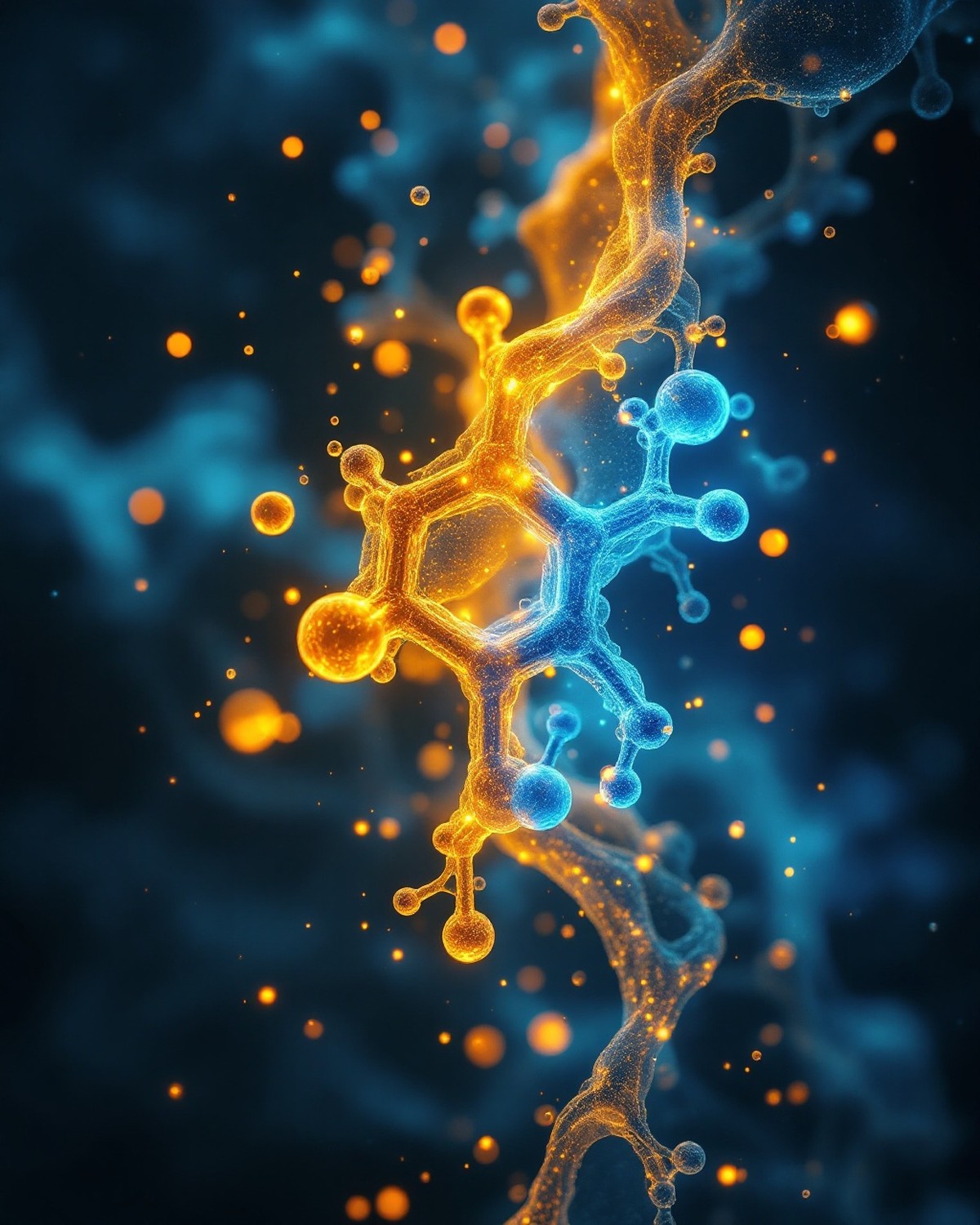
Every history of LSD begins in a Swiss laboratory in 1938. But the molecule Albert Hofmann modified that year was not his invention — it was ergine, d-lysergic acid amide, or LSA, a compound that fungi and a handful of flowering vines had been making for far longer, and that Aztec priests almost certainly consumed centuries earlier as the sacred seeds called ololiuhqui. LSA is LSD stripped of its cleverest chemical trick: it hits the same serotonin receptor, but roughly ten to twenty times more weakly, and produces not a brighter, sharper world but a heavy, dream-like, often nauseating drowsiness closer to the edge of sleep. This is the neuroscience of the older, blunter, naturally-occurring cousin of the most famous psychedelic ever made.
One molecule, two accidents of chemistry
The story of LSA is really the story of a molecular skeleton called the ergoline — a four-ring structure, part indole and part quinoline, that nature builds through the fungus Claviceps purpurea (the ergot that infects rye) and, independently, through a handful of morning-glory vines. From that skeleton the ergot fungus makes a large family of ergot alkaloids: the uterotonic ergometrine, the migraine drug ergotamine, and, at the simple end of the family, lysergic acid and its amide, ergine — which is what “LSA,” d-lysergic acid amide, refers to (Schiff, Ergot and its alkaloids, 2006). Its close isomer iso-ergine differs only in the three-dimensional arrangement at one carbon and readily interconverts with ergine; seed extracts always contain both.
The relationship to LSD is almost absurdly direct. Lysergic acid diethylamide is ergine with two ethyl groups hung on the amide nitrogen. Albert Hofmann made that modification in 1938 while working through a series of lysergic acid derivatives at Sandoz (Britannica), and it is the single reason LSD is active at micrograms while LSA requires milligrams — a potency gap of roughly a thousandfold at the level of a dose, and something like ten to twenty times weaker at the receptor itself. LSA is, in a real sense, what LSD is before the chemistry that made it famous: the naturally-occurring parent form, with LSD the laboratory child.
Ololiuhqui: the Aztec seeds and Hofmann’s 1960 surprise
Long before any of this chemistry, the seeds carrying LSA were sacred. Sixteenth-century Spanish chroniclers, above all the physician Francisco Hernández, described ololiuhqui — the round, brownish seeds of the morning-glory vine Turbina corymbosa (also called Rivea corymbosa) — as a divinatory intoxicant used by Aztec priests to commune with the gods and diagnose illness (Ololiuhqui ethnobotany). A second seed, tlitliltzin (from the black-seeded Ipomoea morning glories), served a parallel role. Colonial authorities condemned the practice, but it survived quietly among Indigenous peoples of southern Mexico.
For centuries the pharmacology was a mystery. The twist came in 1960, when Albert Hofmann — the same chemist who had synthesized LSD — obtained authentic ololiuhqui seeds and, with Hans Tscherter, isolated and crystallized their active alkaloids (Hofmann & Tscherter, Experientia 1960). To wide surprise, the principal constituents were lysergic acid amide (ergine), iso-ergine, and related ergolines — the natural cousins of Hofmann’s own laboratory creation. The finding was so unexpected that some chemists initially suspected contamination; it held up. As Hofmann later put it, the discovery meant that LSD “actually belongs to the group of sacred Mexican drugs.”
The seeds themselves
Today the two sources that matter most are Hawaiian baby woodrose (Argyreia nervosa), a robust climbing vine whose large, hairy seeds are the richest common source of LSA at roughly 0.14% by dry weight, and the ornamental morning glories Ipomoea tricolor and I. violacea (varieties sold as “Heavenly Blue” and “Pearly Gates”), which contain far less — on the order of 0.02% (Argyreia nervosa). Crucially, LSA never occurs alone. The seeds are a complex alkaloid soup — analyses of Argyreia nervosa have identified ergine and iso-ergine alongside chanoclavine, elymoclavine, agroclavine, lysergol, ergometrine, and a dozen others (Paulke et al., Forensic Sci Int 2015) — and the mix, plus the coatings discussed below, is much of why swallowing raw seeds is so physically unpleasant.
Precisely-Dosed Psilocybin Mushroom TreatsOOTW Psilocybin Mushroom Treats
Precisely-dosed, lab-tested, quality psilocybin mushroom treats — crafted for daily ritual, neural support, and sustained clarity. Journal readers: 10% off your first order with code JOURNAL10 (applied automatically at checkout).
Claim 10% Off →Mechanism: the same receptor, a duller key
At the neuroscience core, LSA is a classic serotonergic psychedelic by mechanism: it acts as a partial agonist at the serotonin 5-HT2A receptor, the cortical receptor whose activation on layer-5 pyramidal neurons underlies the perceptual effects of LSD, psilocybin, and mescaline (Nichols, Psychedelics, 2016). Receptor-profiling work on Argyreia nervosa alkaloids — the most detailed pharmacology available for LSA — confirms measurable affinity at 5-HT2A (around pKi 7.6) and even higher affinity at 5-HT1A (around pKi 8.0), together with meaningful binding at α1- and α2-adrenergic receptors and dopamine D2 sites (Paulke et al., J Ethnopharmacol 2013). This is recognizably the LSD receptor fingerprint — but shifted and blunted: across essentially every target tested, LSA binds more weakly than LSD.
Two consequences follow. First, the lower 5-HT2A potency and partial agonism mean LSA produces a shallower, less visually organized psychedelic effect than LSD at any tolerable dose; the crisp geometric visuals and lucid cognition that define an LSD experience are largely absent. Second, the relatively strong 5-HT1A and adrenergic engagement helps explain LSA’s very different texture. 5-HT1A agonism is broadly sedating and anxiolytic-to-dysphoric, and the ergoline’s adrenergic and vascular actions add the autonomic heaviness — the drowsiness, the muddiness, the body load. Where LSD tilts the system toward wakeful, kaleidoscopic activation, LSA tilts it toward a heavy, dream-like drowsiness. Same doorway, a much duller key, and a room that feels more like the threshold of sleep than a lucid vision.
What it actually feels like
Reported effects begin 20–60 minutes after ingestion and last roughly 4–8 hours, with lingering drowsiness that can stretch toward twelve. But the defining feature is sedation. Users consistently describe a heavy-limbed, dreamy, oneiric state — closed-eye imagery and a drifting, semi-lucid quality rather than open-eye visual clarity — frequently shading into an uncomfortable, dysphoric drowsiness. A German human study of Argyreia nervosa seeds went so far as to characterize the psychic effects as sedative-narcotic, “very different from those of LSD” and closer in flavor to the heaviness of an anticholinergic like scopolamine (Paulke et al., Anal Bioanal Chem 2012). Accompanying almost every account are nausea and vomiting, stomach cramps, vasoconstriction (cold, tingling extremities), dizziness, and pupil dilation. Much of the nausea is attributed not to ergine itself but to the other seed constituents and coatings (PsychonautWiki). This is not, by most descriptions, a recreational experience people repeat casually.
Pharmacokinetics and the dosing context
Because OOTW does not publish dosing, the useful frame here is pharmacological, not practical. LSA is active in the milligram range — dramatically more than the microgram doses of LSD — which is why traditional and contemporary use is measured in seed counts rather than by weight of pure compound. Analytical work has detected LSA in human serum and urine after seed ingestion at low nanogram-per-milliliter concentrations, confirming that ergine is genuinely absorbed and circulates (Paulke et al. 2012). The honest takeaway is that seed potency is highly variable between species, varieties, batches, and even individual seeds, and that the physically demanding, long, sedating course of the experience is intrinsic to the pharmacology, not incidental.
AI That Understands The MedicineOOTW Spirit Guide
Set. Setting. Dose. Integration. The questions you can’t bring to your doctor — answered by an AI grounded in every peer-reviewed paper, protocol, and ceremony manual. Private, sober, always there.
Talk to the Spirit Guide → A Sacred 5-MeO-DMT Ceremony · MiamiJoin the OOTW Sacrament
The oldest prayer, remembered — the gentle dissolving of the self into light, held in ceremony by a master facilitator. Sit with our community first: a free, live weekly circle on Zoom. No commitment, simply a conversation.
Join the Weekly Circle →Safety: vasoconstriction, coatings, and interactions
The honest safety picture has three main strands, none of them dramatized but none dismissible.
First, ergot-alkaloid vasoconstriction. The ergolines as a class constrict blood vessels — it is why ergotamine treats migraine and why ergometrine/ergonovine control post-partum bleeding — and the seeds contain those uterotonic, vasoconstrictive alkaloids alongside ergine (Schiff 2006). In classical ergotism (“St. Anthony’s Fire”), sustained ergot exposure caused severe peripheral vasoconstriction and, in extreme historical cases, gangrene. Ordinary LSA use does not approach that, but the mechanism is real: the characteristic cold, tingling limbs are peripheral vasoconstriction, and the theoretical concern is meaningful for anyone with cardiovascular disease or hypertension, anyone combining the seeds with other vasoconstrictors (stimulants, triptans, decongestants), and especially in pregnancy, where uterotonic ergolines are genuinely contraindicated.
Second, the seeds are frequently coated. Ornamental seeds sold for gardening are often treated with fungicides, pesticides, or bittering agents — sometimes specifically to deter ingestion — and these coatings can cause severe nausea and their own toxicity independent of any LSA (Erowid HBW vault). Much of the acute misery, and some of the genuine danger, of raw-seed ingestion comes from what is on the seeds rather than in them.
Third, strong nausea and vomiting are the rule rather than the exception, and drug interactions deserve caution — combining an adrenergically and serotonergically active ergoline with other serotonergic or vasoactive drugs is unwise, and the interaction data specific to LSA are essentially absent. Documented poisoning cases from Hawaiian baby woodrose seeds describe nausea, vomiting, agitation, anxiety and panic, dizziness, dilated pupils, racing heart, and elevated blood pressure — rarely life-threatening in isolation, but a reminder that “natural” and “legal” do not mean benign (RIVM risk assessment 2019). This is deliberately not a how-to; the harm-reduction point is simply that LSA’s discomforts and its cardiovascular cautions are inseparable from its ergot-alkaloid nature.
Precisely-Dosed Psilocybin Mushroom TreatsBring the Science Home
Every article here is the why. OOTW’s precisely-dosed, lab-tested, quality psilocybin mushroom treats are the how — crafted to carry the medicine into your daily practice. Journal readers: 10% off your first order with code JOURNAL10 (applied automatically at checkout).
Claim 10% Off →Legal status in 2026
The legal picture is a genuine mismatch. In the United States, ergine (lysergic acid amide) is a Schedule III controlled substance under the Controlled Substances Act (DEA code 7310) — notably a lower schedule than LSD’s Schedule I, reflecting its listing as a sedative-type ergot alkaloid rather than a high-abuse hallucinogen (DEA Orange Book). Yet the plants and their seeds are generally unregulated as ornamentals: morning glory and Hawaiian baby woodrose seeds are sold legally in garden shops and online across most of the US, and there is no federal prohibition on possessing the seeds themselves — the control attaches to the isolated compound. The practical line is that extracting or preparing LSA for consumption is what crosses into controlled-substance territory. Internationally the picture varies sharply: the seeds are uncontrolled in Germany and available as ornamentals in the UK, while Australia restricts Argyreia nervosa seeds, and countries such as Italy and Poland control Hawaiian baby woodrose specifically (country-by-country overview). (Regulatory status changes and varies by jurisdiction; confirm current local rules before relying on any of this.)
The honest bottom line
LSA is best understood as LSD’s older, plainer, naturally-occurring relative — the same ergoline skeleton and the same 5-HT2A doorway, but weaker, heavier, and far less studied. It carries real historical weight as the likely active principle of Aztec ololiuhqui, and real scientific interest as the molecule whose relationship to LSD taught chemists how a tiny modification can transform a compound’s power. But the accurate account holds the limits in view: the psychedelic effect is shallow and sedating rather than lucid; the experience is reliably accompanied by nausea and vasoconstriction; the coated commercial seeds are a distinct hazard; and the modern clinical and pharmacological literature on LSA specifically is thin, with much of what we know inferred from a handful of receptor and analytical studies and from its famous cousin (systematic review, Pharmacy 2025). It is a fascinating natural bridge between a fungus, a flower, and the most storied psychedelic ever made — and a compound whose real profile is more dreamy, drowsy, and physically demanding than its LSD lineage might suggest.
OOTW Journal is educational and does not provide medical advice. LSA is a naturally-occurring ergot alkaloid with vasoconstrictive properties; it is contraindicated in pregnancy and in cardiovascular disease, and it should not be combined with other vasoconstrictors or serotonergic drugs. Commercially sold ornamental seeds are frequently treated with fungicides, pesticides, or other coatings that are toxic if ingested. This article is not a guide to using these seeds or compounds. Ergine is a controlled substance in the United States and elsewhere; anyone experiencing a suspected poisoning should seek emergency care or contact Poison Control (1-800-222-1222 in the US).