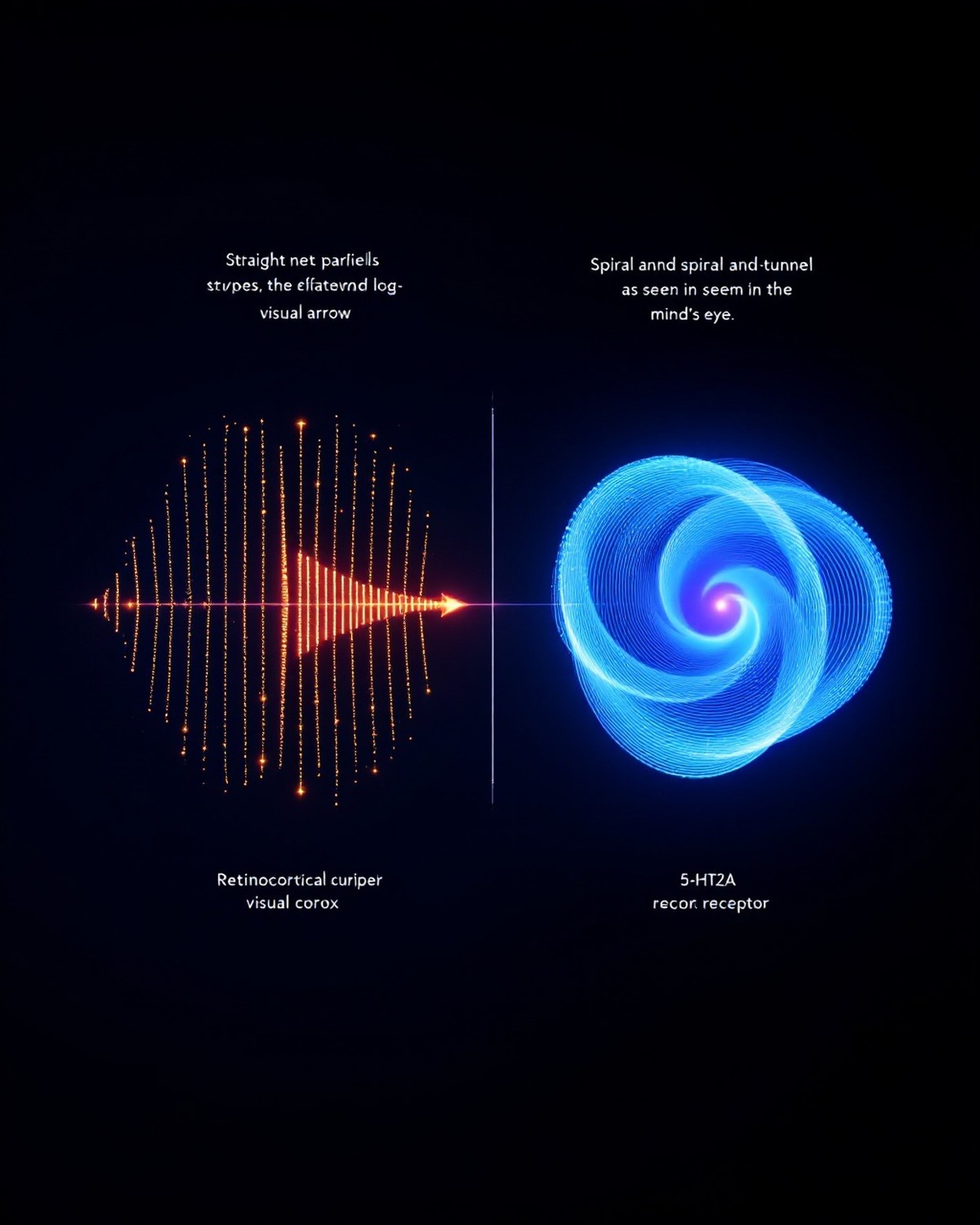
Why do psychedelics make you see geometric patterns? Classic psychedelics activate the 5-HT2A receptor, which sits densely on excitatory neurons in the visual cortex. This causes disinhibition — the brain’s normal “volume control” is turned down, and the visual cortex begins generating its own spontaneous activity. Because of the precise, mathematical way the eye maps onto the cortex (the retinocortical map), simple stripes of activity spreading across the flat cortical sheet are seen as spirals, tunnels, lattices, and honeycombs — the recurring shapes the psychologist Heinrich Klüver named “form constants.” The elegant Ermentrout–Cowan model showed the math works out exactly. So the geometry isn’t coming from outside — it is the structure of your visual brain, made visible. The same patterns appear in migraine, near-death, and sensory deprivation for the same reason. Education, not medical or use advice.
Ask a hundred people to describe what they saw on a psychedelic and, beneath all the personal detail, an uncanny agreement emerges. Again and again: honeycombs and chessboards, cobwebs, funnels and tunnels rushing toward a point, and spirals winding inward. These are not arbitrary. In the 1920s, the psychologist Heinrich Klüver catalogued them so consistently across mescaline users that he gave them a name — “form constants” — and the deep question of neuroscience ever since has been simple to ask and gorgeous to answer: why these shapes, and why the same ones for everyone?
The answer weaves together a serotonin receptor, the wiring diagram of the visual system, and a piece of mathematics so clean it feels like a magic trick. To see it, we build up in three steps: the receptor that flips the switch, the map that shapes what you see, and the math that ties them together.
Step one: the receptor that turns down the brakes
Classic psychedelics — LSD, psilocin (from psilocybin), mescaline, and DMT — share one master mechanism: they are agonists at the serotonin 5-HT2A receptor. This is not incidental to the visuals; it is the cause. Give someone the 5-HT2A blocker ketanserin first, and the characteristic effects of LSD — including the visual ones — largely vanish. The receptor is the switch (Translational Psychiatry, 2025).
Where that switch sits matters enormously. The 5-HT2A receptor is expressed densely on layer-5 pyramidal neurons — large excitatory cells — throughout the cortex, including the visual cortex. When a psychedelic activates these receptors, it makes those neurons more excitable and, critically, reduces the normal inhibition that keeps cortical activity in check. Neuroscientists call this disinhibition. Think of the visual cortex as an orchestra usually held to a tight score by a strict conductor. Psychedelics fire the conductor. The musicians — the neurons — begin to play on their own.
Step two: the map that turns stripes into spirals
Now the beautiful part. To understand what those self-playing neurons look like from the inside, you need to know how the eye is wired to the brain. The image on your retina is not copied faithfully onto the visual cortex like a photo. Instead it is distorted according to a precise mathematical rule — a transformation that mathematicians recognise as a complex logarithm, sometimes called the log-polar or retinocortical map (PNAS).
This map has a startling consequence. Under it, the shapes we experience as concentric circles, radiating rays, and spirals in our visual field become simple, straight, parallel stripes of activity on the flat sheet of the cortex. The relationship runs both ways. So here is the key inversion: if, for whatever reason, the visual cortex spontaneously generates plain stripes of activity — the simplest pattern a disinhibited sheet of neurons can make — your brain, reading them back through the map, will experience them as tunnels, spirals, funnels, and lattices. The geometry you see is the cortex’s simple striped activity, bent through the lens of your own visual wiring. Stripes in the cortex; spirals in the mind.
Precisely-Dosed Psilocybin Mushroom TreatsOOTW Psilocybin Mushroom Treats
Precisely-dosed, lab-tested, quality psilocybin mushroom treats — crafted for daily ritual, neural support, and sustained clarity. Journal readers: 10% off your first order with code JOURNAL10 (applied automatically at checkout).
Claim 10% Off →Step three: the math that ties the knot
This is where the story becomes genuinely thrilling. In 1979, mathematicians Bard Ermentrout and Jack Cowan asked what patterns a sheet of cortical neurons would spontaneously form once you increased its excitation and weakened its inhibition — exactly the condition psychedelics create. Using the same kind of mathematics Alan Turing had used to explain spots and stripes on animal coats, they showed that such a system undergoes a spontaneous symmetry-breaking: out of uniform noise, it self-organises into regular patterns of stripes and hexagons. And when those cortical patterns are mapped back through the retinocortical transform, they become — precisely, mathematically — Klüver’s form constants (Form constant).
Two decades later, in 2001 and 2002, Paul Bressloff, Jack Cowan, Martin Golubitsky, Peter Thomas and Matthew Wiener extended the model to include the visual cortex’s sensitivity to line orientation. Their richer model could generate the entire catalogue — not just tunnels and spirals but the intricate honeycombs, lattices, and cobwebs too. The upshot is one of the most satisfying results in theoretical neuroscience: the specific geometry of a psychedelic vision is a direct, predictable consequence of how the visual cortex is built. You are, quite literally, seeing the wiring diagram of your own brain (Quanta Magazine).
A caveat worth keeping honest: these are elegant, widely accepted mathematical models with remarkable explanatory power, not something yet photographed directly in a hallucinating human cortex. But the fit between the theory and what people actually see is close enough that it stands as the leading explanation.
Simple visions and complex ones
Not all psychedelic visuals are geometry. Researchers distinguish two broad levels. “Simple” hallucinations are the form constants — the spirals, grids, and tunnels — and these arise in the early visual cortex (area V1), the first cortical stop for vision, where the story above unfolds. “Complex” hallucinations are different: meaningful, structured scenes — faces, figures, landscapes, whole narrative worlds. These involve higher visual and association areas, where the brain builds meaning, and they lean heavily on the mind’s expectations and memories flowing backward onto perception.
The two are best pictured as ends of a spectrum rather than a clean divide — complex visions often shimmer with geometric elements, and the same disinhibited, hyper-connected brain underlies both. As doses climb, many people describe the geometry gradually organising itself into scenes, as if the raw lattice were being upholstered with meaning.
The signature of a brain set free
Zoom out from the visual cortex and the same theme repeats across the whole brain. Under psychedelics, the EEG shows a consistent drop in alpha waves — the roughly 8–13 Hz rhythm that normally dominates the resting, eyes-closed brain, especially over the visual areas at the back of the head. Alpha is thought to reflect the brain’s ordinary inhibitory gating of sensory activity; as it falls, visual richness rises. In studies of DMT, the collapse of alpha power tracks almost exactly with the emergence of intense visual imagery (Timmermann et al., 2019).
At the same time, the brain’s activity becomes more diverse, complex, and unpredictable — a finding that gave rise to Robin Carhart-Harris’s “entropic brain” hypothesis. Signal-diversity measures rise reliably with a psychedelic dose and scale with how intense the experience feels. The picture is coherent: turn down the inhibition, and the visual cortex — and the whole cortex — slips from its tightly ordered resting state into a freer, more spontaneous, pattern-generating mode. The visions are what that freedom looks like from the inside.
AI That Understands The MedicineOOTW Spirit Guide
Set. Setting. Dose. Integration. The questions you can’t bring to your doctor — answered by an AI grounded in every peer-reviewed paper, protocol, and ceremony manual. Private, sober, always there.
Talk to the Spirit Guide → A Sacred 5-MeO-DMT Ceremony · MiamiJoin the OOTW Sacrament
The oldest prayer, remembered — the gentle dissolving of the self into light, held in ceremony by a master facilitator. Sit with our community first: a free, live weekly circle on Zoom. No commitment, simply a conversation.
Join the Weekly Circle →Why the same shapes appear at the edge of death and sleep
Here is the clue that proves the shapes belong to the brain and not the drug. The exact same form constants — the spirals, tunnels, lattices, and cobwebs — show up in an astonishing range of conditions that have nothing to do with psychedelics: migraine aura, the hypnagogic imagery on the edge of sleep, flickering-light and blank-field (Ganzfeld) stimulation, sensory deprivation, fever delirium, and near-death experiences, with their famous tunnel toward the light.
What unites this wild list is not a chemical but a state: in every case, the visual cortex is either over-excited or cut off from its normal orderly input, and left to generate activity on its own. When it does, it falls into the same handful of patterns — because those patterns are baked into its structure. The geometry is universal precisely because the wiring is universal. As one summary of the field puts it, the diversity of triggers “suggests that form constants reflect some fundamental property of visual perception.” The drug is just one of many keys that open the same door.
The wonder, kept honest
There is something quietly profound in all of this. The swirling, sacred-seeming geometry that so many describe as a glimpse of another dimension turns out to be a glimpse of something at least as astonishing: the hidden mathematical order of your own mind, ordinarily invisible, briefly made visible when the brakes come off. It does not diminish the experience to understand it. If anything, it deepens the awe — that folded inside three pounds of tissue is a structure so precise that, disturbed just so, it paints spirals and honeycombs the same way for a mescaline user in 1926 and a psilonaut today.
OOTW Journal is educational and does not provide medical advice. Classic psychedelics are powerful, largely illegal (Schedule I) substances that can trigger lasting perceptual changes (such as HPPD) and can be dangerous for people with a personal or family history of psychosis. This article explains the neuroscience of a phenomenon; it is not a guide to using any substance. If you are in crisis, contact a local emergency line or the 988 Suicide and Crisis Lifeline (US).