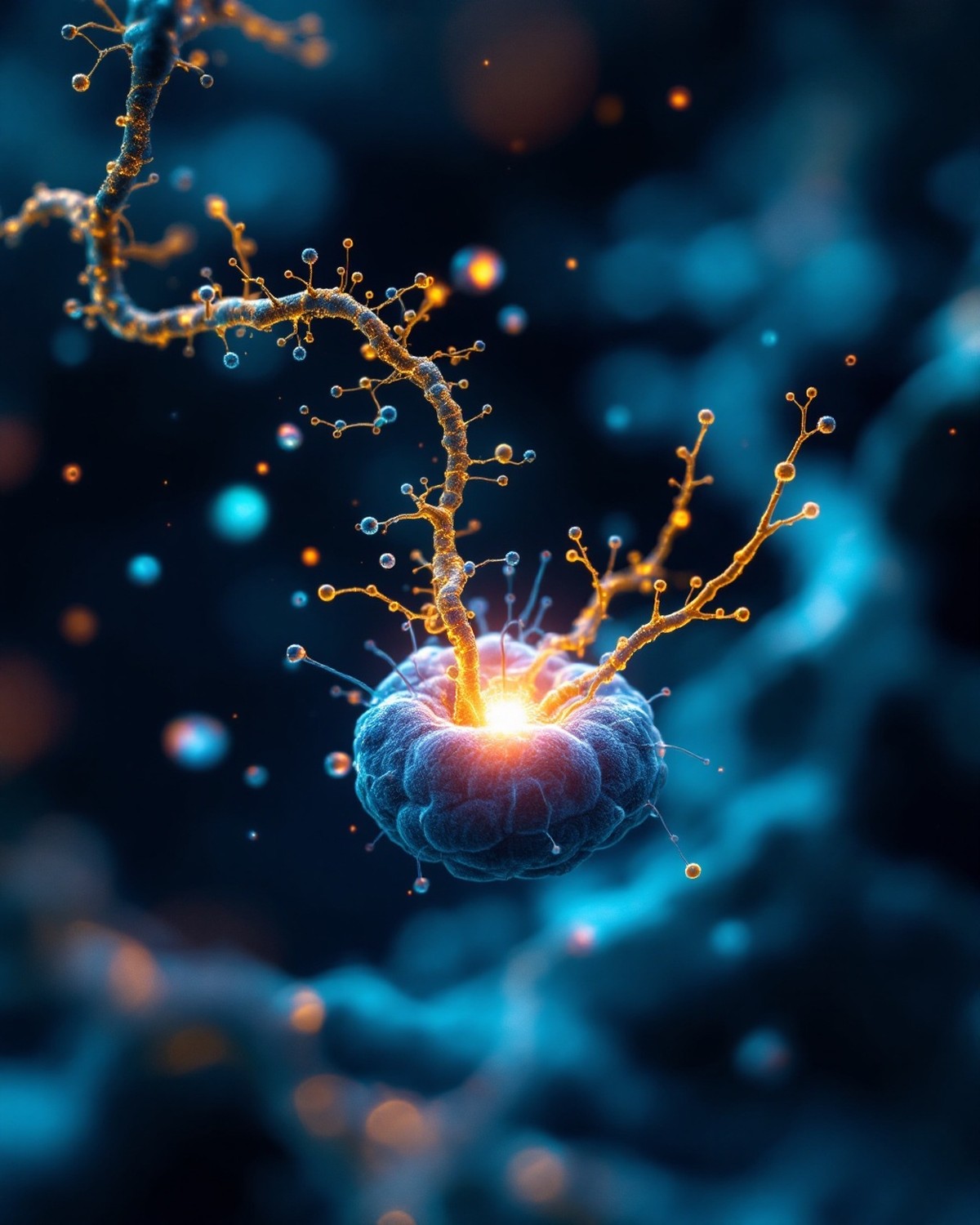
How does ketamine work as an antidepressant? Ketamine is an NMDA-receptor antagonist — it blocks one of the brain’s main glutamate receptors. The twist is that it preferentially silences NMDA receptors on inhibitory (GABA) interneurons, taking the brakes off nearby neurons. The result is a brief surge of glutamate that switches on AMPA receptors and triggers BDNF and the mTOR growth pathway, driving the rapid regrowth of synapses in the prefrontal cortex — connections that chronic stress and depression had pruned away. Because this is a structural rebuild rather than a slow chemical rebalancing, it works in hours, not weeks. A newer clue is that a ketamine metabolite (HNK) may drive part of the effect through AMPA without needing NMDA at all. In 2025 the S-form, esketamine (Spravato), became the first standalone medicine approved for treatment-resistant depression.
For half a century, ketamine had two reputations and neither was “antidepressant.” To anesthesiologists it was a uniquely safe surgical anesthetic that didn’t suppress breathing. To the dance floor it was a dissociative that dissolved the self into the famous “K-hole.” Then, around the turn of the millennium, a handful of psychiatrists tried something that sounded almost reckless — giving a tiny dose to people with severe, medication-resistant depression — and watched something that shouldn’t have been possible: the depression lifted within hours.
That single observation broke open decades of assumptions. Depression, the textbooks said, was about serotonin, and fixing it took weeks. Ketamine works on glutamate, and it works almost immediately. We’ve looked at how psilocybin quiets the default mode network and how MDMA opens the fear circuits; ketamine is a third, entirely different doorway — and understanding it starts with one receptor. (Educational overview only — not medical or use advice.)
What ketamine actually is
Ketamine was synthesized in 1962 as a safer successor to PCP and became a battlefield and operating-room anesthetic prized for one quality: at anesthetic doses it produces profound pain relief and dissociation without shutting down breathing or blood pressure the way other anesthetics do. It is a dissociative anesthetic — not a classic serotonergic psychedelic like psilocybin or LSD, and not a stimulant. At the sub-anesthetic doses used in psychiatry (a fraction of a surgical dose), it produces a short window of altered perception, floating detachment, and sometimes mystical or out-of-body feelings (Wikipedia: Ketamine).
One more detail matters for the story: ketamine is chiral — it comes as two mirror-image molecules, S-ketamine (esketamine) and R-ketamine (arketamine). Standard medical ketamine is a 50/50 racemic mix; the S-form binds the NMDA receptor more tightly and became the basis of the approved nasal spray, while the R-form is under study as a possibly gentler antidepressant. But whichever form, the door it opens is the same one.
The NMDA receptor: the brain’s master switch
To understand ketamine you have to meet glutamate, the brain’s primary excitatory neurotransmitter — the “go” signal behind most of what your cortex does, including learning and memory. Glutamate acts on several receptors, and the most important for our story is the NMDA receptor: a channel that only opens when two conditions are met at once, which makes it a molecular coincidence detector at the heart of how synapses strengthen. Ketamine is an NMDA-receptor antagonist — it slips inside the open channel and plugs it, at the very same site once occupied by PCP (Krystal et al., Neuron 2019).
Here is the puzzle that stumped everyone at first. Glutamate and NMDA receptors drive excitation. If you block the brain’s main excitatory switch, you would expect things to slow down — and at high doses they do, which is why ketamine is an anesthetic. So how could blocking excitation lift depression, a state that already feels like everything has slowed to a stop? The answer is one of the most elegant surprises in modern neuroscience.
Precisely-Dosed Psilocybin Mushroom TreatsOOTW Psilocybin Mushroom Treats
Precisely-dosed, lab-tested, quality psilocybin mushroom treats — crafted for daily ritual, neural support, and sustained clarity. Journal readers: 10% off your first order with code JOURNAL10 (applied automatically at checkout).
Claim 10% Off →The paradox: block the brakes, not the engine
The resolution is about which neurons ketamine hits first. At the low doses used for depression, ketamine preferentially blocks NMDA receptors sitting on inhibitory GABA interneurons — the cells whose whole job is to quiet other neurons. Silence the silencers, and you have taken the brakes off the system. The neighbouring excitatory neurons, suddenly disinhibited, fire more freely and release a brief, sharp surge of glutamate. So the counter-intuitive truth is that an NMDA blocker ends up causing a glutamate burst — not by pressing the engine, but by cutting the brakes (Duman & Aghajanian, Science 2012). That surge is the spark that lights everything else.
The surge, the regrowth: how synapses come back
That pulse of glutamate lands on a different receptor — the AMPA receptor — and this is the pivot of the whole antidepressant effect. AMPA activation triggers the release of BDNF (brain-derived neurotrophic factor), the brain’s master growth signal, which switches on the mTOR pathway inside neurons. mTOR is, in effect, the construction crew: within hours it drives the building of new dendritic spines — the tiny connection points between neurons — in the prefrontal cortex (Li et al., Science 2010).
Why does that matter? Because one of the most robust findings in depression neuroscience is that chronic stress prunes synapses — it literally shrinks the dendrites and thins the connections in the prefrontal cortex and hippocampus. In this model, depression is partly a disorder of lost connectivity, and the slow-acting SSRIs work, when they do, by gradually coaxing that circuitry back. Ketamine short-circuits the timeline: it triggers a rapid structural rebuild of the very synapses stress tore down. That is why the lift can arrive in hours rather than weeks — you are not waiting on a chemical to rebalance, you are watching the wiring come back (Duman & Aghajanian, 2012).
AI That Understands The MedicineOOTW Spirit Guide
Set. Setting. Dose. Integration. The questions you can’t bring to your doctor — answered by an AI grounded in every peer-reviewed paper, protocol, and ceremony manual. Private, sober, always there.
Talk to the Spirit Guide → A Sacred 5-MeO-DMT Ceremony · MiamiJoin the OOTW Sacrament
The oldest prayer, remembered — the gentle dissolving of the self into light, held in ceremony by a master facilitator. Sit with our community first: a free, live weekly circle on Zoom. No commitment, simply a conversation.
Join the Weekly Circle →Hours, not weeks
The clinical story that forced psychiatry to take all this seriously began with a small 2000 study and crystallised in a landmark 2006 trial led by Carlos Zarate at the NIMH. Patients with depression that had resisted multiple medications received a single intravenous infusion of ketamine — and improved dramatically within two hours, with the benefit lasting about a week (Zarate et al., Arch Gen Psychiatry 2006). For a field where every antidepressant took a month to work, an effect measured in hours was almost heretical. Just as striking, ketamine was later shown to rapidly reduce suicidal thinking — a genuinely new capability in psychiatry, where nothing else works that fast on acute suicidality. The catch, then and now, is durability: a single dose fades in days to a couple of weeks, which is why treatment uses repeated, spaced sessions.
The dissociation — and whether it matters
At the doses that treat depression, ketamine also produces its signature dissociation: a floating detachment from body and self, altered time, sometimes a sense of watching yourself from outside. This comes from ketamine’s disruption of thalamocortical signalling — loosening the normal binding of sensory information into a single seamless self-model. A live debate runs through the field: is the dissociative experience just a side effect riding along with the molecular repair, or is the altered state itself part of how it heals, the way set and setting matter for psychedelics? The honest answer is that we don’t fully know yet — trials are actively testing whether the subjective experience adds to the biochemical effect (Krystal et al., 2019).
The metabolite twist
Just when the NMDA story looked settled, a 2016 study complicated it beautifully. Researchers found that a metabolite of ketamine — (2R,6R)-hydroxynorketamine (HNK) — produced antidepressant-like effects in mice without blocking NMDA receptors at all, working instead directly through AMPA (Zanos et al., Nature 2016). This suggested that at least part of ketamine’s magic might be NMDA-independent — a finding that reframed the search for a next-generation antidepressant that could keep the healing without the dissociation or abuse potential. The debate isn’t fully resolved, but it’s a reminder that even a “known” mechanism can still surprise us. Whichever pathway dominates, all roads converge on the same destination: AMPA → BDNF → synaptic regrowth.
Precisely-Dosed Psilocybin Mushroom TreatsBring the Science Home
Every article here is the why. OOTW’s precisely-dosed, lab-tested, quality psilocybin mushroom treats are the how — crafted to carry the medicine into your daily practice. Journal readers: 10% off your first order with code JOURNAL10 (applied automatically at checkout).
Claim 10% Off →From anesthetic to medicine
Racemic ketamine itself is a cheap, generic, off-patent drug, so for years it was used off-label — given as IV infusions in specialty clinics for depression. The pharmaceutical breakthrough came in 2019, when the FDA approved esketamine (Spravato), a nasal-spray form of the S-enantiomer, for treatment-resistant depression — initially only alongside an oral antidepressant. Then, in January 2025, the FDA approved esketamine as the first-ever standalone (monotherapy) treatment for treatment-resistant depression, on the strength of a Phase 4 trial in which 22.5% of patients reached remission at four weeks versus 7.6% on placebo, with improvement visible within 24 hours (HCPLive, 2025). Because of the sedation, dissociation and abuse potential, Spravato is dispensed only under a strict monitoring program — taken in a certified clinic with observation afterward, never at home.
The honest risks
Ketamine is genuinely useful and genuinely not harmless. Acutely it raises heart rate and blood pressure and causes the dissociation and sedation that require medical monitoring. Its most distinctive long-term danger appears with frequent, heavy use: ketamine-induced cystitis, a painful and sometimes irreversible inflammation and scarring of the bladder, first documented in chronic recreational users (Wikipedia: Ketamine). Ketamine also has real abuse and dependence potential — it is a controlled substance and can be psychologically habit-forming, which is precisely why the therapeutic model is a limited number of supervised, spaced sessions rather than open-ended access. And because the effect of a single dose fades, treatment raises hard questions about maintenance and relapse. The gap between a carefully dosed clinical infusion and unsupervised repeated use is wide, and it is where most of the harm lives. (Educational context only — not medical or use advice.)
The honest bottom line
Ketamine did something rare in medicine: it didn’t just add a treatment, it changed the theory. By lifting depression in hours through glutamate and the physical regrowth of synapses, it recast depression as, in part, a disorder of lost connections that can be rebuilt — and it opened the whole field of rapid-acting antidepressants now chasing its mechanism without its baggage. It is not a cure, its effects fade, and it carries real risks that demand supervision. But the core discovery is genuine and beautiful: block the brain’s main excitatory switch in just the right place, and you can set off a wave of repair. It is one of the most important things psychiatry has learned about itself in fifty years.
OOTW Journal is educational and does not provide medical advice.Ketamine and esketamine are potent controlled substances that cause sedation, dissociation, and raised blood pressure, carry real abuse and dependence potential, and can damage the bladder with heavy use. The clinical results described here come from supervised treatment in certified settings with medical monitoring, and do not imply that unsupervised use is safe or advisable. If you are struggling with depression or suicidal thoughts, please reach out to a qualified professional or a crisis line.