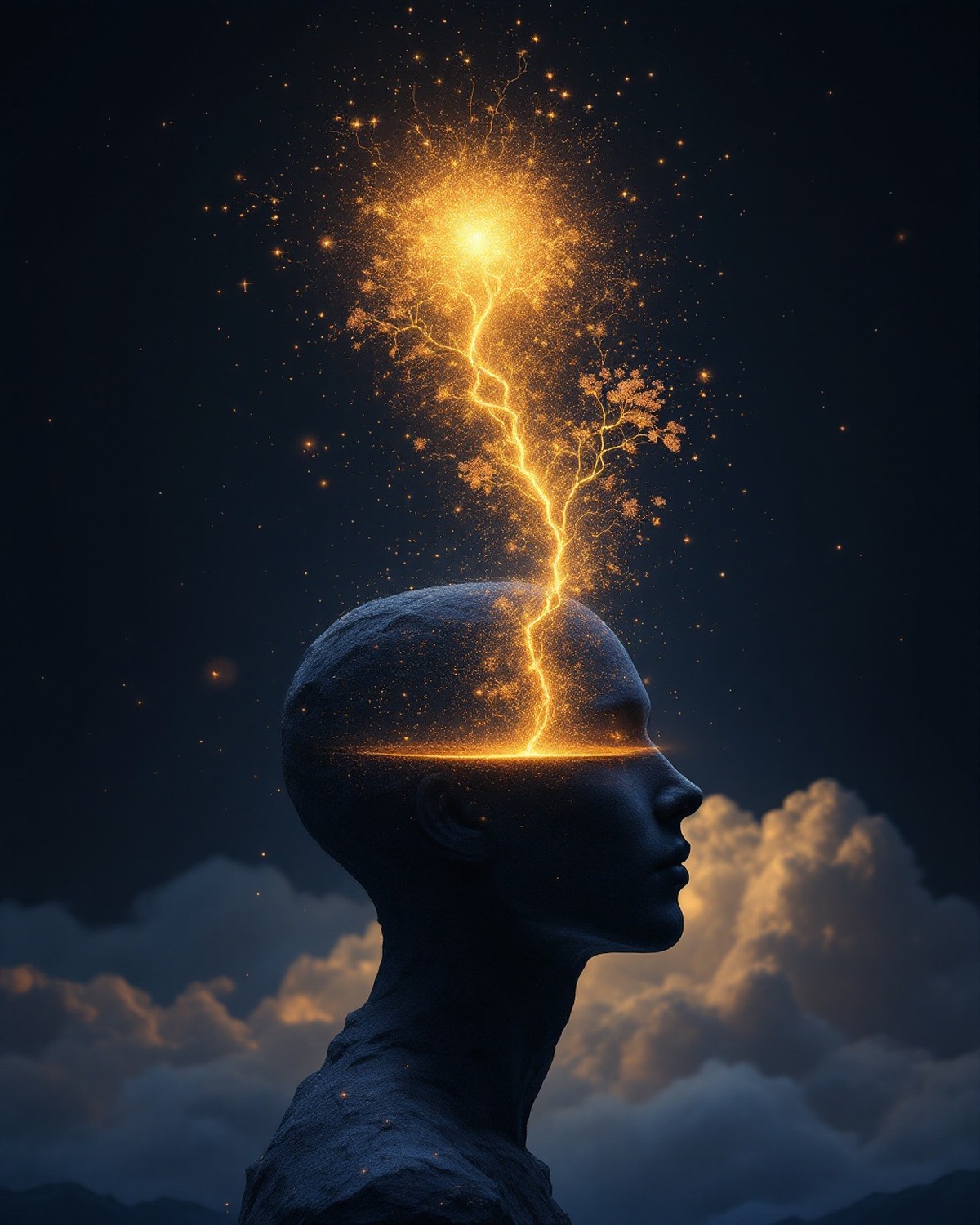
Can a psychedelic change your personality? To a real but specific degree, yes. In a landmark study, a single high-dose psilocybin session significantly raised Openness — one of the Big Five traits — and it remained elevated more than a year later, but only in participants who had a complete mystical-type experience (MacLean et al., 2011). In depression patients, psilocybin also lowered Neuroticism and raised Extraversion and Openness (Erritzoe et al., 2018). This matters because personality is supposed to be stable after about age 30 — and because the Openness change is not simply explained by people becoming less depressed.
Personality is the part of us we treat as fixed — the reliable shape of a person, the thing friends can predict and therapists work around. Decades of research back that intuition: after early adulthood, the Big Five traits barely budge. Which is exactly why one line of psychedelic research is so startling. It suggests that a single, carefully held experience can shift a core trait in a lasting way — not by force of habit over years, but through one profound afternoon. The finding is real, it is specific, and it comes with important caveats. This is what the evidence actually says.
The dogma: personality is fixed after 30
For most of modern psychology, one finding has been treated as close to a law: core personality is stable in adulthood. Longitudinal studies tracking people for decades show that after roughly age 30, the big traits settle and drift only slowly. This is why, to researchers’ knowledge, no study had ever demonstrated a change in personality in healthy adults following a single, experimentally controlled event. Traits were the bedrock; experiences happened on top of them. Against that backdrop, the claim that a few hours could move a trait — and keep it moved — was not a modest one. It needed strong evidence.
A quick map: the Big Five
Modern personality science mostly runs on the Big Five traits, easily remembered as OCEAN: Openness (curiosity, imagination, aesthetic and intellectual exploration), Conscientiousness (discipline, organization), Extraversion (sociability, positive energy), Agreeableness (warmth, cooperation), and Neuroticism (the tendency toward anxiety, sadness and emotional reactivity). Of these, Openness is the one most tied to how a person relates to novelty, beauty, feelings and ideas — and it is the trait that keeps surfacing in psychedelic research, which makes intuitive sense: a psychedelic experience is, almost by definition, a flood of the novel and the ineffable.
The landmark finding: Openness
In 2011, Katherine MacLean and colleagues at Johns Hopkins analyzed data from healthy adults given high-dose psilocybin in a supervised setting. Across the Big Five, one trait moved: Openness rose significantly after the sessions. The remarkable part was durability. When they followed up more than a year later, Openness in the relevant participants was still elevated above baseline — a change large enough and lasting enough that, in a domain famous for stability, it stood out sharply (MacLean et al., 2011). For a trait that is supposed to be locked in by adulthood, a single afternoon had apparently turned a dial and left it turned.
Precisely-Dosed Psilocybin Mushroom TreatsOOTW Psilocybin Mushroom Treats
Precisely-dosed, lab-tested, quality psilocybin mushroom treats — crafted for daily ritual, neural support, and sustained clarity. Journal readers: 10% off your first order with code JOURNAL10 (applied automatically at checkout).
Claim 10% Off →The mystical-experience gate
Here is the finding’s most important nuance, and the reason it is about more than a drug. The rise in Openness did not happen to everyone who took psilocybin. It happened specifically in the participants who had a complete mystical-type experience — the profound sense of unity, sacredness, transcendence of time and self that these doses can occasion. Those who took the same drug but did not cross that threshold showed no change in Openness at all. In other words, it was not the molecule alone that reshaped the trait — it was the experience the molecule made possible. This is a recurring theme across psychedelic science: the drug opens a door, but what walks through it — the quality and meaning of the experience — is what determines the lasting effect.
In patients: the fuller shift
The healthy-volunteer story is echoed, and broadened, in clinical work. When David Erritzoe and colleagues gave psilocybin with psychological support to 20 people with treatment-resistant depression, personality moved on several axes: Neuroticism fell significantly, Extraversion rose, and Openness rose as well, with Conscientiousness trending up and Agreeableness unchanged (Erritzoe et al., 2018). Tellingly, the size of these shifts was predicted by the degree of insightfulness people reported during their sessions — again pointing to the experience itself, not merely the dose, as the active ingredient. A drop in Neuroticism — the trait most tied to anxiety and depression — is exactly what you would hope to see in recovery.
Is it real, or just “less depressed”?
A careful skeptic raises the obvious objection: when depressed people get better, they naturally look less neurotic and more outgoing — so maybe these aren’t personality changes at all, just the fingerprint of feeling better. It is a fair challenge, and partly true: the shifts in Neuroticism and Extraversion probably do overlap with simply becoming less depressed, and conventional antidepressants can nudge those same traits. But Openness is the exception that makes the case. Standard antidepressants do not reliably raise Openness, and in healthy, non-depressed volunteers — who had no depression to recover from — psilocybin raised it anyway. That makes the Openness effect hard to explain away as mood relief in disguise. Something more specific is happening.
AI That Understands The MedicineOOTW Spirit Guide
Set. Setting. Dose. Integration. The questions you can’t bring to your doctor — answered by an AI grounded in every peer-reviewed paper, protocol, and ceremony manual. Private, sober, always there.
Talk to the Spirit Guide → A Sacred 5-MeO-DMT Ceremony · MiamiJoin the OOTW Sacrament
The oldest prayer, remembered — the gentle dissolving of the self into light, held in ceremony by a master facilitator. Sit with our community first: a free, live weekly circle on Zoom. No commitment, simply a conversation.
Join the Weekly Circle →How can a trait change at all?
If personality is so stable, what mechanism could move it? The leading picture combines two threads this journal has covered. First, a high-dose psychedelic produces a genuinely novel state of consciousness — the dissolution of the ordinary self, a sense of expanded perspective — that can update deeply held beliefs about oneself and the world. Second, that experience lands during a window of heightened neuroplasticity, when the brain is unusually able to revise its patterns. Openness — a receptivity to new experience, ideas and feeling — is almost a description of that plastic, post-session state made durable. The trait doesn’t change by willpower or repetition; it changes because a person briefly saw and felt differently, during a period when the brain could consolidate the shift. The drug opens the window; integration builds what remains once it closes.
Precisely-Dosed Psilocybin Mushroom TreatsBring the Science Home
Every article here is the why. OOTW’s precisely-dosed, lab-tested, quality psilocybin mushroom treats are the how — crafted to carry the medicine into your daily practice. Journal readers: 10% off your first order with code JOURNAL10 (applied automatically at checkout).
Claim 10% Off →The honest limits
This is a striking body of work, but it deserves sober framing. The foundational studies are small, some lack the ideal controls, and self-reported personality questionnaires can be nudged by a person’s enthusiasm about a meaningful experience — a possible source of inflation. “Openness” is also a broad trait, and a rise on a questionnaire is not the same as a documented life change. Durability beyond a year or two is still not well mapped, and not everyone who takes a psychedelic has a mystical experience or any lasting shift at all. What the evidence supports is careful and real: under supportive conditions, a psychedelic experience — especially a mystical one — can produce a measurable, durable increase in Openness, most cleanly in the trait least explained by simply feeling better. It is a genuine crack in the dogma of the fixed adult self, not a personality rewrite on demand.
OOTW Journal is educational and does not provide medical advice. The studies described here were conducted with careful screening, preparation and supervision; psychedelics remain controlled substances in most countries and are not safe for everyone, including people with a personal or family history of psychosis or bipolar disorder. Nothing here is a recommendation to use any psychedelic. If you are struggling with your mental health, please reach out to a qualified professional.