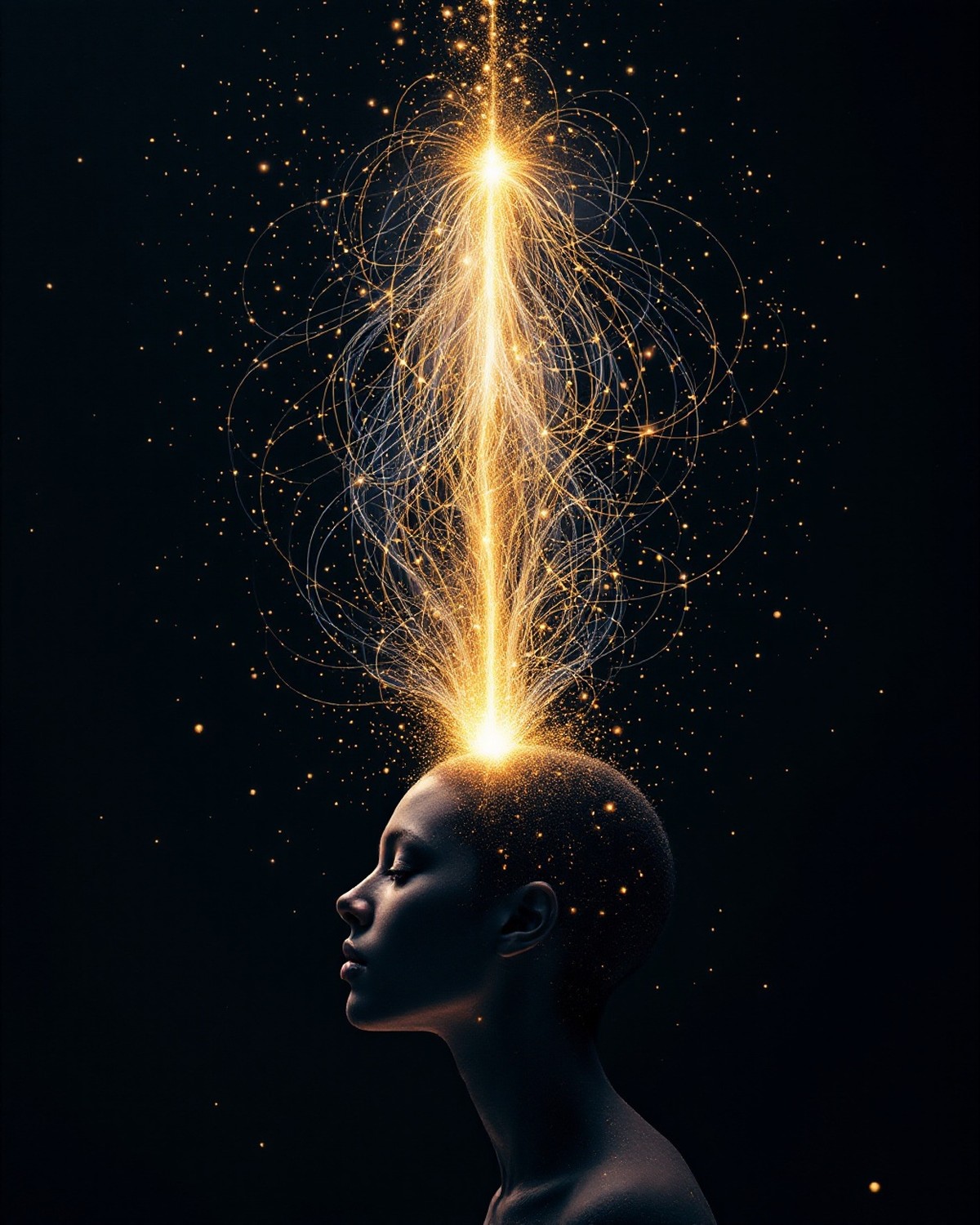
Do psychedelics make you more creative? Partly, and specifically. The best evidence points to a real but subtle boost to divergent thinking — generating many original ideas — while convergent thinking (finding the single right answer) is not reliably helped and can even dip acutely. In a famous 1966 study, professionals given mescaline solved problems they’d been stuck on for months (Harman, Fadiman et al., 1966), but that study had no placebo control. Rigorous modern double-blind microdosing trials find, at most, a small increase in the originality of ideas — and a very large placebo and expectancy effect. The mechanism: a looser, higher-entropy brain that reaches for more distant associations.
The link between psychedelics and creativity is a founding myth of the whole field — Francis Crick and the double helix, Steve Jobs calling LSD one of the most important things he ever did, a generation of artists and coders convinced the molecules opened a door. Myths usually contain a seed of truth wrapped in a lot of wish. The interesting question isn’t whether the legend is inspiring — it is. The question is what actually happens to the creative mind under these compounds when you measure it carefully. The answer is real, but it is not the fairy tale.
The legend, and the famous experiment
Start with the study that launched a thousand microdosing blogs. In 1966, at a research institute in Menlo Park, Willis Harman and James Fadiman ran a now-legendary experiment: 27 professionals — engineers, architects, mathematicians, a furniture designer, an artist — each brought a real, unsolved work problem, took a dose of mescaline, and spent the day working on it in a supportive setting (Harman, McKim, Mogar, Fadiman & Stolaroff, 1966). The reported results were remarkable. Participants described reduced inhibition and anxiety, the ability to see a problem in a wider context, richer visual imagery, and freer flow of ideas — and several arrived at solutions to problems they had been stuck on for weeks or months, some of which were later built. It is a genuinely inspiring study. It is also, by modern standards, uncontrolled: no placebo, highly selected and motivated volunteers, expectations sky-high. It shows what’s possible; it can’t prove the drug caused it.
The key distinction: divergent vs. convergent
To make sense of the modern evidence, you need one idea from creativity science: the difference between two kinds of thinking. Divergent thinking is idea generation — how many, how varied, and how original the possibilities you can produce (think: “list every possible use for a brick”). Convergent thinking is idea selection — zeroing in on the single correct or best answer (think: a logic puzzle with one solution). Real creativity needs both: a wild fountain of options, then the discernment to pick and refine. When people say psychedelics “boost creativity,” the honest scientific question is: which kind? And the two, it turns out, respond very differently.
Precisely-Dosed Psilocybin Mushroom TreatsOOTW Psilocybin Mushroom Treats
Precisely-dosed, lab-tested, quality psilocybin mushroom treats — crafted for daily ritual, neural support, and sustained clarity. Journal readers: 10% off your first order with code JOURNAL10 (applied automatically at checkout).
Claim 10% Off →What the controlled studies actually found
Over the last decade, researchers finally began testing this with double-blind, placebo-controlled designs, mostly on microdosing (sub-perceptual doses). The pattern that emerges is consistent and modest. Microdosing appears to give a small lift to the originality of divergent thinking — people generate somewhat more novel, less obvious ideas — but it does not reliably improve convergent problem-solving, and higher acute doses can actually make convergent, focused reasoning worse in the moment. Effects are subtle, vary between people (tied to things like body weight and prior experience), and are far smaller than the enthusiast lore suggests. So the science half-confirms the myth: there is a real fingerprint, and it lands exactly where you’d expect — on the wild, generative, association-hungry side of the creative mind, not the disciplined, answer-finding side.
Why a looser brain generates wilder ideas
The mechanism fits beautifully with the rest of psychedelic neuroscience. By activating the 5-HT2A receptor, psychedelics loosen the brain’s normal hierarchies — quieting the default mode network and letting regions that don’t usually talk to each other communicate. Carhart-Harris’s “entropic brain” framing captures it: the psychedelic brain is more disordered, more flexible, less bound by its habitual assumptions. Creatively, that is a double-edged gift. A mind that reaches for more distant associations and takes its usual filters less seriously will naturally throw off more novel, surprising combinations — the raw material of divergent thinking. But those same loosened filters make it harder to lock onto one correct answer. The drug widens the search; it doesn’t sharpen the aim.
AI That Understands The MedicineOOTW Spirit Guide
Set. Setting. Dose. Integration. The questions you can’t bring to your doctor — answered by an AI grounded in every peer-reviewed paper, protocol, and ceremony manual. Private, sober, always there.
Talk to the Spirit Guide → A Sacred 5-MeO-DMT Ceremony · MiamiJoin the OOTW Sacrament
The oldest prayer, remembered — the gentle dissolving of the self into light, held in ceremony by a master facilitator. Sit with our community first: a free, live weekly circle on Zoom. No commitment, simply a conversation.
Join the Weekly Circle →The placebo elephant in the room
Now the finding that keeps honest researchers humble. When microdosing is tested against placebo, an enormous share of the reported creativity boost shows up in people who only believe they took the drug. In careful “self-blinding” studies, placebo microdosers reported many of the same improvements as real microdosers. This does not mean nothing happens — there is a small drug effect on top — but it means expectancy is doing a great deal of the work. The ritual of microdosing, the intention, the belief that you are now a more creative person, can shift how you think and feel about your own output. That is not fraud; it is the genuine power of set, mindset, and meaning — the same forces that shape every psychedelic experience. But it is a very different claim from “the molecule made me creative.”
Precisely-Dosed Psilocybin Mushroom TreatsBring the Science Home
Every article here is the why. OOTW’s precisely-dosed, lab-tested, quality psilocybin mushroom treats are the how — crafted to carry the medicine into your daily practice. Journal readers: 10% off your first order with code JOURNAL10 (applied automatically at checkout).
Claim 10% Off →So, do they work?
Here is the fair verdict. Psychedelics can, under the right conditions, do real creative things: lower the inhibition and fear that block ideas, widen your frame, surface unexpected associations, and hand you novel raw material — especially the kind of divergent, generative spark the 1966 professionals described. What they do not do is reliably improve focused problem-solving, replace craft and expertise, or work like a dependable creativity switch you can flip. And a large part of the everyday microdosing effect is expectation, not pharmacology. The most honest way to hold it: a psychedelic can open a wider space of possibility and quiet the inner critic that guards the door — but the actual creating, the discipline of turning wild possibility into finished work, is still yours to do. The molecule can widen the canvas. It cannot paint the painting.
OOTW Journal is educational and does not provide medical advice. Psychedelics remain controlled substances in most countries and are not safe for everyone, including people with a personal or family history of psychosis or bipolar disorder. Nothing here is a recommendation to use any psychedelic. If you are struggling with your mental health, please reach out to a qualified professional.