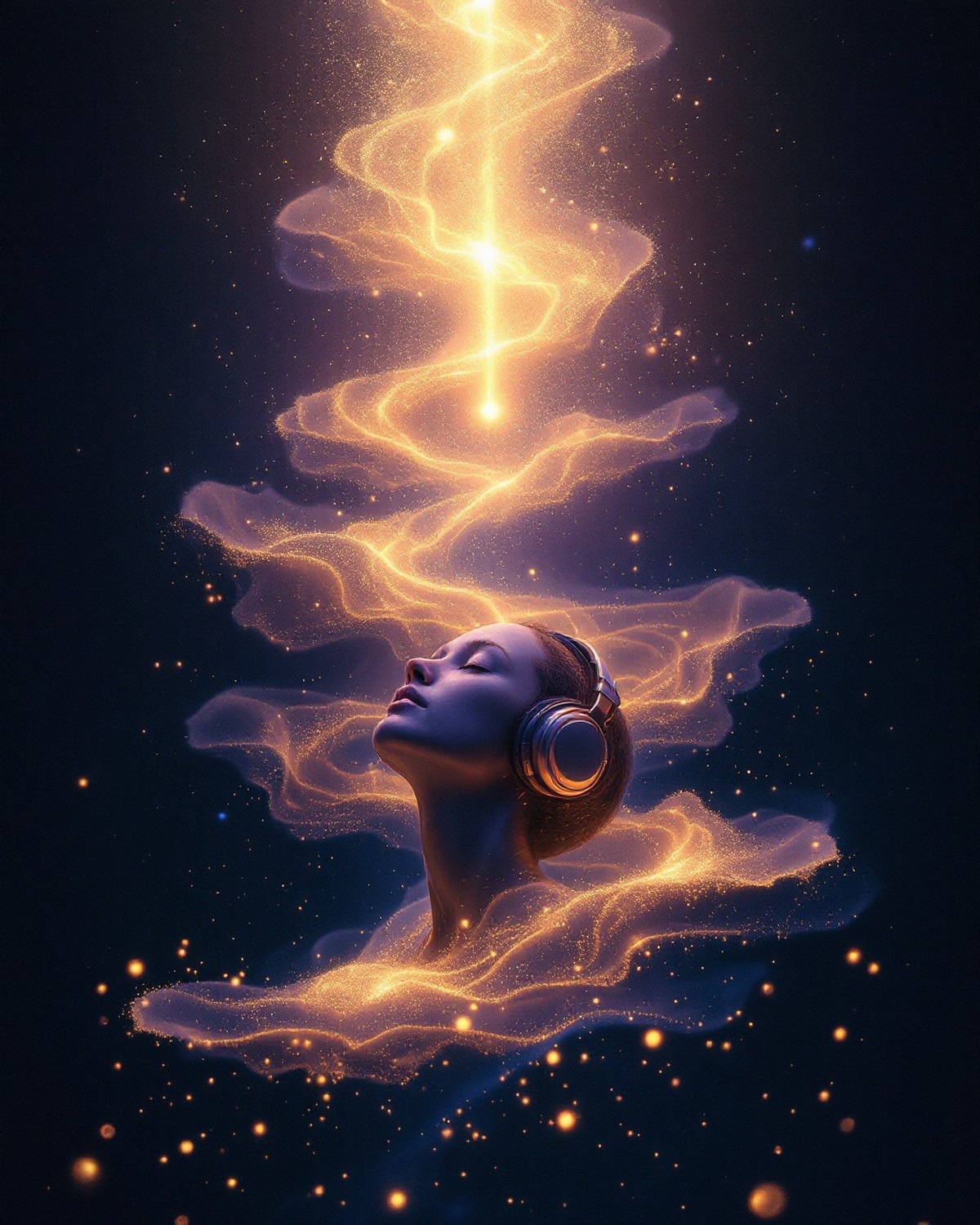
Why is music so central to psychedelic therapy? Because it acts as a co-therapist. Psychedelics make the brain intensely sensitive to emotion, and music becomes the medium that guides it. Studies from Imperial College show LSD enhances the emotional response to music (Kaelen et al., 2015), deepens music-evoked mental imagery through the parahippocampus (Kaelen et al., 2016), and that patients repeatedly describe music as “the hidden therapist” — a guide, a wave, a container (Kaelen et al., 2018). With the default mode network quieted and 5-HT2A firing, the brain surrenders to musical emotion and meaning. Playlists are engineered as an emotional arc.
There is a detail in every serious psychedelic study that outsiders tend to overlook: the music. Not as ambiance, but as protocol — a specific, timed sequence of pieces, delivered through headphones, chosen with the same care as the dose. The people who run these sessions will tell you plainly that the music is doing therapeutic work. And when researchers went back and asked participants what actually helped them heal, an astonishing number pointed not to the drug, not even to the therapist, but to the music. This is the story of the most underrated element in the whole psychedelic renaissance.
Why music, and why always?
The pairing is not new-age decoration — it is inherited from the earliest scientific psychedelic research and has survived because it works. In the modern trials at Johns Hopkins and Imperial College London, a curated playlist runs for the entire dosing session, and eyeshades plus headphones turn attention inward. The rationale is simple and deep: a psychedelic throws the mind wide open but gives it no direction. Music supplies the direction. It provides an emotional structure to lean on when the ordinary structures of the self have gone soft — a hand to hold across the hours. Take the music away and you don’t get a neutral session; you get a disoriented one. The playlist is the banks of the river.
The brain on music, amplified
What changes in the brain to make music so overwhelming under a psychedelic? Two things converge. First, activating the 5-HT2A receptor ramps up the emotional salience of everything — and music is emotion in its purest, most abstract form. Second, the quieting of the default mode network loosens the self-referential grip that normally keeps us at a slight distance from our own feelings. The result, measured directly by Mendel Kaelen and colleagues, is striking: under LSD, the emotional response to music was significantly enhanced (Kaelen et al., 2015). The same music that might move you slightly on an ordinary day can, in this state, feel like it is rearranging your soul.
Precisely-Dosed Psilocybin Mushroom TreatsOOTW Psilocybin Mushroom Treats
Precisely-dosed, lab-tested, quality psilocybin mushroom treats — crafted for daily ritual, neural support, and sustained clarity. Journal readers: 10% off your first order with code JOURNAL10 (applied automatically at checkout).
Claim 10% Off →Music that becomes a world
It goes beyond feeling. In a 2016 study, Kaelen’s team found that LSD amplified the mental imagery evoked by music — the eyes-closed inner visions — and that this enhancement tracked a specific change in the brain: increased connectivity from the parahippocampus, a hub of memory and emotional context, to the visual cortex (Kaelen et al., 2016). In other words, music stopped being an auditory experience and became a visual, autobiographical, world-building one. This is why people so often describe “travelling” through music on psychedelics: the sound is recruiting memory and vision into a single flowing landscape the listener moves through.
“The hidden therapist”
The most important finding is also the most human. When Kaelen and colleagues analyzed how patients in a psilocybin-for-depression trial actually experienced the music, a clear theme emerged and gave the 2018 paper its title: music as “the hidden therapist.” Participants described the music as a guide that led them where they needed to go, a container that made overwhelming emotion safe to feel, and at times a presence almost like another being in the room (Kaelen et al., 2018). Crucially, the relationship to the music mattered: when people could surrender and trust it, sessions tended to go well; resistance to the music tracked with more difficult experiences. The music wasn’t decoration on the therapy. For many, it was the therapy.
AI That Understands The MedicineOOTW Spirit Guide
Set. Setting. Dose. Integration. The questions you can’t bring to your doctor — answered by an AI grounded in every peer-reviewed paper, protocol, and ceremony manual. Private, sober, always there.
Talk to the Spirit Guide → A Sacred 5-MeO-DMT Ceremony · MiamiJoin the OOTW Sacrament
The oldest prayer, remembered — the gentle dissolving of the self into light, held in ceremony by a master facilitator. Sit with our community first: a free, live weekly circle on Zoom. No commitment, simply a conversation.
Join the Weekly Circle →The art and science of the playlist
If music is a co-therapist, then the playlist is a clinical instrument — and it is designed with real intention. A session playlist is built as an emotional arc: gentle and welcoming at the start, building toward more intense, often wordless and transcendent pieces around the expected peak (a few hours in), then softening into warm, resolving, re-integrating music as the person returns. Bill Richards’ program at Johns Hopkins and the Imperial team both refined such arcs over years. The choices are deliberate: mostly lyric-free (words impose someone else’s story), often unfamiliar (to avoid personal associations hijacking the trip), and emotionally deep without being manipulative. This is now its own field — Kaelen went on to found a company (Wavepaths) building adaptive, generative music for therapy. The right sound at the right moment can open a door the drug alone leaves merely unlocked.
Precisely-Dosed Psilocybin Mushroom TreatsBring the Science Home
Every article here is the why. OOTW’s precisely-dosed, lab-tested, quality psilocybin mushroom treats are the how — crafted to carry the medicine into your daily practice. Journal readers: 10% off your first order with code JOURNAL10 (applied automatically at checkout).
Claim 10% Off →The honest limits
A few caveats keep this grounded. Much of the sharpest mechanistic data comes from LSD studies in healthy volunteers with modest sample sizes, and the “hidden therapist” findings are qualitative — rich and consistent, but not the same as a controlled trial isolating music’s causal contribution. We do not yet have a clean study that swaps the playlist and measures the change in clinical outcome, so we cannot precisely quantify how much of the healing the music carries. Music is also not universal: cultural fit matters, and a playlist that opens one person can alienate another, which is why personalized and culturally attuned selection is an active frontier. And none of this is a substitute for a trained human holding the space. What the evidence firmly supports is profound enough: under a psychedelic the brain becomes exquisitely, measurably sensitive to music; that sensitivity reaches into emotion, memory and vision at once; and used with skill, sound becomes one of the most powerful tools we have for guiding a mind through its own depths.
OOTW Journal is educational and does not provide medical advice. Psychedelics remain controlled substances in most countries and are not safe for everyone, including people with a personal or family history of psychosis or bipolar disorder, and those on serotonergic medications. Nothing here is a recommendation to use any psychedelic. If you are struggling with your mental health, please reach out to a qualified professional.