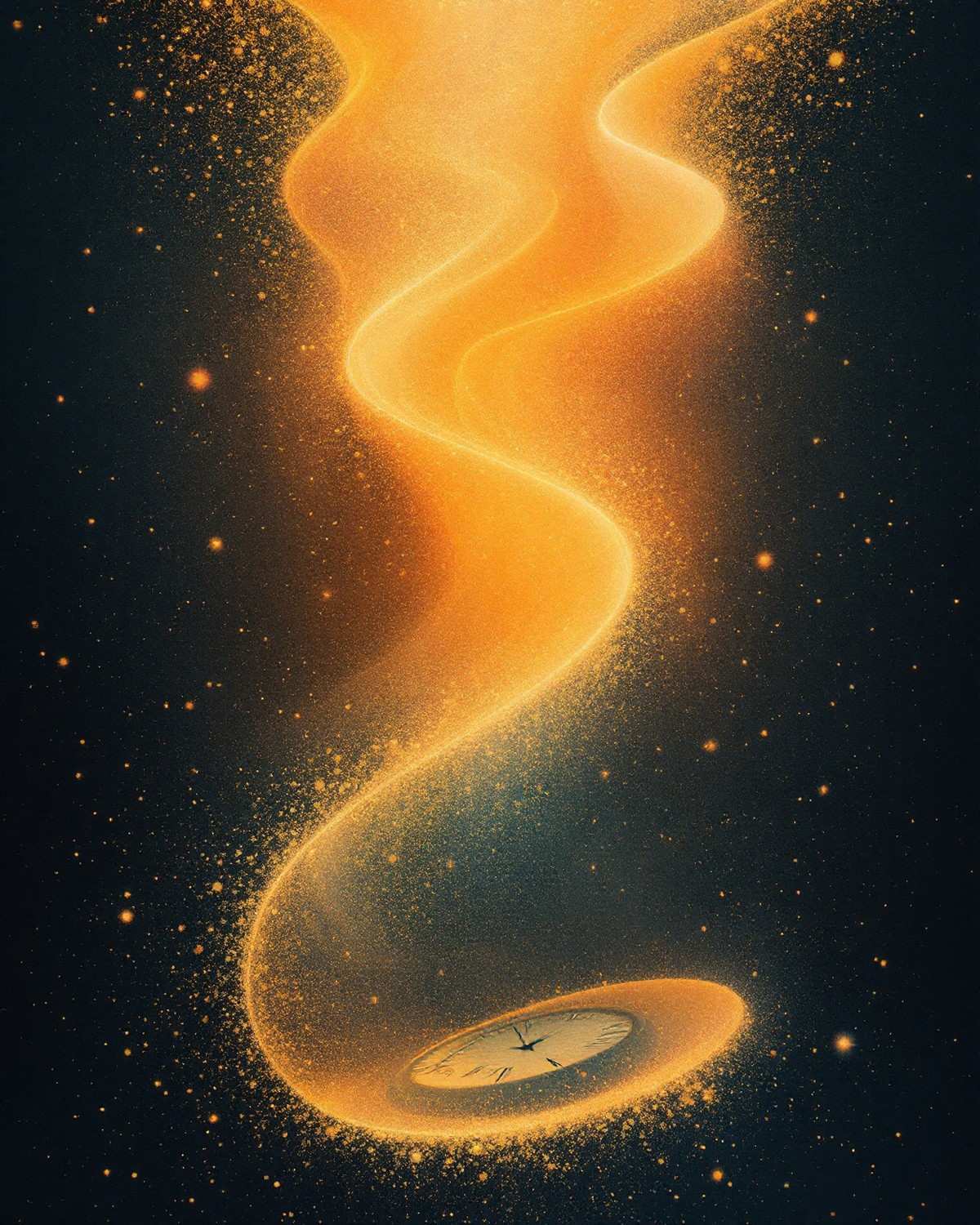
Why does time warp on psychedelics? Because the brain has no single clock — it constructs the feeling of duration, and psychedelics change how. In controlled studies, psilocybin measurably distorted time: people could no longer accurately reproduce intervals longer than about 2.5 seconds and couldn’t keep pace with a slow beat (Wittmann et al., 2007). A leading theory says your sense of time is built from interoception — the felt signals of your own body, tracked in the insula (Wittmann, 2013). As a psychedelic quiets the default mode network and dissolves the self, the “now” can expand into timelessness — the transcendence of time and space that defines the peak (Barrett et al., 2015).
Ask anyone who has taken a high dose what happened to time, and watch them struggle for words. Time slowed. Time stopped. Time didn’t exist. An entire lifetime seemed to pass in an afternoon; a single breath seemed to last for years. We treat these as poetic exaggerations — but to a neuroscientist they are data, and they point at something profound: the smooth, ticking river of time you seem to simply perceive is in fact an elaborate construction your brain assembles moment to moment. Psychedelics don’t distort a clock. They reveal that there was never a clock to begin with.
The clock that isn’t there
Here is the first surprise: there is no single timekeeper in the brain. Your eyes have a retina, your ears have a cochlea — dedicated organs for their senses. But there is no organ for time. Instead, the brain stitches the feeling of duration together from many sources: rhythms of neural firing, the pace of your attention, memory, emotion, and — crucially — the signals rising from your own body. Because duration is assembled rather than measured, it is fragile and pliable. Fear stretches a car crash into slow motion. Boredom drags an hour to a crawl. Flow makes an afternoon vanish. Time perception bends because it was never rigid — and a psychedelic is one of the most powerful levers ever found for bending it.
What psilocybin does to the clock, measured
You can put numbers on this. In a careful study at the University of Zurich, Marc Wittmann, Franz Vollenweider and colleagues gave healthy volunteers psilocybin and ran them through classic timing tasks — reproducing intervals, tapping to a beat, judging durations (Wittmann et al., 2007). The results were clean and striking. Psilocybin left short intervals largely intact but selectively broke longer ones: past roughly 2.5 seconds, people could no longer accurately reproduce a duration. They also could not synchronize their movements to a slow rhythm, and they tended to slow their own self-paced tapping. In other words, the drug didn’t smear all of time equally — it specifically disrupted the longer, more cognitive timescales that depend on working memory and sustained attention, exactly the machinery a psychedelic loosens. The melting clock is real, and it has a signature.
Precisely-Dosed Psilocybin Mushroom TreatsOOTW Psilocybin Mushroom Treats
Precisely-dosed, lab-tested, quality psilocybin mushroom treats — crafted for daily ritual, neural support, and sustained clarity. Journal readers: 10% off your first order with code JOURNAL10 (applied automatically at checkout).
Claim 10% Off →The body is the clock
So if there’s no clock organ, where does the felt sense of duration come from? Wittmann’s answer is one of the most elegant ideas in the science of consciousness: your sense of time is your sense of your body. The theory is that subjective duration is built from interoception — the continuous stream of signals from your heart, gut, lungs and viscera — integrated in a deep cortical hub called the insula (Wittmann, 2013). Neural activity appears to accumulate in the posterior insula as time passes, like sand filling a glass, and the anterior insula reads that bodily state out as felt duration. The clinical evidence lines up: conditions that scramble interoception also scramble time perception (Teghil et al., 2020). Psychedelics act powerfully on this same 5-HT2A-rich circuitry and radically change interoceptive awareness — so when the body-signal that is your clock is transformed, time itself transforms with it. You don’t lose track of time. You lose track of your body’s time.
Why time dissolves at the peak
Distorting the clock is one thing; abolishing it is another. At high doses, people don’t just report that time slowed — they report that time stopped mattering, that they entered an eternal, boundary-less now. This tracks the deepest feature of the psychedelic state. As the drug quiets the default mode network — the self-referential system that narrates “you” across past and future — the autobiographical timeline that stitches your moments into a story goes quiet too. Without the narrating self projecting backward and forward, there is only the present, and the present has no edges. This is why transcendence of time and space is one of the six defining dimensions of the mystical-type experience on the MEQ30 (Barrett et al., 2015), and why it fits the entropic brain: as ordinary constraints loosen, the tidy sequence of clock-time gives way to something wider and stranger. Timelessness isn’t the absence of experience — it’s the self stepping out of the current.
AI That Understands The MedicineOOTW Spirit Guide
Set. Setting. Dose. Integration. The questions you can’t bring to your doctor — answered by an AI grounded in every peer-reviewed paper, protocol, and ceremony manual. Private, sober, always there.
Talk to the Spirit Guide → A Sacred 5-MeO-DMT Ceremony · MiamiJoin the OOTW Sacrament
The oldest prayer, remembered — the gentle dissolving of the self into light, held in ceremony by a master facilitator. Sit with our community first: a free, live weekly circle on Zoom. No commitment, simply a conversation.
Join the Weekly Circle →Why a melting clock might heal
This is more than a curiosity, because so much suffering is a disorder of time. Depression is, in large part, being trapped in the past — rumination looping over what went wrong. Anxiety is being trapped in the future — dread rehearsing what might. Chronic stress compresses life into a grim, hurried tunnel. To be pulled fully into an expansive present, even once, can be genuinely therapeutic: it interrupts the loops and shows, from the inside, that another relationship to time is possible. There is a hint of this in ordinary life — experimental work found that experiences of awe literally expand people’s sense of available time and, in turn, their generosity and life satisfaction (Rudd, Vohs & Aaker, 2012). The psychedelic dilation of time may be a super-charged version of the same effect: by dissolving the anxious, time-bound self and flooding the present with meaning, it can loosen the temporal traps that keep people stuck — part of why the intensity of the experience so often predicts the healing.
Precisely-Dosed Psilocybin Mushroom TreatsBring the Science Home
Every article here is the why. OOTW’s precisely-dosed, lab-tested, quality psilocybin mushroom treats are the how — crafted to carry the medicine into your daily practice. Journal readers: 10% off your first order with code JOURNAL10 (applied automatically at checkout).
Claim 10% Off →The honest limits
Keep the claims proportionate. The core finding — that psilocybin measurably distorts longer-interval timing — is solid, but it comes from small early studies, and the exact circuitry of time is still debated: the insula-interoception model is compelling but not the only account, and rival theories emphasize the basal ganglia, dopamine and distributed cortical rhythms. The link from “time distortion” to “healing” is a plausible bridge, not a proven mechanism; awe-expands-time is a lovely result but a modest one, and the therapeutic story rests on correlation. Set and setting matter enormously, too — the same dissolution of time that feels sacred in a supported session can feel like a terrifying, never-ending bad trip when someone is frightened and believes it will never end. What is genuinely established is remarkable on its own: time is not a fixed backdrop but a construction of the living brain, psychedelics reliably and measurably bend it, and in that bending we glimpse how consciousness builds the river we normally just float down.
OOTW Journal is educational and does not provide medical advice. Psychedelics remain controlled substances in most countries and are not safe for everyone, including people with a personal or family history of psychosis or bipolar disorder, and those on serotonergic medications. Nothing here is a recommendation to use any psychedelic. If you are struggling with your mental health, please reach out to a qualified professional.