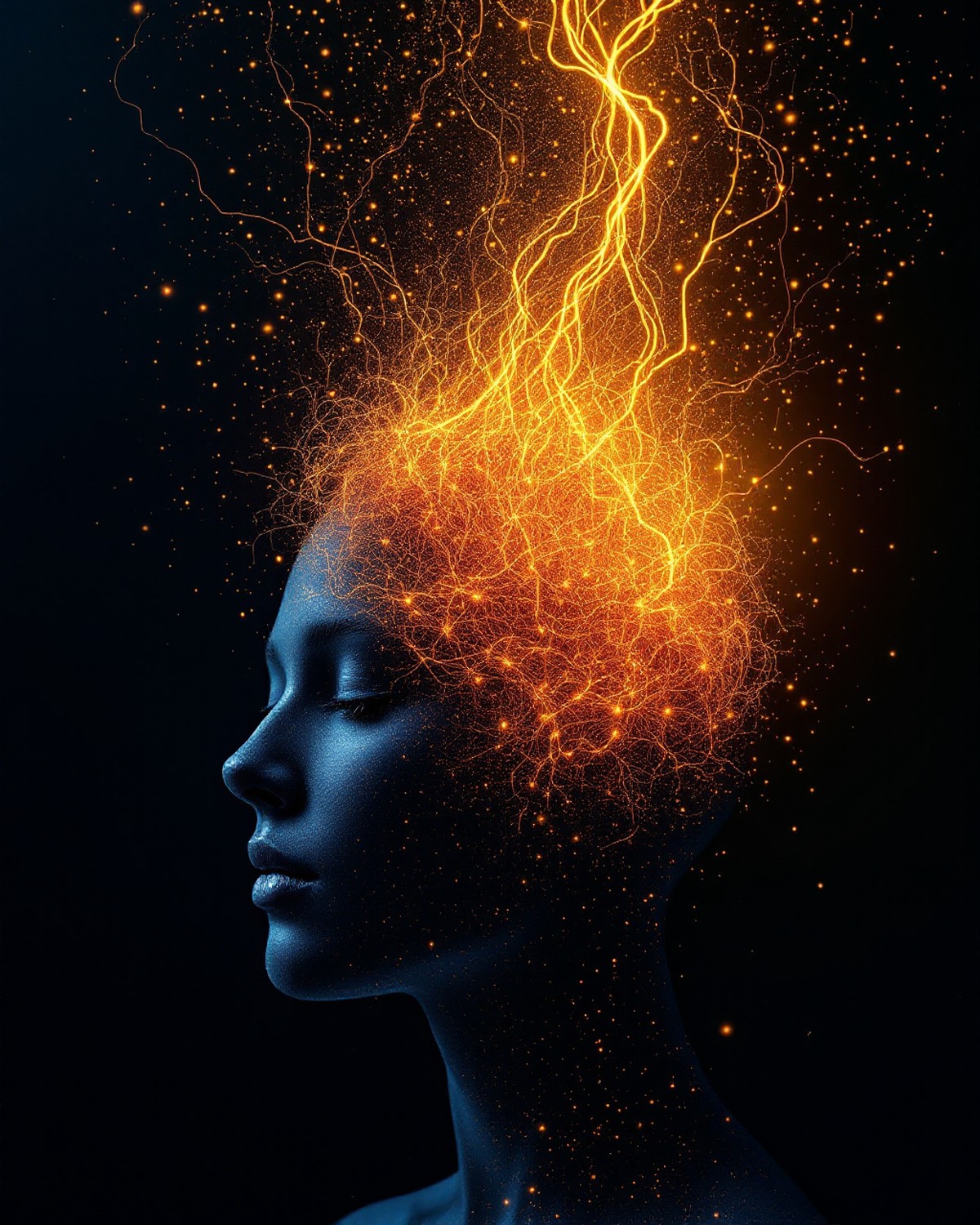
Can psychedelics help chronic pain? The science is early but genuinely promising. Much chronic pain is nociplastic — pain the brain keeps generating after tissue has healed, driven by a sensitized nervous system. Psychedelics act on 5-HT2A receptors, which are woven through the brain’s descending pain-control pathways, and appear to “reset” the maladaptive connectivity that maintains central pain states (Castellanos et al., 2020). They also drive BDNF-TrkB neuroplasticity and lower neuroinflammation. Early human reports are striking: a randomized trial cut cluster-headache attacks (Schindler et al., 2022), and a single dose erased intractable phantom-limb pain (Ramachandran et al., 2018).
We are taught to think of pain as a simple alarm: damage the tissue, ring the bell. But that model collapses in the face of chronic pain, where the bell keeps ringing with no fire left to warn of. Modern pain science has been forced to a stranger, more powerful conclusion — that pain is not a reading piped up from the body, but a construction the brain builds, and that in chronic pain that construction gets stuck “on.” Understand pain as a learned brain pattern, and a radical therapeutic idea comes into focus: the same drugs that loosen the brain’s stuck patterns in depression might loosen them in pain, too.
When pain outlives its cause
The first thing to understand is that chronic pain is often a different beast from acute pain. Acute pain is nociceptive — a faithful signal of tissue damage that fades as you heal. But a large share of chronic pain is nociplastic: pain arising from a change in how the nervous system itself processes signals, rather than from ongoing injury. Through a process called central sensitization, the spinal cord and brain turn up the gain — amplifying, maintaining, and even generating pain until the alarm system becomes the disease. This is the picture in fibromyalgia, many chronic headaches, and much neuropathic and back pain: the hurt is real, but it is being manufactured by a sensitized, over-learned circuit. And a learned circuit is, in principle, something that can be un-learned.
The surprising anti-pain pharmacology
This is where psychedelics get interesting, because their core target is deeply entangled with pain. Psychedelics are 5-HT2A receptor agonists, and serotonin is one of the brain’s master regulators of pain: the descending modulatory pathways that run from the brainstem down into the spinal cord — the body’s own volume knob for incoming pain — are richly serotonergic, and activating them dampens the pain signal before it ever reaches consciousness. Beyond the spinal cord, Castellanos and colleagues proposed that psychedelics’ ability to “reset” maladaptive functional connectivity — the same large-scale rewiring seen in depression — could unwind the central sensitization that sustains chronic pain (Castellanos et al., 2020). In this view a psychedelic doesn’t numb pain like an opioid; it goes after the network that’s generating it.
Precisely-Dosed Psilocybin Mushroom TreatsOOTW Psilocybin Mushroom Treats
Precisely-dosed, lab-tested, quality psilocybin mushroom treats — crafted for daily ritual, neural support, and sustained clarity. Journal readers: 10% off your first order with code JOURNAL10 (applied automatically at checkout).
Claim 10% Off →Rewiring the pain brain
If chronic pain is a maladaptive pattern burned into neural circuitry, then the most exciting property of psychedelics may be the one that matters most for depression too: neuroplasticity. Psychedelics rapidly promote synaptic growth through BDNF-TrkB signaling, opening a window in which entrenched circuits become malleable again — a chance to re-wire a nervous system that has learned to hurt. At the same time, they exert potent anti-inflammatory effects through the very same 5-HT2A receptor, and neuroinflammation is a key driver of central sensitization. So the proposed mechanism is a three-part convergence: turn up descending inhibition at the spinal cord, quiet the neuroinflammation feeding sensitization, and reset the maladaptive connectivity while plasticity is high — and, ideally, use the psychological opening to change a person’s whole relationship to their pain. It is a fundamentally different strategy from masking a signal.
What the human evidence shows
The mechanism is elegant, but does it help real patients? The honest answer: the early human data are limited, mostly small, and genuinely intriguing. The strongest signal comes from cluster headache — among the most excruciating conditions known — where Emmanuelle Schindler’s team ran a randomized, double-blind, placebo-controlled trial of a low-dose psilocybin pulse and saw a meaningful drop in attack frequency (Schindler et al., 2022). Crucially, the benefit did not track the intensity of the acute trip — a strong hint that, for pain, the mechanism may be pharmacological rather than mystical. In a remarkable phantom-limb case, a single psilocybin session paired with mirror therapy produced immediate, lasting, near-complete relief of pain that had resisted everything else (Ramachandran et al., 2018). And open-label work in fibromyalgia — the archetypal nociplastic condition — has reported preliminary safety and symptom improvement with psilocybin-assisted therapy (Glynos et al., 2025). A 2024 scoping review pulls these threads together across cluster headache, phantom-limb, neuropathic and nociplastic pain (scoping review, 2024).
AI That Understands The MedicineOOTW Spirit Guide
Set. Setting. Dose. Integration. The questions you can’t bring to your doctor — answered by an AI grounded in every peer-reviewed paper, protocol, and ceremony manual. Private, sober, always there.
Talk to the Spirit Guide → A Sacred 5-MeO-DMT Ceremony · MiamiJoin the OOTW Sacrament
The oldest prayer, remembered — the gentle dissolving of the self into light, held in ceremony by a master facilitator. Sit with our community first: a free, live weekly circle on Zoom. No commitment, simply a conversation.
Join the Weekly Circle →Pain, suffering, and the mind in the loop
There is also a psychological layer that a purely pharmacological story misses. Chronic pain is not just a sensation; it is a life reshaped — fused with fear, helplessness, depression, and catastrophizing, the mental loop that magnifies and entrenches suffering. Because chronic pain and depression share circuitry and often travel together, the same experiences that help depression — a loosening of rigid negative self-focus, a renewed sense of agency and meaning — may loosen pain’s grip from the top down. Some patients describe not that the sensation vanished, but that their relationship to it changed: the pain stopped being a totalizing threat. This mind-body duality is a feature, not a bug — it’s why psychedelic pain research is being built around psychedelic-assisted therapy, pairing the molecule’s plasticity with psychological support, rather than a pill handed out in isolation.
Precisely-Dosed Psilocybin Mushroom TreatsBring the Science Home
Every article here is the why. OOTW’s precisely-dosed, lab-tested, quality psilocybin mushroom treats are the how — crafted to carry the medicine into your daily practice. Journal readers: 10% off your first order with code JOURNAL10 (applied automatically at checkout).
Claim 10% Off →The honest limits
Real restraint is essential here, because desperate people are watching this field closely. The human evidence is early-stage: small samples, several open-label or single-case reports, short follow-ups, and powerful placebo and expectancy effects that are especially strong in pain. No psychedelic is an approved treatment for any pain condition, and these are potent, still-illegal substances that are unsafe for some people — including those with a personal or family history of psychosis or bipolar disorder, and those on serotonergic medications. Pain patients are also frequently on complex medication regimens that raise real interaction concerns. What is legitimately exciting is the convergence: a coherent, testable mechanism — descending inhibition, reduced neuroinflammation, and a reset of maladaptive connectivity during a plasticity window — lining up with early clinical signals in some of the most treatment-resistant pain conditions in medicine. That is a serious scientific lead worth rigorous trials, not a green light for self-treatment. The promise is real; so is the need for caution.
OOTW Journal is educational and does not provide medical advice. Psychedelics remain controlled substances in most countries and are not safe for everyone, including people with a personal or family history of psychosis or bipolar disorder, and those on serotonergic medications. Nothing here is a recommendation to use any psychedelic or to change any pain treatment. If you are living with chronic pain, please work with a qualified medical professional.