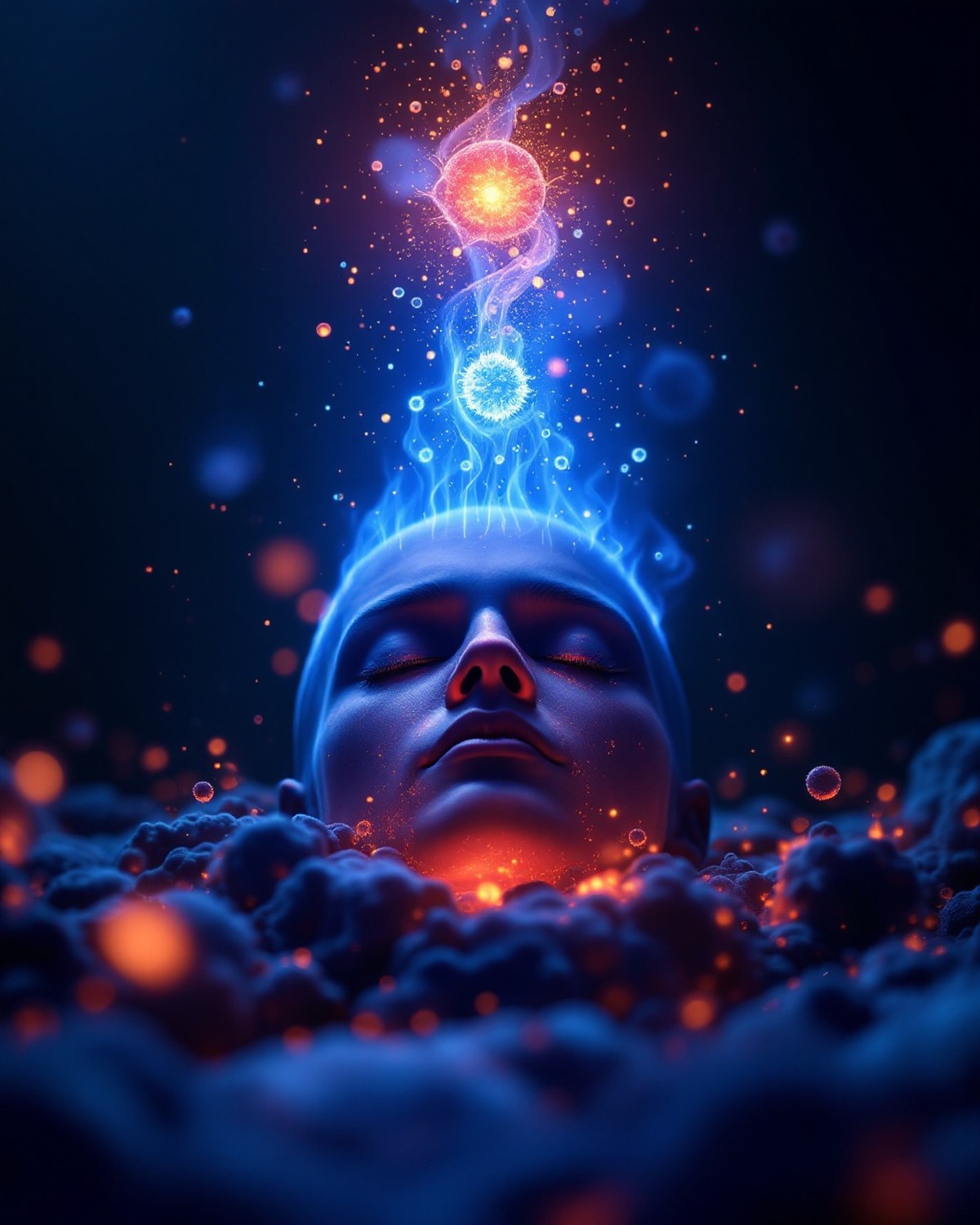
Do psychedelics affect the immune system? Yes — and dramatically. Activating the 5-HT2A receptor produces powerful anti-inflammatory effects. In a landmark study, the psychedelic (R)-DOI blocked TNF-α-driven inflammation in living animals and shut down pro-inflammatory genes (IL-6, ICAM-1, VCAM-1) at picomolar concentrations — making it a “super-potent” anti-inflammatory (Nau, Yu, Martin & Nichols, 2013). Crucially, this works at doses far below those that cause any psychedelic effect. Psilocybin, LSD and DMT similarly calm neuroinflammation, microglia and cytokines. Since inflammation is now linked to depression, this may be a hidden mechanism of their benefit — and a route to non-hallucinogenic anti-inflammatory drugs.
Ask what a psychedelic does and you’ll hear about the mind: dissolved selves, vivid visions, lifted depression. Almost no one mentions the immune system. Yet one of the most remarkable and underappreciated discoveries in the whole field has nothing to do with hallucination at all — it’s that the receptor these drugs target is a master switch for inflammation, and flipping it can calm the body’s fire with a potency that stunned the researchers who found it. This is the quiet, physical half of the psychedelic story, and it may matter as much as the visions.
The receptor with a second job
The whole psychedelic experience runs through one receptor: the serotonin 5-HT2A receptor. We usually think of it purely in the brain, as the switch that opens perception. But 5-HT2A receptors are also found on immune and vascular cells throughout the body — and there they do something completely different. When activated, they turn down the machinery of inflammation. This is the receptor’s hidden second job, and it reframes psychedelics as not only mind-active molecules but powerful immunomodulators. The same key that unlocks the visionary state also, in the body, closes a valve on the immune system’s inflammatory response.
The discovery that stunned the lab
The clearest evidence comes from the lab of Charles Nichols. Studying a research psychedelic called (R)-DOI, his team found it did something extraordinary: it blocked TNF-α — a central driver of inflammation — and shut off pro-inflammatory genes like IL-6, ICAM-1 and VCAM-1 at picomolar concentrations, potent enough that they called it “super-potent” (Nau, Yu, Martin & Nichols, 2013). This wasn’t a dish-only curiosity: given to whole animals, (R)-DOI blocked systemic inflammation in the vasculature and gut, and even the tiniest doses were enough. For context, picomolar potency puts it in a league with the most powerful anti-inflammatory agents known — from a molecule better known for its effect on the mind.
Precisely-Dosed Psilocybin Mushroom TreatsOOTW Psilocybin Mushroom Treats
Precisely-dosed, lab-tested, quality psilocybin mushroom treats — crafted for daily ritual, neural support, and sustained clarity. Journal readers: 10% off your first order with code JOURNAL10 (applied automatically at checkout).
Claim 10% Off →Below the dose that alters the mind
Here is the twist that makes it medically electric. The anti-inflammatory effect appears at doses far below those required to produce any psychedelic experience. In animals, doses a fraction of a behaviorally-active dose completely switched off inflammatory gene expression while lowering circulating TNF-α. That separation is huge: it suggests you could, in principle, harness the immune benefit without the trip — a “non-hallucinogenic” anti-inflammatory built on the psychedelic scaffold. It is exactly this finding that has drawn serious pharmaceutical interest in 5-HT2A agonists for inflammatory diseases far outside psychiatry — asthma, atherosclerosis, inflammatory bowel conditions — where taming TNF-α is the whole game.
Calming the brain’s own fire
The story deepens inside the brain. The brain has its own immune cells, the microglia, and when they run hot — a state called neuroinflammation — they are increasingly implicated in depression, Alzheimer’s and Parkinson’s. Classic psychedelics — psilocybin, LSD, DMT — appear to quiet neuroinflammation through their serotonin-receptor action: dialing down pro-inflammatory cytokines, calming overactive microglia, and shifting the brain’s chemistry away from neurotoxic and toward neuroprotective metabolites. Some tryptamines even induce the anti-inflammatory cytokine IL-10. This connects the immune story directly to the plasticity story: a less inflamed brain is a brain more able to grow, rewire and repair.
AI That Understands The MedicineOOTW Spirit Guide
Set. Setting. Dose. Integration. The questions you can’t bring to your doctor — answered by an AI grounded in every peer-reviewed paper, protocol, and ceremony manual. Private, sober, always there.
Talk to the Spirit Guide → A Sacred 5-MeO-DMT Ceremony · MiamiJoin the OOTW Sacrament
The oldest prayer, remembered — the gentle dissolving of the self into light, held in ceremony by a master facilitator. Sit with our community first: a free, live weekly circle on Zoom. No commitment, simply a conversation.
Join the Weekly Circle →Why this might be a hidden antidepressant mechanism
Now the pieces converge on the mind. Over the last two decades, a major shift in psychiatry has linked inflammation to depression itself — a substantial subset of depressed patients show elevated inflammatory markers, and inflammation can produce the very symptoms of low mood, fatigue and anhedonia. If that is true, then a molecule that is both a 5-HT2A agonist (driving plasticity and the therapeutic experience) and a potent anti-inflammatory is acting on depression from two directions at once. The visionary experience may do part of the work; quietly cooling systemic and brain inflammation may do another part. It fits the theme running through this journal — that a psychedelic is a whole-body event, healing the mind partly by way of the body that carries it.
Precisely-Dosed Psilocybin Mushroom TreatsBring the Science Home
Every article here is the why. OOTW’s precisely-dosed, lab-tested, quality psilocybin mushroom treats are the how — crafted to carry the medicine into your daily practice. Journal readers: 10% off your first order with code JOURNAL10 (applied automatically at checkout).
Claim 10% Off →The honest limits
Real caution is required. The most dramatic potency data come from (R)-DOI — a research chemical, not a medicine anyone should seek — and much of the strongest evidence is in cells and animals, not yet in large human trials. It is not established that the doses of psilocybin used in depression therapy produce a clinically meaningful anti-inflammatory effect in people, nor that inflammation-lowering is the reason those therapies work; it is a compelling hypothesis under active investigation, not a settled fact. And “anti-inflammatory” is not automatically good — inflammation is a vital defense, and blunting it carelessly carries its own risks. What the evidence firmly supports is striking enough: 5-HT2A activation is a genuine, sometimes extraordinarily potent, anti-inflammatory signal; psychedelics modulate the immune system as well as the mind; and this opens a real frontier — both for understanding how they heal and for building new medicines, some of which may never occasion a vision at all.
OOTW Journal is educational and does not provide medical advice. Psychedelics remain controlled substances in most countries and are not safe for everyone, including people with a personal or family history of psychosis or bipolar disorder, and those on serotonergic or immune-modulating medications. Nothing here is a recommendation to use any psychedelic. If you are struggling with your health, please reach out to a qualified professional.