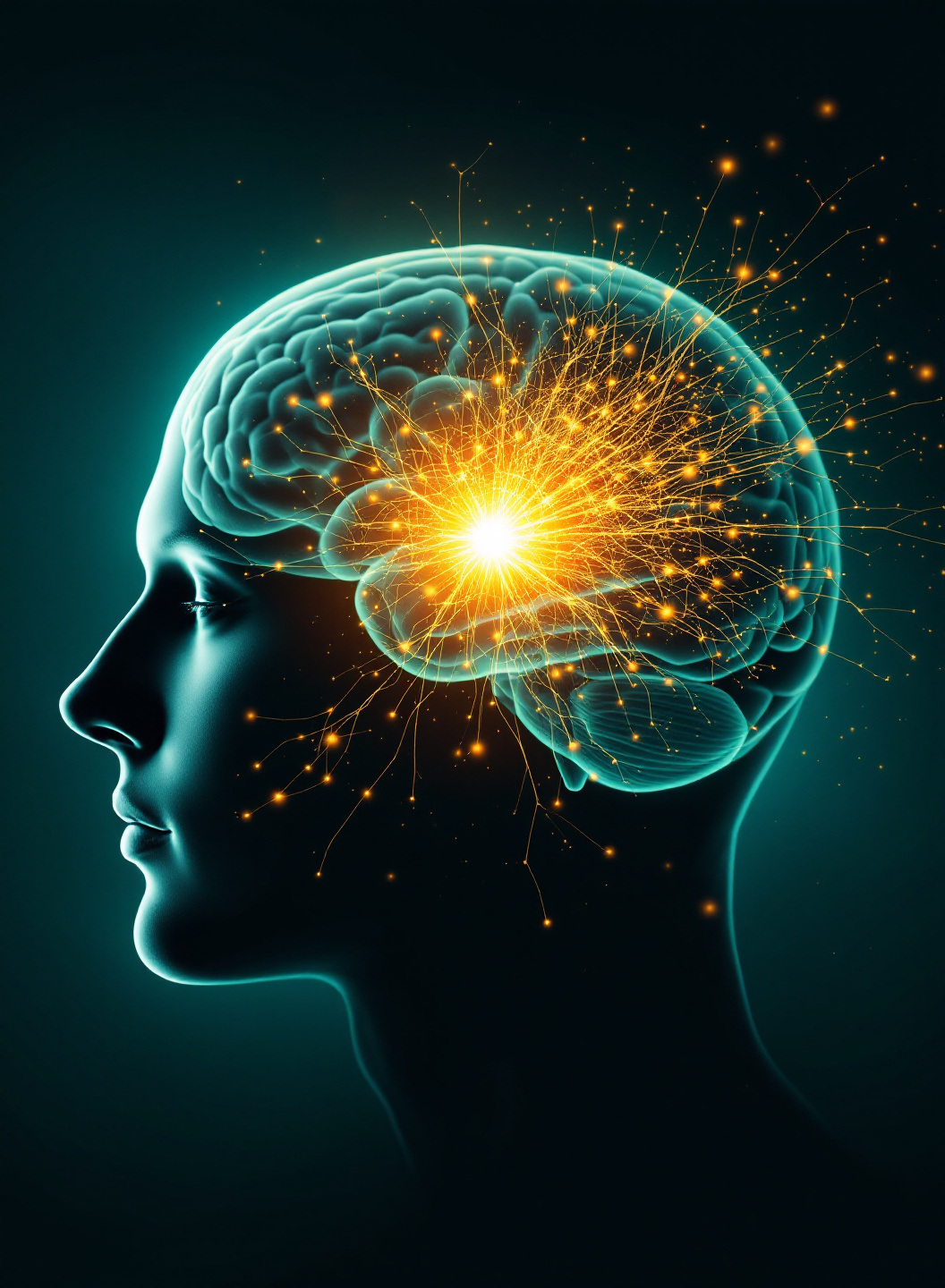
What is the salience network? It is a brain system — anchored in the anterior insula and the dorsal anterior cingulate cortex — whose job is to detect what is most relevant, or “salient,” among everything competing for your attention (Seeley et al., 2007). Its deeper role is that of a switch: when it flags something as important, it toggles the brain between the inward-facing default mode network (self, memory, mind-wandering) and the outward-facing executive network that handles tasks (Menon & Uddin, 2010). The right anterior insula appears to cause that switching (Sridharan et al., 2008). When the switch is stuck, disorders follow — and psychedelics may heal partly by loosening it (Tagliazucchi et al., 2016).
Readers of this journal have met the brain’s two great opposing systems many times. There is the default mode network — the inward system of self, memory, and mind-wandering that hums when we are lost in thought. And there is the executive, or “central executive,” network — the outward system that engages when we focus on a demanding task. They are like two rooms in the mind, and, remarkably, they tend to be anticorrelated: when one lights up, the other goes dark. But this raises an obvious question that the tidy two-network story never answers. Who works the light switch? What decides, moment to moment, which room the mind should be in? The answer is a third network, less famous than the other two but arguably the most important of the three.
Discovering a third network
In 2007, William Seeley, Vinod Menon and colleagues at Stanford were mapping the brain’s intrinsic networks — the systems that stay coupled even at rest — when they identified one that did not fit the familiar categories. Anchored in two regions, the anterior insula (folded deep in the side of the brain) and the dorsal anterior cingulate cortex (dACC, on the midline), it was wired into the emotional and visceral machinery of the body and the brainstem’s arousal systems. They named it the salience network, after its apparent job: picking out the stimuli — internal or external — that are most behaviorally relevant in the moment (Seeley et al., 2007). Tellingly, they found that a person’s pre-scan anxiety tracked the connectivity of this network specifically, not the executive one — a first hint that this system is where the felt weight of things is registered.
The choice of the anterior insula as a hub was profound. This journal has explored the insula before as the seat of interoception — the sense of the body’s internal state, the felt thump of the heart and tightening of the gut. The salience network reveals why that location is perfect for a relevance detector. What matters to an organism is, at root, what affects its body and survival. By sitting atop the stream of interoceptive and emotional signals, the anterior insula is positioned to feel the bodily stakes of a situation — and to use that felt significance to decide what deserves the mind’s limited spotlight.
Not just a detector — a switch
Detecting what matters is only half the story. The salience network’s deeper role, argued Vinod Menon and Lucina Uddin, is to act as a switch between the brain’s other great networks (Menon & Uddin, 2010). In their influential model, when the salience network detects something important, it initiates a rapid reconfiguration: it dials down the inward default mode network and dials up the outward executive network, so that attention and working memory can be marshalled to deal with whatever just became relevant. This is the “triple network” model of the mind — default mode, executive, and the salience network that referees between them. The switch is what lets you snap out of a daydream the instant your name is called across a room; the salience network caught the signal and flipped the mind from inward to outward in a fraction of a second.
Is the salience network really causing the switch, or just going along for the ride? In 2008, Devarajan Sridharan, Daniel Levitin and Menon tested this directly, using a method that can infer the direction of influence between brain regions. Across different tasks and senses, they found that the right anterior insula’s activity reliably came first — it preceded and predicted the switching of the other two networks, not the other way around (Sridharan et al., 2008). The insula was not a passenger. It was the hand on the switch. This gave the salience network a claim to being a genuine control hub — a gateway through which the brain decides how to allocate itself.
Precisely-Dosed Psilocybin Mushroom TreatsOOTW Psilocybin Mushroom Treats
Precisely-dosed, lab-tested, quality psilocybin mushroom treats — crafted for daily ritual, neural support, and sustained clarity. Journal readers: 10% off your first order with code JOURNAL10 (applied automatically at checkout).
Claim 10% Off →The special cells inside the switch
There is a striking anatomical detail that fits the salience network’s role as a fast, whole-brain coordinator. The anterior insula and dACC are two of the very few brain regions rich in von Economo neurons — large, spindle-shaped cells found almost exclusively in humans, great apes, elephants, and whales, all animals with big brains and complex social lives. Their unusual size and long projections are thought to allow especially rapid signaling across distant brain regions — exactly the kind of hardware a switch would need to reconfigure the whole system quickly. That these rare cells cluster in the salience network’s two hubs suggests the network’s job — fast, brain-wide reallocation based on what matters — may be an evolutionarily recent and precious capacity.
When the switch gets stuck
A control system this central becomes a single point of failure. When the salience network malfunctions — misjudging what is salient, or failing to switch cleanly — the consequences ripple across mental health, and a “triple network” account of psychiatric disorders has grown up around exactly this idea.
In depression and rumination, the switch struggles to pull the mind out of the self-focused default mode; a person gets stuck inward, cycling through the same painful self-referential thoughts. In anxiety, the salience network becomes hypersensitive, tagging harmless things as threats — recall that anxiety tracked salience-network connectivity in the very first study. In addiction, drug cues hijack the salience system, so that a lighter or a location screams “this matters” far louder than it should. In psychosis, aberrant salience — the assignment of profound significance to random stimuli — may be how delusions take root, a neutral event suddenly feeling unbearably meaningful. Across these conditions the theme is the same: a switch that is stuck, or firing at the wrong things, traps the mind in the wrong room.
AI That Understands The MedicineOOTW Spirit Guide
Set. Setting. Dose. Integration. The questions you can’t bring to your doctor — answered by an AI grounded in every peer-reviewed paper, protocol, and ceremony manual. Private, sober, always there.
Talk to the Spirit Guide → A Sacred 5-MeO-DMT Ceremony · MiamiJoin the OOTW Sacrament
The oldest prayer, remembered — the gentle dissolving of the self into light, held in ceremony by a master facilitator. Sit with our community first: a free, live weekly circle on Zoom. No commitment, simply a conversation.
Join the Weekly Circle →What psychedelics do to the switch
If many forms of suffering involve a salience network locked into rigid patterns — stuck inward in depression, over-tagging threat in anxiety, over-valuing cues in addiction — then a treatment that could loosen the switch and let the brain re-choose what matters would be powerful. This is one of the frontiers of psychedelic neuroscience.
Classic psychedelics act on serotonin 2A receptors, which are densely expressed across exactly the high-level association hubs that make up the salience and default mode networks. Under psychedelics, the normally crisp, anticorrelated boundaries between the big networks blur; the brain becomes more globally interconnected and less rigidly modular. In a landmark LSD imaging study, Enzo Tagliazucchi, Robin Carhart-Harris and colleagues found that the drug produced a large increase in global functional connectivity concentrated in high-level association cortices — including the salience-network hubs — and, strikingly, that the degree of this increased connectivity correlated with the intensity of ego dissolution, the collapse of the ordinary boundary between self and world (Tagliazucchi et al., 2016). The switch, in effect, stops enforcing the usual sharp separation between the inner and outer rooms; the walls become permeable.
The therapeutic hope is that this temporary loosening lets a stuck salience network be re-set. Freed briefly from its habitual, over-trained patterns of what matters, the brain may be able to lay down new ones — to stop compulsively flagging the self’s worries, or the drink, or the threat, as the most important thing in the room. It is the same story this journal has told from the angle of criticality and the global workspace: a rigid brain made briefly more flexible, and a person given a chance to reorganize around something healthier.
Precisely-Dosed Psilocybin Mushroom TreatsBring the Science Home
Every article here is the why. OOTW’s precisely-dosed, lab-tested, quality psilocybin mushroom treats are the how — crafted to carry the medicine into your daily practice. Journal readers: 10% off your first order with code JOURNAL10 (applied automatically at checkout).
Claim 10% Off →The honest cautions
The triple-network model is elegant, but it is a model, and the brain rarely respects our neat diagrams. The salience network’s regions do many things beyond switching — the anterior insula alone is implicated in interoception, empathy, disgust, pain, uncertainty, and time perception — and assigning one tidy “job” to a network risks oversimplifying a system that is deeply distributed and context-dependent. The causal-switching claim, while well-supported, rests on inference methods that have their own critics, and network labels drawn from resting-state scans can blur together at finer resolution.
The psychedelic story is real but early. That psychedelics increase global connectivity and blur network boundaries is one of the more robust findings in the field; that this specifically re-sets the salience network to therapeutic effect is a plausible and actively studied hypothesis, not an established mechanism. Much of the human imaging comes from small samples, and the leap from “connectivity changed in the scanner” to “a life was healed” is still being bridged. Psychedelics are controlled substances, are not safe for everyone — and, given the salience network’s role in psychosis, are specifically risky for people with a personal or family history of psychotic or bipolar disorders.
The keeper of what matters
We like to think we choose what we pay attention to. Mostly we do not. Beneath the level of will, a small, ancient network anchored in the insula and the cingulate is continuously appraising the flood of the world and the body, deciding what rises to the level of mattering, and throwing the switch that puts the right part of the mind in charge. When it works, we are appropriately absorbed and appropriately alert, able to lose ourselves in thought and snap back when it counts. When it locks up, we are trapped — in rumination, in fear, in craving, in the false blazing significance of the wrong things. To understand the salience network is to understand something intimate about freedom of attention: that it depends on a switch we do not consciously hold, and that loosening that switch, gently and safely, may be one of the truest things a medicine can do for a suffering mind.
OOTW Journal is educational and does not provide medical advice. The triple-network model and the salience network’s role in psychiatric illness are active areas of research, and the proposal that psychedelics heal by re-setting the salience network is a hypothesis under investigation, not settled fact. Psychedelics are controlled substances, carry particular risk for people vulnerable to psychosis, and nothing here is a recommendation to use them.