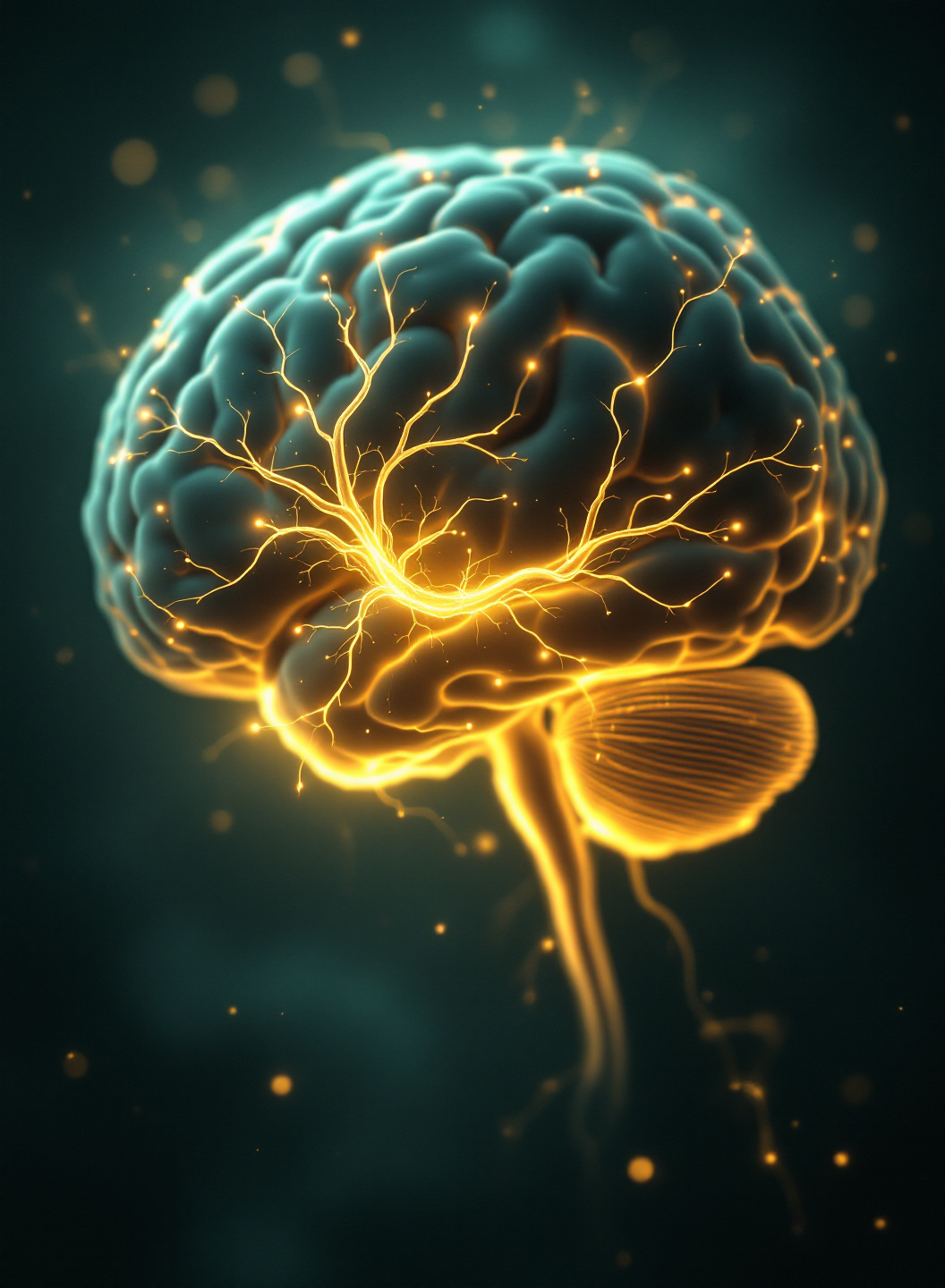
What is the endocannabinoid system? It is a signaling network the body uses to keep itself in balance, built from three parts: lipid messenger molecules called endocannabinoids (chiefly anandamide and 2-AG), the receptors they act on (CB1, dense throughout the brain, and CB2, mainly in immune tissue), and the enzymes that build and destroy them. Anandamide was discovered in 1992 and named for the Sanskrit word for bliss (Devane et al., 1992); the CB1 receptor had been cloned two years earlier (Matsuda et al., 1990). Its defining trick is retrograde signaling: it runs backwards across the synapse to let a neuron turn down its own incoming signals (Wilson & Nicoll, 2001). THC works only because it hijacks this system.
The story begins, as so much of modern neuroscience does, with a plant and a puzzle. Cannabis has been used by humans for thousands of years, but for most of that time no one had any idea how it worked. Its main active ingredient, THC, was finally isolated in 1964 by Raphael Mechoulam in Israel. That raised an even deeper question. THC is a foreign molecule from a flowering plant — so why should the human brain be studded with receptors that fit it so precisely? Evolution does not build locks for keys that do not exist. The presence of a cannabis receptor in the brain was a loud clue that the body must make its own key. Finding that inner key would reveal one of the brain’s most fundamental control systems.
Finding the lock, then the key
In 1990, Lisa Matsuda and colleagues at the National Institute of Mental Health cloned the receptor that THC binds — the cannabinoid receptor type 1, or CB1 (Matsuda et al., 1990). What they found was startling: CB1 is not some rare, specialized receptor. It is one of the most abundant G-protein-coupled receptors in the entire brain, blanketing the cortex, hippocampus, basal ganglia, and cerebellum. A system this large and this conserved does not exist to process a recreational plant. It exists to do something essential — and it must have its own native signaling molecules.
Two years later, the key turned up. Working in Mechoulam’s lab, William Devane and Lumir Hanus isolated a lipid molecule from pig brain that bound CB1, and they gave it a name worthy of its effects: anandamide, from ananda, the Sanskrit word for bliss (Devane et al., 1992). A few years after that, a second and far more abundant endocannabinoid, 2-arachidonoylglycerol (2-AG), was identified. Unlike classical neurotransmitters, which are packaged in advance and stored in little vesicles, these molecules are made from the fatty membrane of the neuron itself, on demand, precisely when and where they are needed — and then broken down within minutes by dedicated enzymes. They are not a stockpile. They are a signal manufactured in the moment.
The system that runs backwards
Here is where the endocannabinoid system breaks the textbook. In an ordinary synapse, signaling runs one way: the upstream (presynaptic) neuron releases a neurotransmitter that crosses the gap to the downstream (postsynaptic) neuron. It is a one-directional message, sender to receiver. Endocannabinoids reverse this arrow.
When a postsynaptic neuron becomes very active — flooded with calcium — it synthesizes endocannabinoids on the spot and releases them backwards, out of the receiving end of the synapse and back across the gap to the sender. There they land on CB1 receptors sitting on the presynaptic terminal and tell it, in effect, to quiet down: to release less neurotransmitter. In 2001, Rachel Wilson and Roger Nicoll at UCSF nailed the mechanism, showing in hippocampal slices that this backward message — long observed as a phenomenon called depolarization-induced suppression of inhibition — is carried by endocannabinoids acting on CB1, and is abolished when CB1 is blocked (Wilson & Nicoll, 2001). This is retrograde signaling, and it turns the endocannabinoid system into something unique: a way for a neuron to reach back and adjust its own inputs. It is a feedback dimmer switch, wired into synapses all over the brain.
Precisely-Dosed Psilocybin Mushroom TreatsOOTW Psilocybin Mushroom Treats
Precisely-dosed, lab-tested, quality psilocybin mushroom treats — crafted for daily ritual, neural support, and sustained clarity. Journal readers: 10% off your first order with code JOURNAL10 (applied automatically at checkout).
Claim 10% Off →A master regulator of balance
Why would the brain want a dimmer switch on nearly every circuit? Because the nervous system’s deepest problem is balance. Too much excitation and you get seizures and excitotoxic damage; too little and the system goes silent. The endocannabinoid system is one of the brain’s master tools for homeostasis — the maintenance of a stable internal state. By letting overactive neurons turn down their own inputs, it acts as a brake that engages exactly where and when activity runs too hot, then releases moments later. This is why endocannabinoids have been described not as a single-purpose messenger but as a general-purpose stabilizer, tuning the gain across circuits that govern pain, appetite, mood, stress, temperature, and memory. It is less a specific voice than the mixing engineer riding the faders of the whole brain.
That regulatory role is why the same system shows up everywhere in health and medicine. CB1 in the hypothalamus and limbic system shapes appetite — the reason cannabis famously produces “the munchies,” and the reason drugs that block CB1 to treat obesity had to be withdrawn when they caused severe depression and anxiety, a stark demonstration of how central this system is to mood. CB1 on pain pathways dampens the transmission of pain. The second receptor, CB2, sits mostly on immune cells and helps regulate inflammation, tying the endocannabinoid system into the body’s immune defenses as well.
The runner’s high was never the endorphins
For decades, the euphoric calm that can wash over a distance runner — the fabled “runner’s high” — was attributed to endorphins, the body’s natural opioids. It made a tidy story, but it had a fatal flaw: endorphins are large molecules that do not readily cross the blood-brain barrier, so it was never clear how they could produce a change in consciousness at all.
In 2015, Johannes Fuss and colleagues put the story to the test in mice. Running raised the animals’ endocannabinoid levels and produced the classic signs of a runner’s high: less anxiety and greater tolerance of pain. The decisive part was what happened when the researchers blocked the two systems. Blocking opioid receptors did not abolish the effect. Blocking cannabinoid receptors did — the reduced anxiety and the pain relief disappeared (Fuss et al., 2015). The runner’s high, at least in mice, depends on cannabinoid receptors, not endorphins. The blissful reward the body hands out for sustained effort is written, fittingly, in the language of its own inner cannabis.
AI That Understands The MedicineOOTW Spirit Guide
Set. Setting. Dose. Integration. The questions you can’t bring to your doctor — answered by an AI grounded in every peer-reviewed paper, protocol, and ceremony manual. Private, sober, always there.
Talk to the Spirit Guide → A Sacred 5-MeO-DMT Ceremony · MiamiJoin the OOTW Sacrament
The oldest prayer, remembered — the gentle dissolving of the self into light, held in ceremony by a master facilitator. Sit with our community first: a free, live weekly circle on Zoom. No commitment, simply a conversation.
Join the Weekly Circle →Erasing fear: endocannabinoids and memory
Some of the most consequential work on the endocannabinoid system concerns not pleasure but fear. This journal has explored how the brain extinguishes fear — how a learned threat can be unlearned when it repeatedly turns out to be safe. In 2002, Giovanni Marsicano and colleagues discovered that this process depends on CB1. Mice genetically stripped of the CB1 receptor could still learn to fear a tone paired with a shock, but they were strikingly impaired at extinguishing that fear — at letting it go once the tone became harmless. Endocannabinoids, released in the amygdala during the safe re-exposure, were required to quiet the fear circuit and allow the new, safer learning to take hold (Marsicano et al., 2002).
This places the endocannabinoid system at the heart of processes we have covered from other angles: the editing of emotional memory, the taming of the amygdala, and the extinction of trauma-linked fear. It also explains a genuine clinical interest in the system for post-traumatic stress and anxiety — and hints at why cannabis affects memory so profoundly, for better and worse. The same molecular hand that helps release old fear can also blur the formation of new memories, which is why heavy THC use impairs short-term recall: it jams a dimmer switch the brain relies on to encode experience.
Where this meets the psychedelic story
Cannabis is not a classic psychedelic — it does not act primarily on the serotonin 2A receptor the way psilocybin and LSD do — and this journal is careful not to blur that line. But the endocannabinoid system matters to the psychedelic story for a subtler reason: it governs the very same processes psychedelic therapy tries to move. Fear extinction, memory reconsolidation, emotional regulation, and neuroplasticity are all shaped by endocannabinoid tone. A brain’s baseline capacity to let go of fear and update old learning is, in part, set by this system.
This is also why the increasingly common practice of combining cannabis with psychedelics deserves real caution rather than hype. The two systems interact in ways that are genuinely understudied: cannabis can intensify or destabilize a psychedelic experience, sharpen anxiety, and — because CB1 signaling shapes the fear circuitry — tip a difficult moment in either direction. The honest scientific position is that the endocannabinoid system is a powerful, brain-wide regulator whose interaction with classic psychedelics is not yet well mapped. Respecting it means not assuming that two tools that each touch fear and memory will combine gently.
Precisely-Dosed Psilocybin Mushroom TreatsBring the Science Home
Every article here is the why. OOTW’s precisely-dosed, lab-tested, quality psilocybin mushroom treats are the how — crafted to carry the medicine into your daily practice. Journal readers: 10% off your first order with code JOURNAL10 (applied automatically at checkout).
Claim 10% Off →The honest cautions
The endocannabinoid system is real, vast, and well-established — the retrograde-signaling mechanism and the discovery of anandamide and CB1 are textbook neuroscience, not speculation. But its very ubiquity makes it hard to reason about simply. Because CB1 sits on so many different circuits, nudging the whole system with a blunt tool like THC produces a scattershot of effects — some therapeutic, some impairing — that vary enormously between people, doses, and contexts. The failure of CB1-blocking weight-loss drugs, which lifted appetite but sank mood into depression and suicidality, is a permanent reminder that you cannot pull one lever of this system without moving many others.
The runner’s-high finding, striking as it is, comes from mice, and the human picture is still being filled in. The therapeutic promise of targeting endocannabinoids for PTSD, anxiety, and pain is real but early, and cannabis itself is a crude, high-variability way to engage a system that the body normally tunes with exquisite precision. Cannabis is not risk-free — it can worsen anxiety, impair memory and motivation with heavy use, and carries particular risk for adolescents and for people vulnerable to psychosis. None of this is a recommendation to use it.
The dimmer switch of the self
We tend to think of the brain as a system of signals firing forward — sensation to thought to action. The endocannabinoid system reveals a quieter, stranger layer underneath: a network of molecules made from the brain’s own membranes, released backwards, on demand, to keep every circuit from running too hot. It is the reason effort can feel like bliss, the reason fear can be let go, the reason a plant used for millennia touches the human mind at all. Long before we cultivated cannabis, evolution had already grown its logic inside us — a homemade calm, a built-in brake, an inner cannabis whose real job is not intoxication but balance.
OOTW Journal is educational and does not provide medical advice. The endocannabinoid system is a well-established area of neuroscience, but its therapeutic applications and its interactions with cannabis and psychedelics are still under active investigation. Cannabis and related compounds are not safe for everyone, carry particular risk for adolescents and people vulnerable to psychosis, and nothing here is a recommendation to use them.