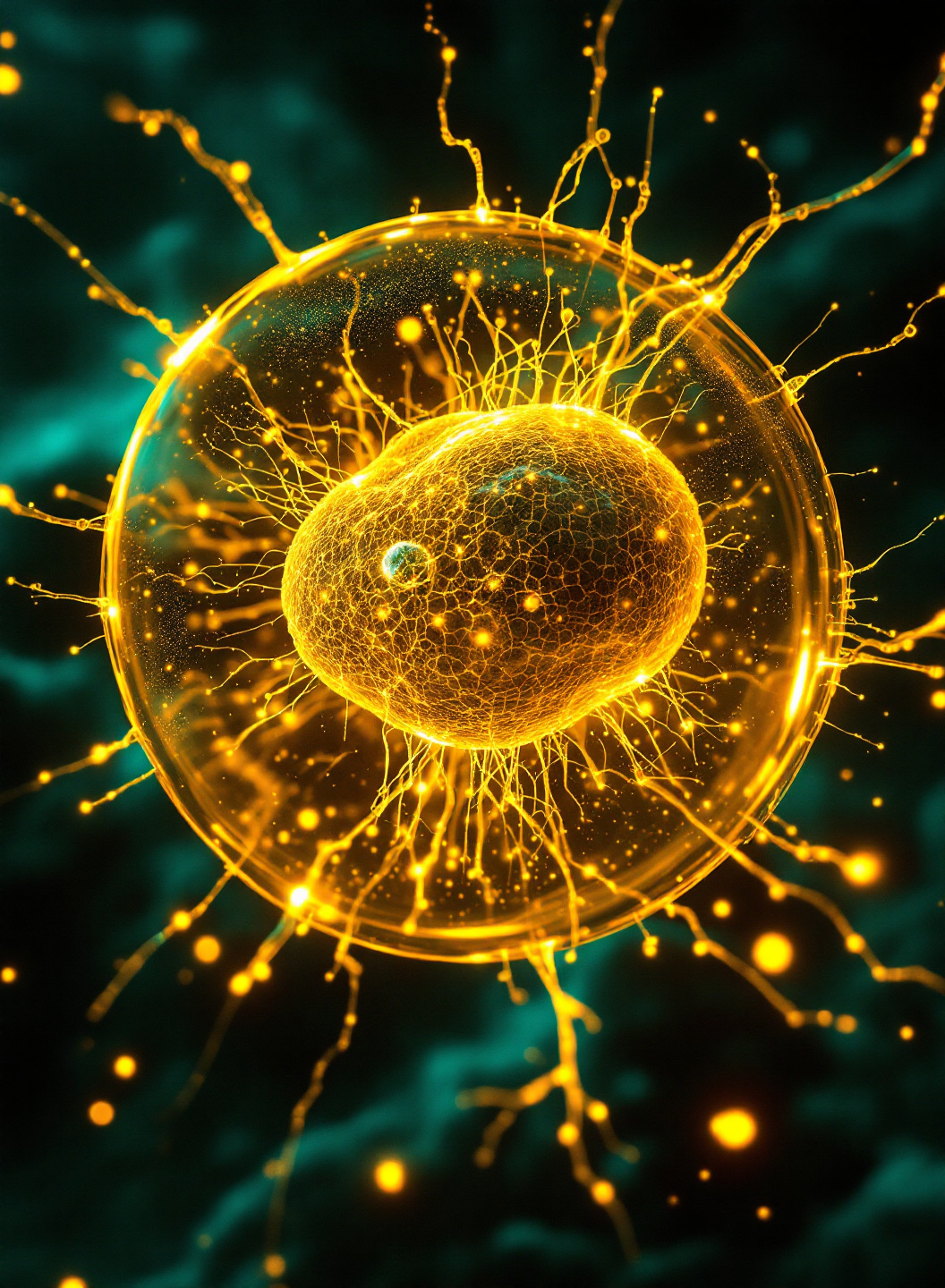
What is the sigma-1 receptor, and what does it have to do with DMT? The sigma-1 receptor is an unusual protein that lives inside the cell — not on its surface — at the membrane junction between the endoplasmic reticulum (ER) and the mitochondria. There it works as a molecular chaperone: it stabilizes other proteins, helps regulate calcium flow from the ER to the mitochondria, and protects cells against stress and death (Hayashi & Su, 2007). In 2009, a landmark study in Science reported that N,N-dimethyltryptamine (DMT) — the powerful psychedelic that the body also makes on its own (see endogenous DMT) — binds to the sigma-1 receptor and acts as an endogenous regulator of it (Fontanilla et al., 2009). This raised a fascinating possibility: that the brain’s own DMT may have a quiet, non-psychedelic job as a signal to a cellular guardian. This is emerging, largely preclinical science.
Some receptors sit on the surface of the cell like antennas, facing outward, waiting for a chemical message from the world beyond the membrane. The sigma-1 receptor is not one of them. It hides deep inside the cell, in a place most signaling molecules never reach, doing a job that for decades no one could quite name. Understanding it means turning the usual picture of a receptor inside out — and it leads to one of the strangest and most beautiful ideas in the science of psychedelics: that the most powerful visionary molecule known to biology may also be, in its quieter moments, a caretaker of the cell.
A receptor unlike the others
When the sigma receptors were first described in the 1970s, they were badly misunderstood — initially mistaken for a type of opioid receptor, then for a target of PCP. It took decades to work out what the sigma-1 receptor actually is, and the answer turned out to be genuinely novel. It is not a classical neurotransmitter receptor at all. It is a small protein, only around 220 amino acids long, embedded in the membrane of the endoplasmic reticulum — the cell’s internal factory and folding-house for proteins — and it concentrates at a special zone called the MAM, the mitochondria-associated membrane, where the ER presses up against the mitochondria.
Its structure, finally solved by X-ray crystallography in 2016, was as unusual as its location: a trimer of three identical units, each with a single membrane-spanning helix and a cupin-like pocket cradling its ligand — a shape unlike any other human receptor (Schmidt et al., 2016). This is not a protein built to sit on the surface and relay a fast signal. It is built to live inside, and to work on other proteins.
The chaperone at the crossroads
The breakthrough in understanding what the sigma-1 receptor does came from the work of Teruo Hayashi and Tsung-Ping Su. They showed that it functions as a molecular chaperone — a protein whose job is to help other proteins fold correctly, stay stable, and reach where they need to go. Specifically, the sigma-1 receptor sits at the ER–mitochondrion interface and stabilizes the IP3 receptor, the channel that releases calcium from the ER into the mitochondria. By steadying that calcium hand-off, it keeps the mitochondria properly fueled and helps the cell weather stress and avoid death (Hayashi & Su, 2007).
Think of the sigma-1 receptor as an on-call structural engineer stationed at the busiest junction in the cell. Under normal conditions it goes about its work quietly. But when the cell comes under stress — a shortage of oxygen, a flood of misfolded proteins, the chemical chaos of injury — the sigma-1 receptor mobilizes, redistributes through the cell, and helps hold the machinery together. This is why it has drawn intense interest as a target for neurodegenerative disease, where cells die from exactly these kinds of stress. It is, in the most literal cellular sense, a guardian.
The 2009 surprise
For years, the sigma-1 receptor had a conspicuous gap in its biography: no one knew its natural, endogenous ligand — the molecule the body itself makes to speak to it. Many candidates were proposed. Then, in 2009, Dominique Fontanilla and colleagues published a result in Science that startled two fields at once. The endogenous molecule that fit the sigma-1 receptor, they reported, was N,N-dimethyltryptamine — DMT (Fontanilla et al., 2009).
Their evidence ran across several levels. DMT bound to the sigma-1 receptor at physiologically plausible concentrations. Acting through it, DMT influenced ion channels in cells that carry the receptor. And in living animals, DMT produced a characteristic change in movement in normal mice — but not in mice genetically lacking the sigma-1 receptor, tying the behavioral effect directly to that protein. Together, the biochemistry, the cell physiology, and the behavior pointed to a single conclusion: DMT is an endogenous regulator of the sigma-1 receptor.
Precisely-Dosed Psilocybin Mushroom TreatsOOTW Psilocybin Mushroom Treats
Precisely-dosed, lab-tested, quality psilocybin mushroom treats — crafted for daily ritual, neural support, and sustained clarity. Journal readers: 10% off your first order with code JOURNAL10 (applied automatically at checkout).
Claim 10% Off →The spirit molecule's second job
To feel why this is such a provocative idea, hold two facts side by side. First, DMT is the most dramatic psychedelic known — the visionary core of ayahuasca, the molecule behind the overwhelming near-death-like journeys people report. Second, the body makes it on its own, in tiny amounts, through its own enzymes (see our deep dive on endogenous DMT). The obvious question — if we make DMT, why? — has never had a good answer, precisely because the amounts the body produces seem far too small to cause visions.
The sigma-1 finding offers a way through that puzzle. Perhaps the small, everyday amounts of endogenous DMT are not there to make us hallucinate at all. Perhaps their job is to act as a signal to the cellular guardian — nudging the sigma-1 receptor, tuning the cell’s stress-defense and calcium machinery, contributing to protection and resilience at the level of the cell. In this view, the towering psychedelic experience is what happens only when DMT is present in massive, unnatural amounts; its true native role would be quiet, chemical, and protective — a caretaker’s whisper rather than a visionary’s roar.
A hypothesis of protection
This line of thinking has been developed most fully by Ede Frecska, Attila Szabo, and colleagues, who proposed that a sigma-1-mediated action of DMT could underlie a role in tissue protection, regeneration, and immune regulation — especially under extreme stress such as oxygen deprivation, of the kind the brain faces during cardiac arrest and near-death states (Frecska et al., 2013). Later cell studies lent some support to the protective theme, showing that sigma-1 activation can help cells survive oxidative stress. It is a genuinely elegant hypothesis: it would give the body’s otherwise mysterious production of a psychedelic a sober, life-preserving purpose.
It is essential to be clear, though, about what is established and what is still speculation. That DMT binds and regulates the sigma-1 receptor (Fontanilla et al., 2009), and that the sigma-1 receptor is a stress-responsive chaperone that protects cells (Hayashi & Su, 2007), are solid, published findings. The larger story — that endogenous DMT’s main biological purpose is sigma-1-mediated cellular protection during stress or dying — is a compelling and much-discussed hypothesis, not a demonstrated fact. It rests heavily on cell cultures and animal models, and the leap to human physiology, let alone to the meaning of near-death experiences, remains unproven.
Why it reframes the whole question
What makes the sigma-1 receptor so worth knowing is how it changes the shape of the questions we ask about psychedelics. The dominant story of the last two decades has been about the 5-HT2A receptor — a surface receptor, a fast signal, the switch that flips the mind into the visionary state. The sigma-1 receptor tells a completely different kind of story: a receptor hidden inside the cell, working slowly on the machinery of survival, possibly listening for a molecule we have always thought of as purely mind-altering.
It suggests that a psychedelic molecule can lead a double life — one role loud and visible in the theater of consciousness, another silent and structural in the engine room of the cell. And it hints that the reason our own bodies bother to make something as strange as DMT may have nothing to do with visions at all, and everything to do with the ancient, unglamorous work of keeping cells alive. The guardian within does not deal in revelation. It deals in resilience.
AI That Understands The MedicineOOTW Spirit Guide
Set. Setting. Dose. Integration. The questions you can’t bring to your doctor — answered by an AI grounded in every peer-reviewed paper, protocol, and ceremony manual. Private, sober, always there.
Talk to the Spirit Guide → A Sacred 5-MeO-DMT Ceremony · MiamiJoin the OOTW Sacrament
The oldest prayer, remembered — the gentle dissolving of the self into light, held in ceremony by a master facilitator. Sit with our community first: a free, live weekly circle on Zoom. No commitment, simply a conversation.
Join the Weekly Circle →The honest cautions
This is a field where the temptation to over-tell the story is strong, so the boundaries deserve emphasis. The protective, sigma-1-mediated role of endogenous DMT is a hypothesis under investigation, built largely on preclinical work in cells and animals. It should not be read as an established explanation for near-death experiences, spiritual states, or healing, however poetic that framing may be. Endogenous DMT is real, and its binding to the sigma-1 receptor is real; the grand purpose sometimes attached to those facts is not yet earned.
Nothing here should be taken as medical advice or as encouragement to use DMT, which is a powerful, illegal, and potentially destabilizing substance in most of the world. The sigma-1 receptor is an exciting drug target for neurodegeneration and other conditions, but that research is early and belongs in the hands of scientists and clinicians. What is genuinely thrilling here is not a cure or a claim — it is a mystery being slowly, carefully mapped.
The caretaker molecule
We are used to thinking of DMT as the ultimate escape hatch — the molecule that blows the doors off perception and hurls the mind into other worlds. The sigma-1 receptor offers a humbler and, in its way, more moving picture: the same molecule, in its natural trace amounts, quietly tending the cell from the inside, steadying the flow of calcium, helping the mitochondria endure. If that picture holds, then the spirit molecule was never only about leaving the body. It may have been, all along, about helping the body last. The guardian within keeps its vigil in the dark interior of the cell — and the strangest psychedelic we know may be one of the voices it was built to hear.
OOTW Journal is educational and does not provide medical advice. The sigma-1 receptor's identity as an ER-mitochondrion chaperone that regulates calcium and cell survival (Hayashi & Su 2007), its unusual trimeric structure (Schmidt et al. 2016), and the finding that DMT is an endogenous sigma-1 regulator (Fontanilla et al. 2009) are documented in the cited work. The broader idea that endogenous DMT's primary purpose is sigma-1-mediated cellular protection (Frecska et al. 2013) is a hypothesis built largely on preclinical evidence, not an established fact. DMT is a controlled substance and nothing here is a recommendation to use it.