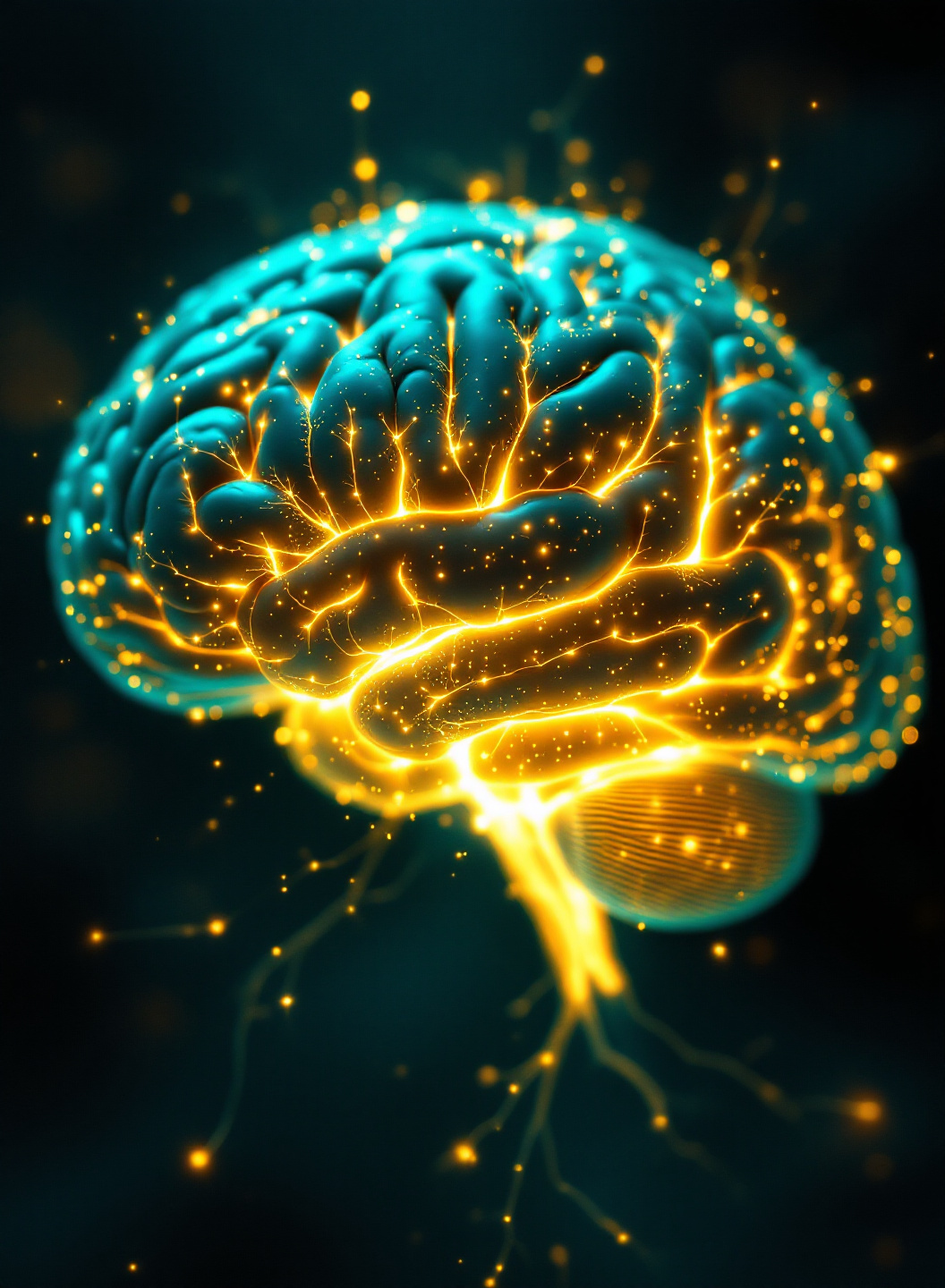
What is the cerebellum, and why does it matter beyond movement? The cerebellum (Latin for “little brain”) is a dense, tightly folded structure at the back and bottom of the brain. Despite taking up only about a tenth of the brain’s volume, it contains roughly 69 billion neurons — about 80% of all the neurons in your brain (Herculano-Houzel, 2009). For a century it was considered a pure motor-control device that smooths and times movement. But when researchers studied people with cerebellar damage, they found something startling: alongside clumsiness came disruptions of thinking, planning, language, and emotion — a pattern named the cerebellar cognitive affective syndrome (Schmahmann & Sherman, 1998). The modern view is that the cerebellum runs the same trick everywhere: it takes any process — a movement, a thought, a feeling — and makes it smooth, coordinated, and well-timed. And it lights up under psychedelics too.
Ask someone to point to the brain and they will tap the top of their head, imagining the wrinkled hemispheres of the cortex — the seat, we’re told, of everything that makes us human. Almost no one points to the back of the skull, low, near the neck. Yet that is where you would find the structure holding most of your neurons, and one of the most quietly important organs of the mind. Its story is a lesson in how easy it is to mistake a thing’s job for its whole nature.
The structure we underestimated
The cerebellum looks nothing like the rest of the brain. Where the cortex is a sprawling, loosely folded sheet, the cerebellum is packed into fine, parallel ridges — like the pages of a book pressed edge-on. That architecture is not decorative. It is what lets the cerebellum cram in so many cells: by the best modern count, around 69 billion neurons, roughly four out of every five in the whole brain, even though the flashy cortex gets all the attention (Herculano-Houzel, 2009). If neuron count were the measure of importance, the cerebellum would be the star of the show.
Its circuitry is also strangely regular — almost crystalline. The same simple microcircuit repeats over and over, millions of times, across the whole structure. This uniformity is a crucial clue. It suggests the cerebellum is not doing many different specialized things in different places, the way the cortex does. It is doing one kind of operation, over and over, on whatever information happens to be routed through it. The deep question, then, is: what is that one operation — and what gets routed through?
The century-long mistake
For most of neuroscience’s history, the answer seemed obvious. People and animals with cerebellar damage move badly: their gait is unsteady, their reaching overshoots and corrects, their speech slurs. So the cerebellum was cast as the brain’s motion-control unit — the part that smooths and times and calibrates movement so it comes out graceful instead of jerky. That is true, and it is important. But it was only ever part of the picture, and mistaking the part for the whole delayed the real discovery by decades.
The turning point came in 1998, when Jeremy Schmahmann and Janet Sherman carefully studied a group of patients whose damage was confined to the cerebellum. Alongside the expected motor problems, they documented something the textbooks did not predict: trouble with planning and mental flexibility, spatial reasoning, language, and the regulation of emotion and personality. They named the pattern the cerebellar cognitive affective syndrome (Schmahmann & Sherman, 1998). The little brain, it turned out, was not just for moving. It was for thinking and feeling too.
Precisely-Dosed Psilocybin Mushroom TreatsOOTW Psilocybin Mushroom Treats
Precisely-dosed, lab-tested, quality psilocybin mushroom treats — crafted for daily ritual, neural support, and sustained clarity. Journal readers: 10% off your first order with code JOURNAL10 (applied automatically at checkout).
Claim 10% Off →Dysmetria of thought
Schmahmann proposed a beautifully simple way to unify all of this, an idea called dysmetria of thought. “Dysmetria” is the clinical word for the cerebellum’s classic motor sign: movements that miss their target, overshooting and undershooting, poorly measured and poorly timed. His insight was that the cerebellum might do the exact same job for everything — that it applies one universal operation, smoothing and coordinating and correctly timing whatever passes through, whether that’s a reaching arm, a train of thought, or a wave of feeling.
In this view, the cerebellum is the brain’s great coordinator. When it tunes movement, you get grace. When it tunes thought, you get mental flow — ideas that arrive smoothly and in the right order. When it tunes emotion, you get feelings that are proportionate to the moment rather than overshooting into chaos. Damage it, and each of these can become clumsy in its own way: not just a stumbling walk, but stumbling thoughts and stumbling moods. It is the same machine, applied to different material.
The felt sense of the body
Here is where the cerebellum touches something intimate. It sits at the crossroads of the body’s signals — balance, position, movement, the constant stream of feedback about where you are in space and how your body is arranged. It is deeply tied to the felt, physical sense of being an embodied creature, working alongside the brain’s interoceptive machinery that tracks the body’s inner state. Much of what we experience as the smooth, seamless background feeling of “having a body” is the cerebellum quietly doing its coordinating work beneath awareness.
That makes it quietly relevant to altered states, where the sense of the body so often changes — the feelings of floating, of dissolving, of the body’s boundaries softening or rearranging that people describe on psychedelics. A structure this central to embodiment and timing is almost certainly part of why those states feel the way they feel, even if it has been overlooked in favor of the cortex.
The cerebellum on psychedelics
For a long time, psychedelic neuroscience focused almost entirely on the cortex — the 5-HT2A receptors densely spread across its surface, the loosening of high-level networks. The cerebellum was largely left out of the story. But when researchers looked closely at the whole brain under LSD, the little brain lit up. In one careful study, LSD increased connectivity in sensory and somatomotor networks, including the cerebellum, even as it loosened the brain’s associative, executive networks — and crucially, blocking the 5-HT2A receptor with a drug called ketanserin switched the whole effect off (Preller et al., 2018).
That is a striking pattern: as the “thinking” networks let go, the “sensing and moving” networks — the cerebellum among them — become more tightly linked. It fits the lived report of the psychedelic state so well: the intellect quiets while raw sensation and the body come forward, vivid and immediate. The cerebellum, so bound up with the body and with timing, may be part of why the psychedelic world can feel so physically present. This is an emerging line of research, not a settled account — but it is a strong hint that any full picture of psychedelics will have to include the half of the brain we forgot.
AI That Understands The MedicineOOTW Spirit Guide
Set. Setting. Dose. Integration. The questions you can’t bring to your doctor — answered by an AI grounded in every peer-reviewed paper, protocol, and ceremony manual. Private, sober, always there.
Talk to the Spirit Guide → A Sacred 5-MeO-DMT Ceremony · MiamiJoin the OOTW Sacrament
The oldest prayer, remembered — the gentle dissolving of the self into light, held in ceremony by a master facilitator. Sit with our community first: a free, live weekly circle on Zoom. No commitment, simply a conversation.
Join the Weekly Circle →Why the little brain matters
The rehabilitation of the cerebellum is one of the great quiet corrections in modern neuroscience — a reminder of how a plausible early story can freeze a field in place. Because cerebellar damage so obviously wrecks movement, movement became the whole explanation, and for a hundred years the structure holding most of the brain’s neurons was treated as a mere accessory. It took patients whose thinking and feeling had come undone, and researchers willing to notice, to reveal the truth.
It also reshapes the picture of the mind we carry around. The cortex is not a lone genius doing all the interesting work while a humble motor servant keeps the body upright. Thought and feeling and movement all lean on the same patient coordinator working in the background, measuring and timing and smoothing, so that a life can flow rather than lurch. The little brain is not little in what it does. It is only little in how long it took us to see it.
The honest cautions
A few boundaries are worth naming. The core science is solid: the cerebellum holds most of the brain’s neurons (Herculano-Houzel, 2009), and its damage impairs cognition and emotion, not just movement (Schmahmann & Sherman, 1998). The unifying “dysmetria of thought” idea is an influential and well-supported framework, but it remains a theory of how the cerebellum contributes, not a closed case. And the cerebellum’s specific role in the psychedelic experience is an early and active area of research: the LSD connectivity findings are real (Preller et al., 2018), but exactly how the cerebellum shapes the felt quality of these states is still being worked out.
Nothing here is medical advice. The point of this piece is not a treatment or a claim about what to do — it is a shift in seeing: an invitation to include, in your picture of your own mind, the dense and patient little brain that has been coordinating it all along.
The coordinator
Most of what the cerebellum does, you will never notice — and that is precisely its gift. The seamless flow of a gesture, the orderly arrival of a thought, the proportion of a feeling, the quiet background sense of simply being in a body: these come to us finished and smooth because, underneath, the little brain is measuring and correcting a thousand times a second. It asks for no attention. It holds most of our neurons and almost none of our awareness. And when the mind slips into an altered state and the body comes rushing forward, vivid and strange, the little brain is there too — coordinating a world that suddenly feels entirely new.
OOTW Journal is educational and does not provide medical advice. The cerebellum’s neuron count (Herculano-Houzel 2009), its role in cognition and emotion via the cerebellar cognitive affective syndrome (Schmahmann & Sherman 1998), and LSD’s 5-HT2A-dependent increase in sensory-somatomotor and cerebellar connectivity (Preller et al. 2018) are documented in the cited work. The “dysmetria of thought” framework and the cerebellum’s precise role in psychedelic experience are active areas of research, not settled conclusions.