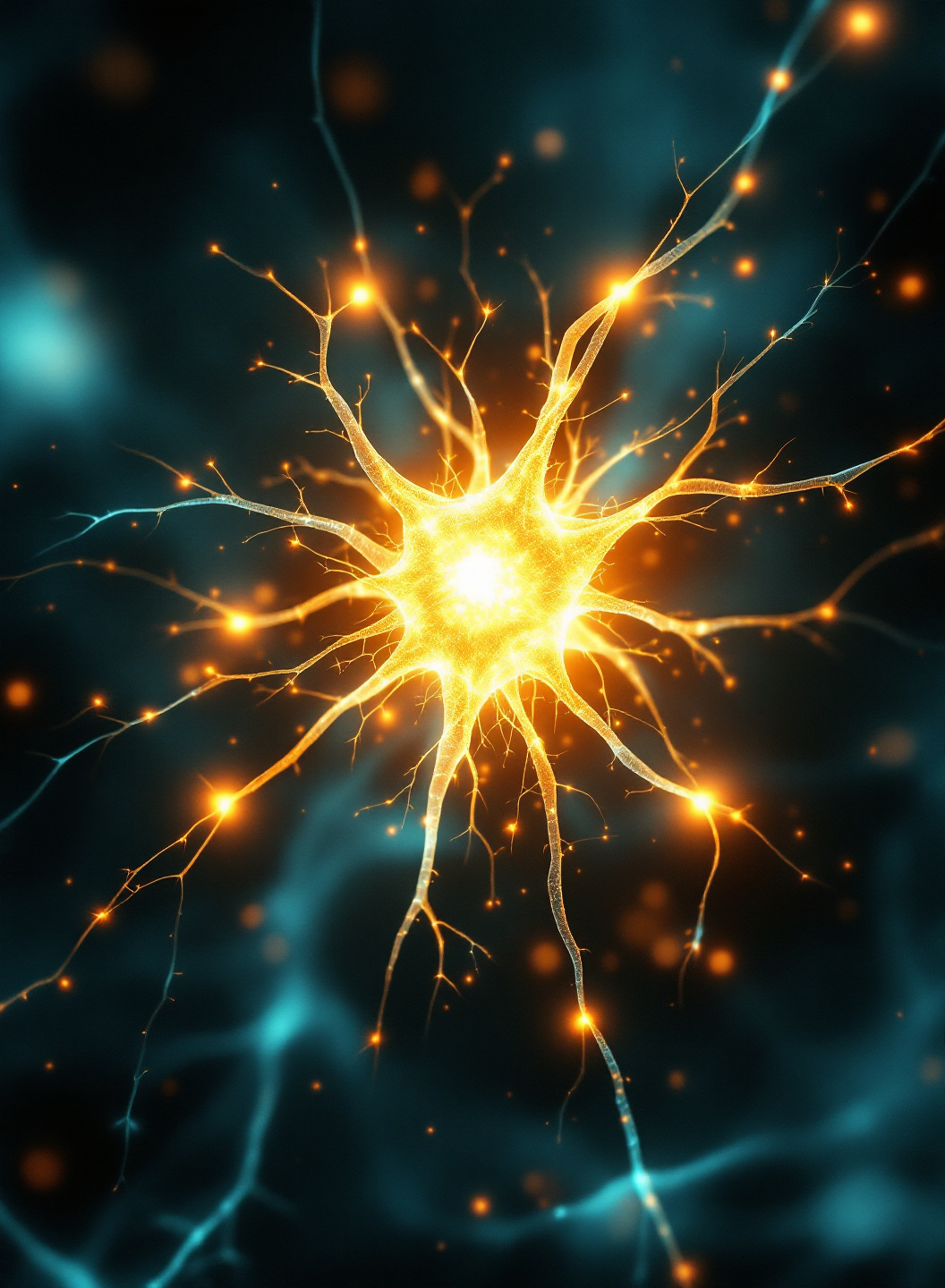
What is an astrocyte, and what is the “tripartite synapse”? An astrocyte is a star-shaped brain cell — a type of glia — and glia make up roughly half of all the cells in your brain. Astrocytes are not neurons and do not fire electrical spikes, but they are anything but passive. Each one wraps its fine branches around thousands of synapses, the tiny gaps where neurons pass messages. There it does three jobs at once: it feeds the neurons, it mops up used-up chemical messengers, and — the surprising part — it listens to the signal and can release its own chemicals back, changing how strong the connection becomes. Because of this, scientists proposed that a synapse really has three partners, not two: the sending neuron, the receiving neuron, and the astrocyte cradling them both (Perea, Navarrete & Araque, 2009). That idea is called the tripartite synapse.
Picture the brain and you probably picture neurons — those spidery cells with their branching arms, crackling with electricity, wiring thought to thought. It is a beautiful picture, and it is only half the story. Woven silently among all those neurons is a second population of cells, just as numerous, that for most of the history of neuroscience nobody took seriously. They did not spark. They did not fire. So they were filed away as scaffolding. We now know that these cells are active participants in almost everything the brain does — and getting to know them changes what you think a thought even is.
The cells we called glue
When the great anatomists of the nineteenth century first stained brain tissue and peered at it, they saw the elegant neurons — and they saw a second kind of cell packed in between. They named this second population glia, from the Greek word for glue, because they assumed that was its purpose: to hold the real machinery, the neurons, in place. The name stuck for well over a century, and so did the assumption behind it. Glia were the supporting cast. Neurons were the stars.
The most common glial cells in the brain are the astrocytes — named for their star-like shape, with dozens of fine branches radiating out in every direction. They do not produce the fast electrical spikes that neurons use to signal, which is a large part of why they were overlooked for so long: the tools neuroscientists built were designed to catch electrical firing, and astrocytes are electrically quiet. But quiet is not the same as inactive. When researchers finally developed ways to watch the chemistry inside living astrocytes rather than their electricity, a hidden world opened up.
The synapse gets a third partner
The turning point came in 1999, when Alfonso Araque and his colleagues proposed a deceptively simple idea with a memorable name: the tripartite synapse (Araque et al., 1999). For a century, the synapse — the junction where one neuron passes a chemical message to the next — had been drawn as a two-part affair: a sender and a receiver. Araque’s group argued that this picture was missing a crucial character. Wrapped intimately around almost every synapse is the fine tip of an astrocyte branch, and that astrocyte is not just watching. It is part of the circuit.
Here is what that means in practice. When a neuron fires and releases its chemical messengers into the synapse, some of those molecules reach the astrocyte, which carries receptors for them just as the receiving neuron does. The astrocyte “hears” the message. Inside it, the arrival of the signal triggers a wave of calcium — astrocytes communicate not with electricity but with slow, rolling surges of calcium moving through the cell. And in response, the astrocyte can release its own chemical messengers, called gliotransmitters, back into the synapse, where they can strengthen or dampen the connection between the two neurons. The conversation, in other words, was never just between two cells. It was always a three-way exchange.
Precisely-Dosed Psilocybin Mushroom TreatsOOTW Psilocybin Mushroom Treats
Precisely-dosed, lab-tested, quality psilocybin mushroom treats — crafted for daily ritual, neural support, and sustained clarity. Journal readers: 10% off your first order with code JOURNAL10 (applied automatically at checkout).
Claim 10% Off →How a star-shaped cell helps you remember
This is not an abstract curiosity — it reaches right into how memories form. One of the best-studied examples involves a molecule called D-serine. To lay down a lasting memory, neurons strengthen certain connections through a process called long-term potentiation, and that process depends on a particular receptor (the NMDA receptor) opening. But that receptor is fussy: it will not open for the neuron’s signal alone. It also needs a second key present at the same time — and in many parts of the brain, that key, D-serine, is supplied by the astrocyte.
In an elegant 2010 study, researchers showed just how central the astrocyte is. When they quietened the calcium signaling inside a single astrocyte, the nearby synapses could no longer strengthen properly — memory’s basic mechanism stalled — because the astrocyte had stopped delivering its D-serine key (Henneberger et al., 2010). Read that again: silence one supporting cell, and the neurons around it lose their ability to learn. The astrocyte is not assisting memory from the sidelines. It is holding one of the keys.
Why human astrocytes may be special
If astrocytes are so involved in the brain’s work, a natural question follows: are human astrocytes different from those of other animals? The answer appears to be a striking yes. When researchers compared them, they found that human astrocytes are far larger and more intricate than those of mice — many times bigger, with vastly more branches. A single human astrocyte can drape its branches around on the order of two million synapses at once, coordinating an enormous territory of connections, where a rodent’s astrocyte manages a small fraction of that (Oberheim et al., 2009).
This has led to one of the more tantalizing ideas in the field: that part of what makes the human brain human may lie not only in our neurons but in the sheer scale and sophistication of our glia. It is far too early to say that astrocytes explain human intelligence — that would be a leap well beyond the evidence. But the discovery reframes an old assumption. The cells we dismissed as glue turn out to be one of the places where the human brain is most unusual.
Astrocytes, mood, and psychedelics
Because astrocytes sit at the heart of the synapse, they inevitably touch the systems that psychedelics act on. Astrocytes carry many of the same receptors neurons do, including the 5-HT2A serotonin receptor that classic psychedelics switch on. That means a psychedelic entering the brain is not speaking to neurons alone; it is also whispering to the astrocytes wrapped around every connection. Researchers are only beginning to map what that second conversation does, but it is a live and growing area of study — part of a broader recognition that glia help shape mood, stress, and the brain’s capacity to rewire itself.
That capacity to rewire — the growth of new connections that psychedelics and other plasticity-promoting molecules encourage — does not happen in a vacuum. Synapses are built, pruned, and strengthened with astrocytes as active partners at every step. And astrocytes are close cousins to microglia, the brain’s immune cells, with which they coordinate the brain’s response to stress and inflammation. The more carefully we look, the clearer it becomes that the story of how the brain changes is a story about glia as much as neurons.
AI That Understands The MedicineOOTW Spirit Guide
Set. Setting. Dose. Integration. The questions you can’t bring to your doctor — answered by an AI grounded in every peer-reviewed paper, protocol, and ceremony manual. Private, sober, always there.
Talk to the Spirit Guide → A Sacred 5-MeO-DMT Ceremony · MiamiJoin the OOTW Sacrament
The oldest prayer, remembered — the gentle dissolving of the self into light, held in ceremony by a master facilitator. Sit with our community first: a free, live weekly circle on Zoom. No commitment, simply a conversation.
Join the Weekly Circle →What this changes
The rise of the astrocyte is one of those quiet revolutions that rearranges a whole field without any single dramatic moment. There was no eureka, no overturned paradigm announced on a magazine cover — just a steady accumulation of evidence, over two decades, that the cells we ignored are doing an astonishing amount of the work. It is a lesson in scientific humility. For a hundred years, the answer to “what does the other half of the brain do?” was, in effect, “probably nothing important.” It turned out we simply lacked the tools to see.
It also gently reshapes how we might picture our own minds. A thought is not only a chain of neurons firing in the dark. It is neurons firing while, all around them, a slower population of star-shaped cells listens, responds, feeds, prunes, and tunes — setting the conditions under which the fast electric story can even happen. The brain is not a machine of wires alone. It is a partnership, and half the partnership only recently learned to speak up.
The honest cautions
A few boundaries are worth naming clearly. The core science here is solid: astrocytes actively participate in synaptic signaling, they release gliotransmitters, and they supply co-factors like D-serine that neurons need to strengthen connections (Araque et al., 1999; Henneberger et al., 2010). What remains genuinely debated is how much of ordinary moment-to-moment brain function depends on gliotransmission, and how far the findings from mice and brain slices carry into the living human brain. This is an active, sometimes contested frontier, not a closed case.
Likewise, the idea that oversized human astrocytes help explain human cognition is an intriguing hypothesis, not an established fact, and the role of astrocytes in psychedelic effects is early-stage research. Nothing here is medical advice. The point of this story is not a treatment or a claim — it is a shift in perspective: an invitation to see the brain as it actually is, glia and all.
The listening cells
We named them glue and forgot about them. It took a century and a new set of tools to notice that the brain’s other half had been part of the conversation all along — wrapped around every synapse, catching every message, answering in slow waves of calcium. The astrocyte does not fire, does not spike, does not announce itself. It listens. And in that patient, star-shaped listening lies a truth the field is still catching up to: the mind was never the work of neurons alone.
OOTW Journal is educational and does not provide medical advice. The tripartite synapse concept and astrocytes’ active role in synaptic signaling (Araque et al. 1999; Perea, Navarrete & Araque 2009), the dependence of long-term potentiation on astrocyte-derived D-serine (Henneberger et al. 2010), and the unusual size and complexity of human astrocytes (Oberheim et al. 2009) are documented in the cited work. The broader claims — that glia explain human intelligence, or their precise role in psychedelic effects — are active areas of research, not settled conclusions.