What is the AMPA receptor, and why does it matter? The AMPA receptor is a tiny protein gate on the receiving side of a synapse that opens when the chemical messenger glutamate lands on it, letting a fast electrical signal into the next neuron. It carries almost all of the brain’s quick excitatory traffic — the split-second signaling that thinking is made of. Its deeper importance is that the brain constantly adds and removes these gates from a connection: put more in and the synapse gets stronger (long-term potentiation); take them out and it weakens. This trafficking of AMPA receptors is a core molecular mechanism of learning and memory (Malinow & Malenka, 2002). Strikingly, the same gate is the final common path for fast-acting antidepressants: ketamine’s mood effect requires working AMPA receptors — block them and the effect disappears (Maeng et al., 2008; Autry et al., 2011).
The brain runs on electricity, but that electricity does not leap directly from one neuron to the next. It stops at a gap — the synapse — and gets carried across as a puff of chemical, which then has to be caught and turned back into an electrical signal on the far side. The catchers are receptors, and the fastest, busiest of them all is a small protein with an unglamorous name: the AMPA receptor. Understand this one gate and you understand a surprising amount about how brains learn, how memories form, and even how the newest antidepressants lift a mood in hours instead of weeks.
The workhorse gate
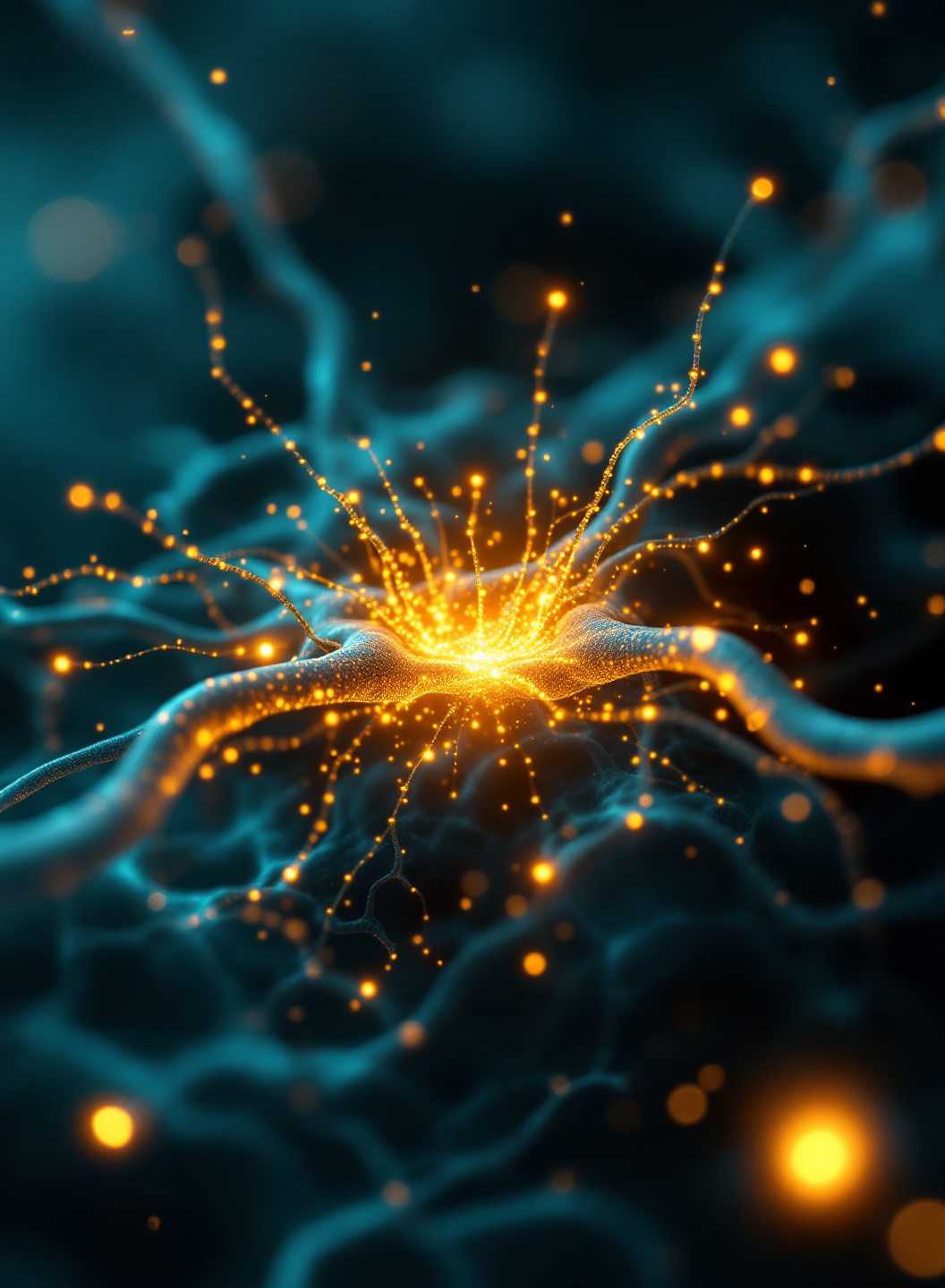
Picture the receiving end of a synapse as a wall studded with little doors. When the neuron upstream fires, it releases the messenger glutamate, the brain’s main “go” signal. Glutamate drifts across the gap and lands on receptors waiting on the far wall. The AMPA receptor is the one that responds fastest: the instant glutamate touches it, it snaps open and lets a rush of charged particles flow in, nudging the next neuron a little closer to firing. This happens in well under a thousandth of a second, over and over, everywhere in your brain, all the time. It is the raw currency of fast thought.
There is a companion door right next to it — the NMDA receptor — that is slower and pickier, and acts more like a sensor that decides when change should happen. But the AMPA receptor is the one that carries the everyday traffic. If the NMDA receptor is the supervisor watching for meaningful patterns, the AMPA receptor is the worker actually moving the signal through, moment to moment.
Learning, written in doors
Here is the beautiful part. The number of AMPA receptors sitting in a given synapse is not fixed. The brain can physically move more of them into the wall, or pull them out, and it does this constantly. And because these gates carry the signal, changing how many are present changes how strongly that connection responds. Move more AMPA receptors into a synapse and the same incoming message now produces a bigger effect — the connection has been strengthened. This strengthening is called long-term potentiation, or LTP, and the reverse (pulling receptors out to weaken a connection) is long-term depression.
In a landmark synthesis, Roberto Malinow and Robert Malenka gathered the evidence that this trafficking of AMPA receptors — shuttling them in and out of synapses — is a central mechanism of synaptic plasticity, the brain’s ability to rewire itself with experience (Malinow & Malenka, 2002). This is one of the deepest ideas in neuroscience: a memory, at its most physical level, can be partly a matter of how many tiny gates got added to which connections. Learning is not just abstract. It is doors being installed.
Precisely-Dosed Psilocybin Mushroom TreatsOOTW Psilocybin Mushroom Treats
Precisely-dosed, lab-tested, quality psilocybin mushroom treats — crafted for daily ritual, neural support, and sustained clarity. Journal readers: 10% off your first order with code JOURNAL10 (applied automatically at checkout).
Claim 10% Off →The fast lane and the slow one
This molecular picture also solved a long-standing puzzle in psychiatry. Traditional antidepressants — the SSRIs that raise serotonin — can take weeks to lift a person’s mood, if they work at all. Then came a shock: a single low dose of ketamine, an old anesthetic, could lift severe depression in hours. That speed made no sense under the old serotonin story. Something faster, something structural, had to be happening at the synapse itself — and the AMPA receptor turned out to be at the center of it.
The clinching experiments were elegant. Researchers gave ketamine and watched its rapid antidepressant-like effect appear — then they blocked AMPA receptors with a drug called NBQX and the effect vanished. The mood benefit required working AMPA receptors to happen at all (Maeng et al., 2008). A parallel line of work showed that blocking the NMDA receptor at rest triggered a rapid, BDNF-dependent burst of synaptic protein-building that underlies the fast response (Autry et al., 2011). The emerging logic: quiet the NMDA “supervisor” for a moment, and the cell responds by strengthening synapses through AMPA — installing new doors, and even, over hours, growing new dendritic spines.
A cleaner key
The story took an even more surprising turn. Ketamine has baggage — it can be dissociating and has misuse potential — so researchers asked whether the antidepressant effect could be separated from the anesthetic, mind-altering part. Studying how the body breaks ketamine down, they found a metabolite called (2R,6R)-hydroxynorketamine, or HNK. Remarkably, this molecule produced rapid antidepressant-like effects in animals without strongly blocking the NMDA receptor at all — and its effect still depended on AMPA receptors (Zanos et al., 2016).
That finding pointed a bright arrow back at the AMPA receptor. If a compound can lift mood quickly while barely touching the receptor everyone assumed was the target, but cannot do it without AMPA, then AMPA is not a bystander — it is closer to the destination. It suggested the tantalizing possibility of fast-acting antidepressants that keep the therapeutic effect while shedding the dissociation. That work is still unfolding, and much remains debated, but the throughline is clear: the humble fast-traffic gate keeps turning up as the place where rapid change actually lands.
AI That Understands The MedicineOOTW Spirit Guide
Set. Setting. Dose. Integration. The questions you can’t bring to your doctor — answered by an AI grounded in every peer-reviewed paper, protocol, and ceremony manual. Private, sober, always there.
Talk to the Spirit Guide → A Sacred 5-MeO-DMT Ceremony · MiamiJoin the OOTW Sacrament
The oldest prayer, remembered — the gentle dissolving of the self into light, held in ceremony by a master facilitator. Sit with our community first: a free, live weekly circle on Zoom. No commitment, simply a conversation.
Join the Weekly Circle →Why the fast lane matters
Step back and the AMPA receptor reveals something profound about how the brain works. The same tiny mechanism that carries an ordinary split-second signal is also the mechanism the brain uses to change itself. There is no separate “learning organ” bolted onto the thinking machinery — learning is what happens when the thinking machinery adjusts its own parts. The gate that passes the signal is the very gate whose numbers encode the memory of that signal. Function and plasticity run through the same door.
That unity is why AMPA has become such a focus for anything to do with rapid change in the brain, from memory to mood to the broader family of experience-driven rewiring. When a treatment or an experience quickly reshapes how someone feels or thinks, it is a fair bet that somewhere underneath, the traffic of these little gates has shifted. The fast lane is not just how the brain runs. It is how the brain becomes something new.
The honest cautions
Some boundaries are important here. The core cell biology is well established: AMPA receptors carry fast excitatory transmission, and their trafficking in and out of synapses underlies LTP and learning (Malinow & Malenka, 2002). The ketamine findings are also robust in the sense that AMPA blockade reliably abolishes the rapid antidepressant-like effect in animal studies (Maeng et al., 2008; Autry et al., 2011). But much of the antidepressant mechanism work is built on animal models, and the exact human mechanism — and the precise role of the (2R,6R)-HNK metabolite (Zanos et al., 2016) — remains actively debated, with some findings harder to replicate than others.
None of this is a treatment recommendation. Ketamine and related compounds are powerful drugs used under medical supervision, with real risks; this article explains a mechanism, not a course of action. The value here is the concept: seeing that the brain’s everyday signaling and its capacity to change are, at the finest scale, the same machinery.
The door that learns
It is easy to imagine the brain’s wonders living in grand places — sweeping networks, vast folded hemispheres, mysterious depths. But some of the deepest magic is almost absurdly small: a single kind of protein gate, snapping open when glutamate touches it, letting a signal through. Multiply it by trillions and you have thought itself. Change how many of them sit in a connection and you have memory. Nudge that same process and you have, perhaps, the fastest route we have yet found from despair back toward hope. The fast lane runs through the smallest of doors — and the doors, quietly, are always learning.
OOTW Journal is educational and does not provide medical advice. AMPA receptor trafficking as a mechanism of synaptic plasticity and learning (Malinow & Malenka 2002), the AMPA-dependence of ketamine’s rapid antidepressant-like effect (Maeng et al. 2008; Autry et al. 2011), and the AMPA-dependent, NMDA-independent action of the (2R,6R)-HNK metabolite (Zanos et al. 2016) are documented in the cited work. Much of the antidepressant-mechanism research is based on animal models and remains an active, debated area.